
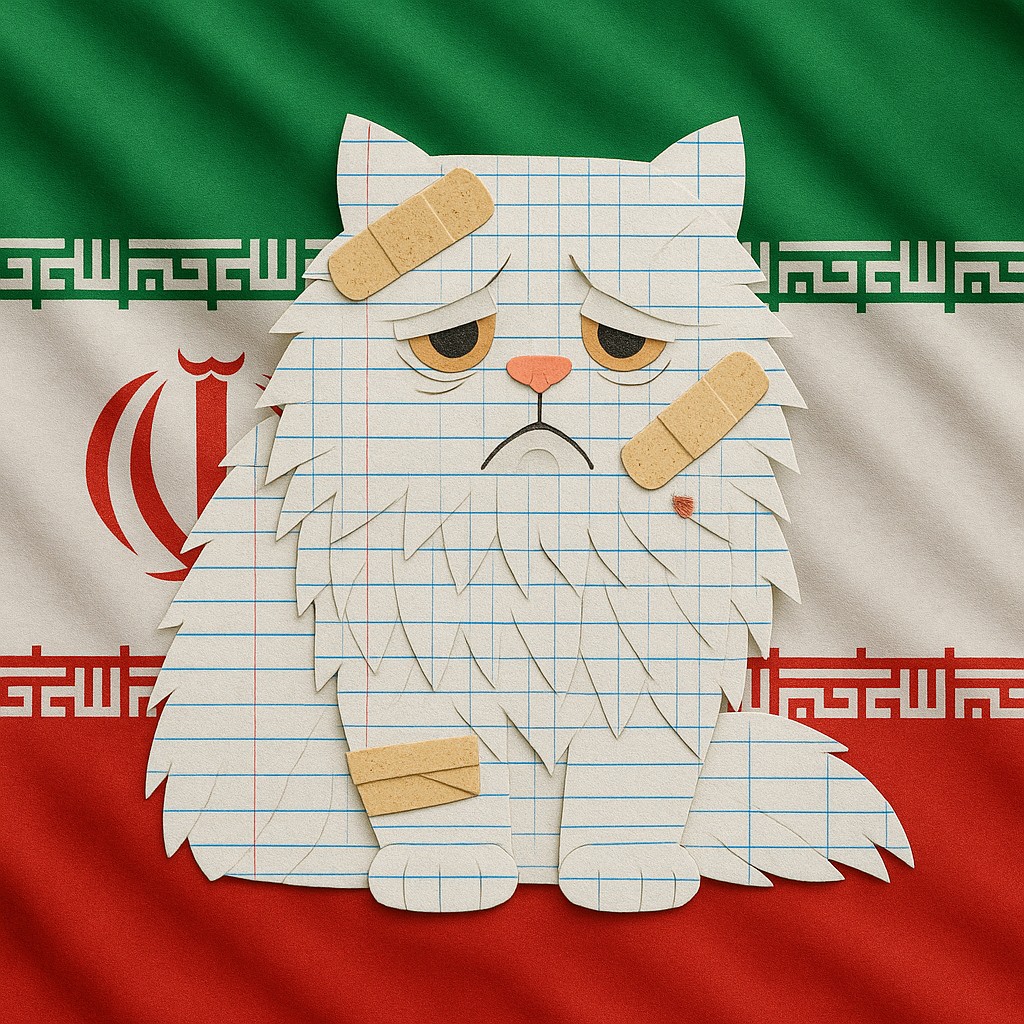
For the Paper Pussycat: Timeline Doesn’t Matter, Humiliation Does
Over the last 21 months, Israel has dismembered the Islamic Republic of Iran’s entire “ring of fire” and crippled its nuclear ambitions. Since Israel’s miraculous military victory over the regime, pundits have debated whether Iran’s nuclear program was set back by months, years, or longer.
That debate misses the point. The most significant consequence of this war isn’t the delay of centrifuges spinning in Iran—it is the everlasting humiliation and exposure of the regime.
On June 4th, just before the war began, Ali Khamenei, Iran’s so-called supreme leader, publicly declared: “They cannot do a damn thing [to us]”. Twenty days later he had lost six top generals, over a dozen senior military and IRGC commanders (including the entire leadership of his air force), eleven of his most senior nuclear scientists, key missile production capabilities, and his air defense system. Even regime institutions such as its TV broadcaster were severely damaged. And yes, he also suffered damage to at least three of his most important nuclear sites.
The regime took hit after hit all while fighting completely alone. Not one of its proxies or allies lifted a finger to help defend it. Not Hamas, Hezbollah, or the Houthis. Not even the Shia militias of Iraq. Not Russia. Not China. No one. The silence must have been deafening for Khamenei as he cowered in his secluded bunker hiding from Israeli jets flying unmolested across all of Iran.
Power, even perceived power, is the primary currency of the Middle East. It is for this reason that 6 months before the “Supreme Leader” title was bestowed in the post-revolution constitution, the Iranian Revolutionary Guard Corps was established, independent of the country’s military. A force that by all accounts quickly became stronger and more powerful than any other institution in the country. It is the IRGC that ushered in the new constitution and the supreme leader.
The IRGC was not only responsible for protecting the revolution and its revolutionaries, but also for exporting its ideology by amassing and dispensing an incredible amount of the country’s’ resources to ideological compatriots. The IRGC was extremely successful in projecting an immutable strength in the region, and around the world, by winning over followers and taking control of failed states like Lebanon, Syia and Yemen. That is, until recently.
This matters because Ali Khamenei rules under the doctrine of Velayat-e Faqih, the belief that his authority is divinely ordained. For 46 years, Iranians have been indoctrinated to believe that God has favorites and reveals His will through worldly outcomes. And yet, Khamenei’s shrinking base just watched their so-called divine leader utterly humiliated by Israel and America, the regime’s two greatest enemies. No amount of propaganda can erase that disgrace. Humiliation wasn’t just a byproduct of Israel’s war plan, it was a strategic objective. And now, amplifying that humiliation in the aftermath of the war is equally vital. It reinforces the message that the world’s leading state sponsor of terrorism has not just lost its defenses, but its swagger.
We Iranians are not sheep. In fact, we are known for the opposite. We are known for being critical, confrontational, and proud. We know how to smell weakness. And today, the stench is coming directly from regime headquarters.
The regime knows the truth too. Should it attempt to rebuild its nuclear weapons infrastructure, it will be destroyed again (this is likely why Iraq and Syria did not rebuild their reactors after Israel destroyed them in 1981 and 2007 respectively). That deterrence is now undeniable.
Before the war, over 80% of Iranians opposed the regime. Since the war, regime propaganda has tried to rewrite that story, but Iranians aren’t fooled. We in the diaspora see it clearly, and those inside Iran feel it daily: rolling blackouts, water shortages, and billions of national wealth squandered. The supposed “axis of resistance” has collapsed, from Gaza to Lebanon, through the Assad regime’s demise, and into a shattered nuclear program that delivered neither dignity nor prosperity. Base Dee’geh (Enough!)
Israel’s greatest victory in this war was psychological: the exposure of the regime not as a paper tiger, but as a paper pussycat—and a badly beaten one at that.
Ray Takeyh ends his brilliant book The Last Shah with this line:
“The only thing that can be said with certainty is that the Iranian masses’ search for freedom continues. Should it one day succeed, it will confound yet another generation of Americans who has assured themselves that, like the Shah, The Islamic Republic would endure.”
InshAllah, the regime’s exposure has lit the fuse. And once again, history will be written in the streets of Tehran, by her people, rising not in protest alone, but in pursuit of freedom, dignity, and a future reclaimed. When that day comes, whenever and however they choose, we in the West, and across the Iranian diaspora, will be ready to stand with them. Not as saviors, but as brothers and sisters, cheering them on, and helping to build the free Iran they so deeply deserve.