
Where history exposes power and moral failure
Foreign Policy as Electoral Performance
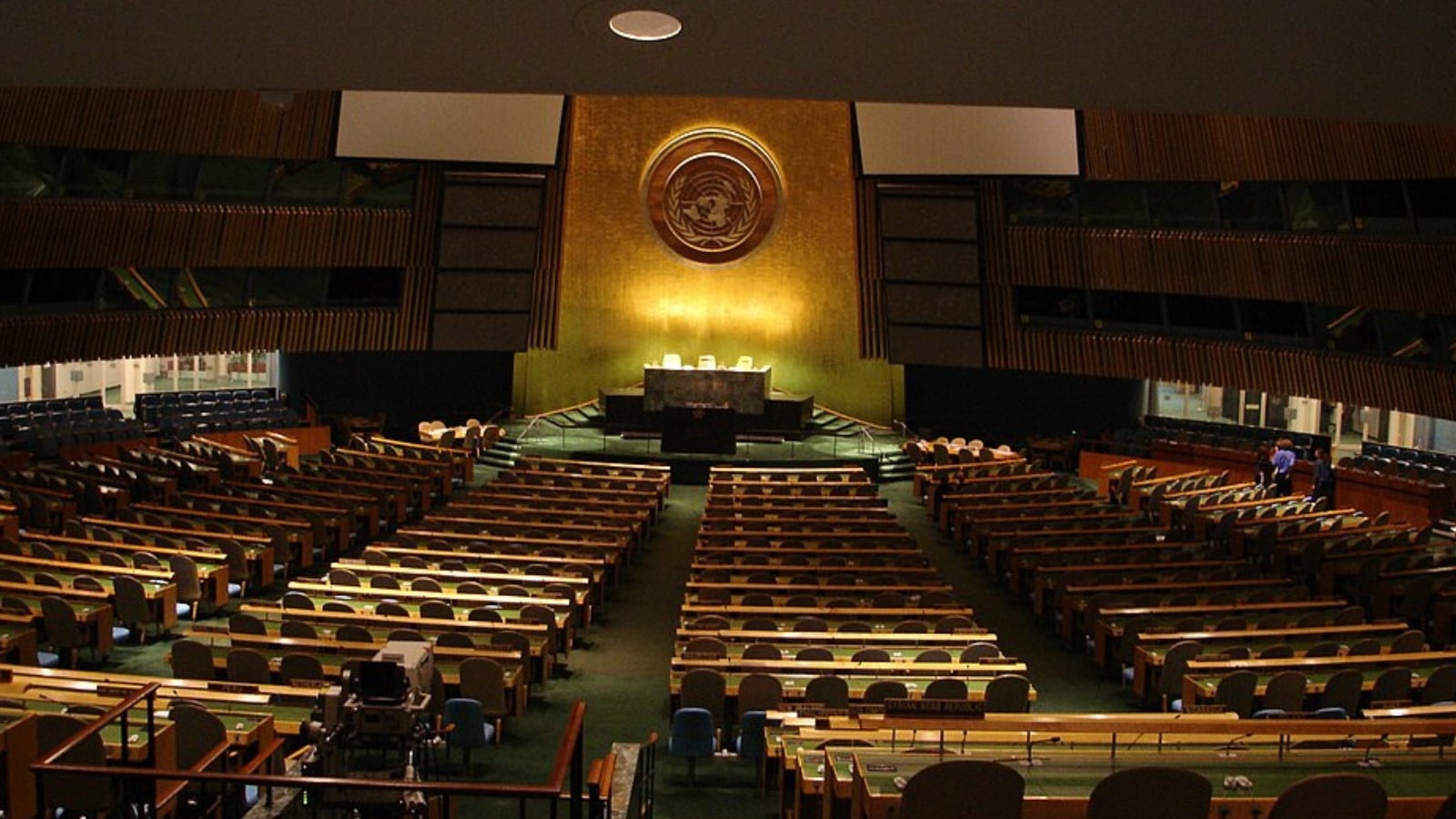
The United Nations General Assembly Hall at United Nations Headquarters in New York. Photo: Wikimedia Commons (CC BY 2.0).
Within several days, four stories moved through Washington, Muscat, New York, and the occupied West Bank. Each arrived under its own headline. Together they described a political order in which domestic performance has begun to consume the work of foreign affairs.
President Donald Trump refused to sign the largest housing bill passed by Congress in decades. The legislation had cleared both chambers by margins large enough to survive a veto and became law without his signature. His objection had little connection to housing. Trump announced that he was withholding his name in protest over the Senate’s failure to pass the SAVE America Act, the voting legislation around which he has built another campaign of grievance and threat. A bill addressing mortgages, construction costs, zoning incentives, and the national shortage of homes became collateral in an unrelated electoral battle.
At nearly the same moment, another ceasefire between the United States and Iran gave way to strikes and retaliation. American aircraft attacked Iranian maritime targets. Iran answered with missiles and drones directed at American positions across several neighboring states. Commercial traffic through the Strait of Hormuz fell sharply. Oman received an Iranian delegation in Muscat. Qatar and Pakistan again attempted to reopen communications. France and Britain reportedly studied an Omani proposal involving navigational fees under the authority of the International Maritime Organization.
The diplomacy continued because it had to. Oil tankers still required a navigable channel. Gulf governments still had cities, ports, and military installations within reach of Iranian weapons. Iran still faced an American president whose account of the negotiations was disputed by Iranian officials within hours. The same governments that had failed to preserve the ceasefire returned to the same tables, carrying new damage and fewer assurances.
New York entered the picture through a reported attempt by the Mayor’s Office for International Affairs to meet Iran’s representative to the United Nations. The State Department intervened, and the meeting was canceled. The episode was small beside missile exchanges in the Gulf, though it exposed the same confusion of jurisdiction. A municipal office created to manage the diplomatic presence of foreign governments in New York appeared to be approaching a live dispute between Washington and Tehran while City Hall, according to the reporting, had not been fully informed.
Then Representative Ro Khanna described being detained in the occupied West Bank by armed Israeli settlers. Khanna said that Israeli soldiers arrived and continued the detention rather than ending it. He returned to the United States speaking about settlers carrying American-made rifles and young soldiers laughing as they held an American congressional delegation on a blocked road. The encounter entered the domestic American argument almost immediately, bringing settlement policy, military aid, race, congressional oversight, and the authority of the Israeli state into the same political frame.
Foreign affairs once demanded at least the appearance of distance from campaign logic. Treaties outlived election cycles. Territorial disputes resisted slogans. Shipping lanes, troop deployments, sanctions, and military alliances imposed consequences long after the speechwriters had moved on. The events of July 2026 show that distance collapsing. Washington’s electoral obsessions travel outward into the Gulf and the West Bank. Events in the Gulf and the West Bank return to Washington as proof of weakness, strength, betrayal, loyalty, or ideological contamination. Diplomacy is still being conducted, though increasingly before an audience that treats concession as confession.
The historical record offers few examples of peace achieved while every participant preserved every claim that had sustained the conflict.
The Egyptian-Israeli negotiations of 1978 nearly failed at Camp David. Jimmy Carter spent thirteen days carrying proposals between Menachem Begin and Anwar Sadat, often meeting them separately because direct exchanges had become too brittle. Egypt demanded the return of the Sinai Peninsula, occupied by Israel since 1967. Begin faced ministers and settlers who regarded withdrawal as a strategic danger and a surrender of land won in war. Sadat had already crossed a political boundary by traveling to Jerusalem and addressing the Knesset.
The agreement required action on the ground. Israeli settlements in Sinai were dismantled. Israeli forces withdrew in stages. Egypt recognized Israel and departed from a regional consensus that had treated recognition as capitulation. Sadat’s decision isolated Egypt in much of the Arab world and helped create the political climate in which he was assassinated in 1981. Begin returned territory that Israeli soldiers had died to capture and that Israeli civilians had been encouraged to settle. The treaty survived because both governments accepted losses with names, maps, buildings, graves, and domestic constituencies attached to them.
Northern Ireland reached its settlement through an accumulation of exhausted institutions and bodies. By 1998, the conflict had produced decades of bombings, shootings, imprisonment, military patrols, funerals, and retaliatory logic. The Good Friday Agreement left the constitutional future of Northern Ireland dependent upon consent. Irish nationalists accepted that British sovereignty would continue unless a majority voted to change it. Unionists entered institutions that recognized Irish national identity and gave nationalist parties an enduring place in government.
The agreement altered policing, released prisoners, created cross-border institutions, and placed former enemies within the same political machinery. Those decisions enraged families who had buried victims and constituencies that had been taught to regard compromise as surrender. The settlement worked imperfectly and periodically broke down. It nevertheless replaced a political order organized around armed coercion with one in which adversaries had to share offices, budgets, procedures, and responsibility for decisions that none of them could control alone.
France delayed the equivalent recognition in Algeria until the war had damaged the French state itself. French governments had insisted that Algeria formed part of metropolitan France, even while millions of Muslim Algerians lived under a political and legal order that denied them equality with European settlers. The war produced torture, bombings, mass displacement, military revolt, and the collapse of the Fourth Republic. Charles de Gaulle returned to power with support from many who expected him to preserve French Algeria.
He eventually accepted Algerian self-determination. The Évian Accords ended French sovereignty and opened the way to independence. Nearly one million European settlers left Algeria, many convinced that France had abandoned them. Algerians carried the wounds of colonial rule and war into a new state already marked by internal violence. De Gaulle survived assassination attempts organized by French extremists who regarded withdrawal as treason.
None of these settlements produced innocence. Camp David left the Palestinian question unresolved. The Good Friday Agreement did not reconcile every memory of the Troubles. Évian ended French rule without repairing the injuries of conquest, segregation, torture, and displacement. Their endurance came from decisions that moved land, altered law, dismantled settlements, released prisoners, and deprived powerful constituencies of outcomes they had been promised.
The present leadership of the United States and Israel has shown far greater comfort with the spectacle of negotiation than with its cost.
Trump’s refusal to sign the housing bill offered a compressed display of the governing instinct. Congress had produced a rare bipartisan achievement on an issue affecting rent, home ownership, construction, and the cost of living. Trump allowed the bill to become law while denying it the ceremony of his signature because the Senate had not given him a separate electoral weapon. The practical result survived. The presidential act became theater.
The same instinct shadows the administration’s conduct toward Iran. Ceasefires are announced, disputed, violated, and replaced by threats. American strikes generate Iranian retaliation. Regional governments then perform the labor of preventing the escalation from consuming their ports and airspace. Oman negotiates over the Strait of Hormuz because shipping companies cannot operate on presidential improvisation. Qatar approaches Tehran while hosting American forces that Iran may target. Pakistan offers mediation while every public statement from Washington or Tehran risks narrowing what their diplomats can accept.
Likud-led governments in Israel have spent years making territorial concession progressively more dangerous within Israeli domestic politics. Settlement expansion has created communities, roads, security arrangements, and political organizations whose continued existence depends upon resisting Palestinian sovereignty. Armed settlers operating in the West Bank do not represent an abstraction. They occupy land, block roads, intimidate Palestinian residents, and increasingly confront foreign observers with the practical authority they believe they possess. Khanna’s account is so significant because an American congressman encountered that authority directly and alleged that Israeli soldiers enforced it with American weapons.
The Israeli government can condemn particular acts of settler violence while maintaining the territorial and military structure that permits settlers to operate with extraordinary protection. The Trump administration can announce negotiations while rewarding displays of force and punishing any appearance of concession. Both governments speak about peace under political conditions in which the surrender of land, coercive authority, or coalition support is treated as a greater danger than the continuation of conflict.
Iranian leaders preserve their own repertoire of strategic possession. Control over passage through Hormuz provides leverage against states with stronger conventional militaries. Missile attacks sustain a language of resistance while placing neighboring populations at risk. Tehran returns to mediation after each escalation without surrendering the tools that make the next escalation likely.
Camp David, Belfast, and Évian reached the page only after leaders accepted that peace would damage them politically. Begin dismantled Israeli settlements. Sadat recognized Israel and lost allies before losing his life. British and Irish leaders rewrote constitutional arrangements while former prisoners entered government. De Gaulle surrendered Algeria and survived French gunmen who called him a traitor.
Diplomacy often appears useless because governments arrive at the table still guarding the territory, weapons, domestic alliances, inherited grievances, and symbols of prestige that keep the conflict alive. It begins to function when a leader accepts that peace will take something away. July 2026 has produced an abundance of envoys, emergency meetings, ceasefire language, and public threats.
It has produced little evidence that the men directing the conflict are prepared to relinquish what peace would require.
Select Sources
Al Jazeera. “The Zero-Sum Logic: Why the US-Iran Framework Constantly Unravels.” Al Jazeera English, July 10, 2026.
Bardan, Fadi. “Muscat’s Tightrope: How Oman, Qatar, and Pakistan Broker Fragile Gulf Ceasefires.” Al Jazeera English, July 8, 2026.
Bew, John. The Architecture of Compromise: The British-Irish Intergovernmental Machinery. Oxford: Oxford University Press, 2021.
Carter, Jimmy. Keeping Faith: Memoirs of a President. Fayetteville: University of Arkansas Press, 1995.
Connelly, Matthew. Electoral Imperatives vs. Colonial Realities: The Collapse of the Fourth Republic. Paris: Éditions de la Sorbonne, 2020.
Democracy Docket. “The Legislative Battleground: The SAVE Act Suite and Electoral Politics.” Democracy Docket, June 14, 2026.
Evans, Martin. De Gaulle and the Reckoning of Évian: The Domestic Cost of Algerian Independence. London: Sciences Po Historical Series, 2022.
Goldstein, Amir. “From Sinai to Area C: The Political Cost of Territorial Concessions in Israeli Politics.” Israel Studies Journal 29, no. 2 (2024): 45–68.
Harel, Amos. “The Price of Land: Domestic Electoral Incentives and Settlement Expansion.” Haaretz, June 22, 2026.
Horowitz, Michael C. “The Inversion of Foreign Policy: Domestic Audiences and Strategic Restraint.” International Security 49, no. 1 (2024): 9–42.
Karni, Annie. “Rep. Ro Khanna Detained by Armed Settlers During Fact-Finding Tour of Occupied West Bank.” The New York Times, July 9, 2026.
Lazaroff, Tovah. “The Transatlantic Echo: How West Bank Realities Shape Congressional Debate.” The Jerusalem Post, July 9, 2026.
McBride, Sam. “The Dynamics of Power-Sharing: Managing Grievance and Identity Post-1998.” The Irish Times, April 11, 2025.
O’Malley, Padraig. The Belfast Agreement: Relinquishing Sovereignty for Peace. Dublin: Trinity College Dublin Press, 2019.
Pinfold, Rob Geist. “The Northern Ireland Model: Lessons on Relinquishment for Modern Intractable Conflicts.” Irish Studies in International Affairs 34, no. 1 (2023): 112–135.
Smith, Connor. “Bipartisan Housing Reform Enacted Automatically Without Presidential Signature Following SAVE Act Dispute.” TIME, July 11, 2026.
Stansfield, Gareth. “Chokepoint Diplomacy: Maritime Security and Regional Escalation in the Persian Gulf.” Royal United Services Institute (RUSI) Journal 169, no. 3 (2025): 34–51.
Stojanovic, Daria. “The Cost of Closing the Strait of Hormuz: Energy Bottlenecks and Global Supply Chains.” London: Chatham House Briefings, May 2026.
Todd, Shepard. “The Trauma of Relinquishment: The Évian Accords and Post-Colonial French Identity.” French Historical Studies 47, no. 4 (2024): 581–609.
Vance, Michael. “State Department Intervenes to Cancel Planned Meeting Between Mamdani Administration and Iranian Envoy.” City Journal, July 9, 2026.
Related Topics