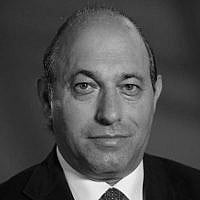
Forever the firebrand
On October 6, an awful terror attack took place in Be’er Sheva. An Israeli citizen of Bedouin descent from Hura fired a pistol at the Central Bus Station, killing one female border cop and injuring others. I cannot imagine the pain and suffering her family is experiencing. While I felt terrible about the loss for her family and hope for a speedy recovery for all those who were injured, the country’s government could offer some solace and support to the nation. Then, Itamar Ben Gvir arrived at the scene. Perhaps, he would offer some much needed support. Alas, Itamar will remain Itamar.
Itamar Ben Gvir’s actions have brought him renown. Fiery characters are always interesting to many, they manage to captivate audiences with their harsh rhetoric, lofty promises, and simple solutions. That Sunday, Itamar delivered once again. Instead of offering condolences to the family of the woman slain, thanking the present security forces who quickly eliminated the terrorist or announcing that he would do everything in his power to find out if someone was connected to this attack, he did the opposite. He stood there shouting, as he usually does, reminding people that a law needed to be passed, making it possible to deport the families of terrorists, in this case a Bedouin Israeli. If Ben Gvir would have his way, the Israeli family of an Israeli terrorist could be deported to the West Bank or Gaza. He then continued that people needed to wake up and realize that Israel was at war. Those who did not understand this, obviously did not understand much.
I was watching Channel 12 and they cut his shouting to continue a panel discussion about the terror attack. Maybe, just maybe, Ben Gvir offered his condolences to the woman’s family. I doubt it. I was not watching a minister, capable of calming people, offering support, and promising justice. No, I was watching a firebrand politician, shouting once more and lashing out at who knows. I saw someone fanning the flames, not trying to calm the situation. Someone who continuously acts like an opposition politician, even when he is a member of the governing coalition. Ben Gvir the minister acts in the exact same way as Ben Gvir, the member of the opposition. During the short tenure of the change government, there were terror attacks, unfortunately. Each time, the minister of public security, Omer Bar Lev, would appear. And Ben Gvir would show up, too. Each time, Ben Gvir would curse him, verbally attack him, scream at him and blame the attacks on Bar Lev. Now, Ben Gvir does the same thing, only he cannot blame himself. So, he shouts as always, apparently picking a fight with everyone for failing to listen to him.
To make matters worse, Ben Gvir once again proposed his solution to prevent terror attacks by Israelis: punish their families and deport them. Is this how democratic Israel is supposed to operate? No. You need to investigate if the terrorist received support and if Israelis helped him, whether family or friends, and, if so, they need to be brought to justice. That is how it works. But Ben Gvir simply wants to punish the families of the terrorist, regardless of what they did or did not do. Does this mean that his law would apply to every Israeli terrorist? Does it mean that a Jewish terrorist who firebombs a Palestinian home and kills and injures its inhabitants will be deported to Gaza, including his family? Probably not. No, this law would serve one purpose and one purpose only: reducing the number of Arab Israelis within the country’s borders.
Does Ben Gvir consider all Arab Israelis potential terrorists? Perhaps not, but past statements seem to indicate that he does not trust roughly a quarter of Israel’s population. For instance, on October 10, 2023 he already warned that he was preparing for Guardian of the Walls 2.0. It did not happen, but already then, Ben Gvir was expecting unrest within Israel’s borders. His party is based on Kahanist views. And, he has not reprimanded his party members Amihai Eliyahu or Limor Son Har Melech for the various horrible statements they have made. Therefore, I would like to remind the honorable minister of the contribution made by Arab Israelis to the state. Arab Israelis can be found on the football pitches of Israel every week, playing for the biggest clubs. Arab Israeli athletes don their uniforms and jerseys and represent the country in various sporting events. Arab Israelis comprise a major part of the country’s health care system, working as doctors, nurses, and pharmacists and serving the entire Israeli public.
Israel’s Druze are conscripted into the army and have been since the country’s early years. They serve with distinction, such as the late Salman Habaka, the hero of Be’eri who would later fall in Gaza. And what about the heroes of the Bedouin Reconnaissance Battalion who rushed to the Gaza border region on October 7? I see a man like Yoseph Haddad, a Christian Arab Israeli who served in the Golani and was injured in the Second Lebanon War work tirelessly to defend Israel abroad during this war and run his own organization to stimulate the integration of Arab Israelis in society. I listen to Arab Israelis who enrich the country’s cultural scene, like singers Valerie Hamaty and Nasrin Kadri, who even converted to Judaism. I watch Lucy Aharish on Channel 13, a Muslim Arab Israeli woman, who was Israel’s first female Muslim TV anchor. On her show, she continuously offers a platform to the families of the hostages, to make sure that their stories will be heard.
I like to listen to the critical analyses of a journalist like Mohammad Magadli, a Muslim Israeli from the north, whose family is now caught up in the war with Hezbollah. I think of Israel’s small yet strong Lebanese community, Christian Arabs, several of whom have taken to devote themselves to Israeli advocacy, like Jonathan Elkhoury. I remember the joy I felt, when I watched Farhan al-Qadi get out of the helicopter at Soroka, rescued by the IDF from Gaza after he languished for months in a tunnel. He was taken to Gaza by Hamas terrorists because he refused to show them the locations of Jews. A Bedouin, Muslim Israeli refused to show them the locations of Jews. They punished him by shooting him in the leg, taking him to Gaza, humiliating him by making him crawl up the stairs of a Gazan hospital on his hands and knees while they ridiculed him and, finally, put him in a tunnel. I think of the Arabs who died on October 7, whether in the communities near the Gaza border or as a consequence of rocket attacks on the south. Finally, I think of our hostages, which includes a number of Arab Israelis, who have not come home yet.
These are just examples, as there are many more that I have not mentioned. On October 7 Israel experienced a massive trauma. And, though there are differences, tensions, and problems, Israelis came together, helping each other, supporting each other. A show of strength, an example of unity. I have not forgotten this, which is why I would like to ask the honorable minister Itamar Ben Gvir to act like a leader, to be responsible. A minister who is responsible for public security needs to combat terror and crime within Israel’s borders, he needs to keep all Israelis safe, not scan TikTok and order the arrest of an Muslim Israeli woman for posting a dance video – the way she was treated by the police makes this horrible arrest even worse. In fact, after listing just a few examples of the contributions Arab Israelis make to society, I am struggling to identify any positive contribution Ben Gvir has made.
A minister should be a force that cherishes the bond between Jewish and Arab Israelis, strengthens it. He or she should not use those powers to divide Israelis, it is the last thing the country needs.