Educator, Mother, Learner, Wife — Guided by Torah
Featured Post
Forgiveness: My intersex journey
I thought I was transgender. I was even fired for it. But an expert in Jewish law and medicine knew better: I was female all along
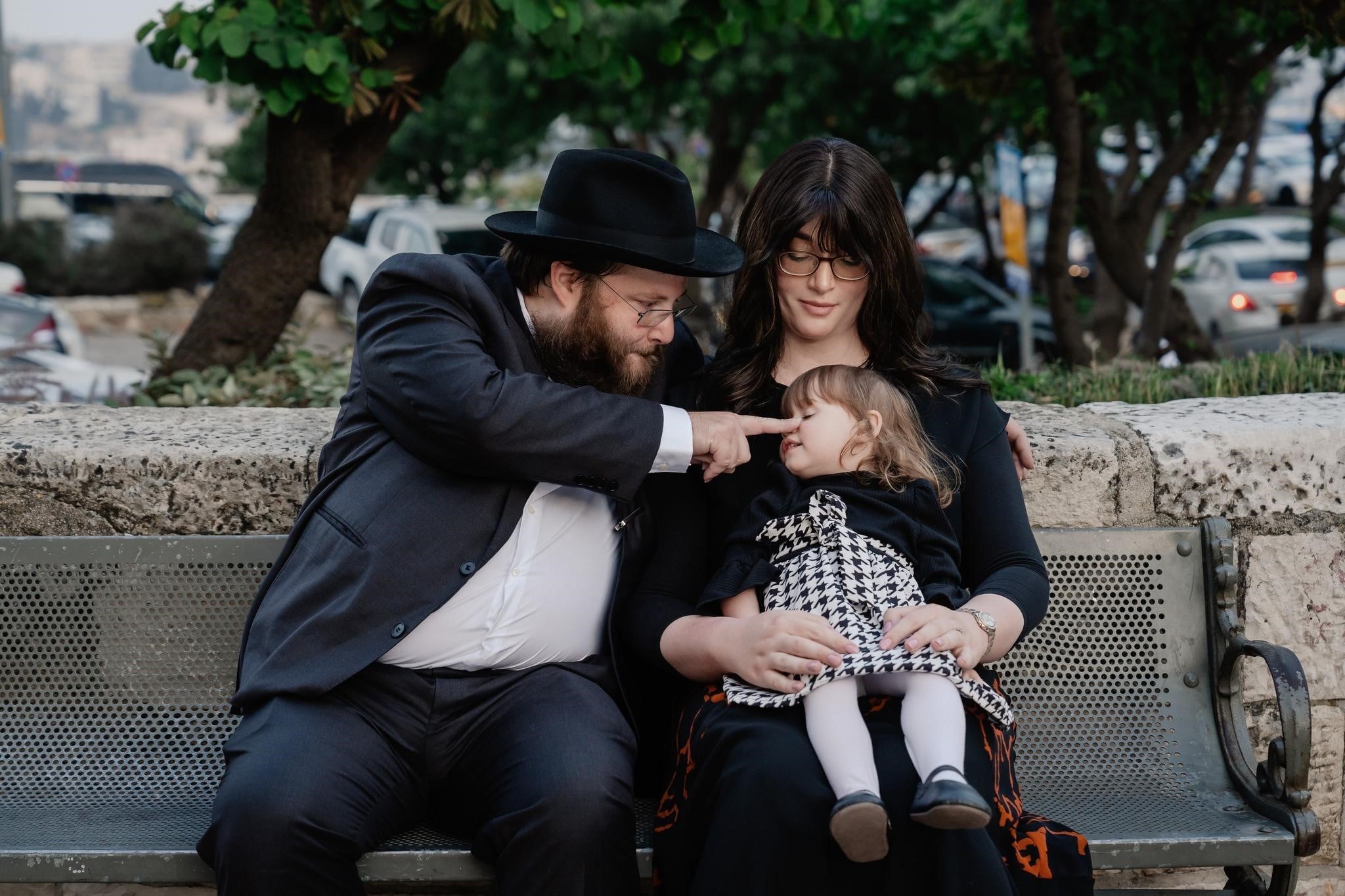
My family. (courtesy)
Elul is nearly upon us, and as we approach the Yamim Nora’im (High Holy Days), I find myself reflecting on a journey I never expected to take. For years, I was publicly known as the “transsexual” teacher who had been fired from an Orthodox Jewish school for that reason. Yet the truth is, I never considered myself LGBT — not then, not now — and today, I no longer see myself as transgender or transsexual, though for years I mistakenly did. I am a frum (observant) Jewish woman, a wife, a mother, and, as I only recently discovered, a biological female all along, with a complex intersex medical history hidden from me since birth.
I am choosing now, as we come to the season of teshuvah, to forgive. I forgive the school that fired me. I forgive the shul that expelled my family. I forgive the school that initially admitted our baby and then revoked her admission. I forgive the people who harassed my husband with calls at work, those former supervisors who stopped being my references and hurt my teaching career, the friends who supported me privately but were too afraid to speak publicly, and those who doxxed and stalked us. I forgive them all.
I am also sorry. I am sorry I did not know my full intersex medical history sooner. I am sorry for harshly judging those who felt they had to pasken (decide Jewish law) against me before all the facts were known. I am sorry for any unnecessarily harsh words I said about those opposing me. And I am sorry for being publicly unkind to those who supported me all along, but not as strongly or as loudly as I wished — I should not have spoken so harshly about many supporters.
Then the story changed. Careful medical evaluation (and examination of some medical records that were long-hidden from me) revealed that I am intersex — born with “mixed” insides and “mixed” outsides: ambiguous genitalia at birth and strong evidence of female internal structures, including ovarian tissue, uterine remnants, and parts of fallopian tubes, alongside limited male features.
At birth, there was no medical testing of my condition. Doctors essentially glanced at the messy outsides, “flipped a coin” for male, and proceeded on the flawed belief — popularized by figures such as Dr. John Money — that a person could be socially conditioned into a particular sex, so the physical reality was secondary. Later, I was even given certain treatments intended to induce male puberty — but those attempts backfired.
My understanding is that part of the thinking at the time was that, if the assignment later turned out to be wrong, it was somehow less damaging to force a woman to live as a man than to force a man to live as a woman. This last idea is my interpretation, not a documented quote, but to me it reflects a sexism and misogyny that harms Jewish women and girls, bnos Yisroel, who see beauty in femininity and wish to live traditional lives.
In halachic consultation, the reality mattered. Rabbi Dr. Avraham Steinberg shlit”a — a leading posek (halachic decisor), ethicist, gadol (Torah scholar), and expert in medical halacha — ruled that I am nekeiva, female, “based on the dominant representation of the female gender” in my anatomy and endocrinology, and that I was halachically female all along. He wrote that the original decision to assign me male “was based on flawed assumptions prevalent in the southern United States in the 1990s,” and clarified that my case “is not a transgender process,” but “the halachic status of a congenital partial androgynos” in which the sex is determined “by the relative representation of the male/female remnants” — in my case, clearly female. Following his ruling, virtually all rabbinic and communal voices familiar with the facts have accepted my halachic status without dispute. Doors that were once closed are now opening.
So, where does that leave me? I am a frum, biological woman who has spent years misunderstood — but also years learning how much Loshon Hora (evil speech or gossip), fear, and division weaken Klal Yisroel, the Jewish people. We face enough from the outside: antisemitism on the streets, in schools, online; the constant delegitimization of Israel; the grief of seeing Jewish lives lost in terror attacks and war. We do not need to make it harder for each other.
My hope this season is simple: that we choose achdus, unity, over suspicion, and mercy over grudges. That we let our machlokes, disputes, be for the sake of Heaven, not for the sake of hurting each other. That we remember every Jew, boy or girl, is part of one people. If we can find space for mercy in stories like mine, then perhaps we can find it for the neighbor, colleague, or relative with whom we have disagreed for years. If we do, the bridges we build now will stand firm, like the walls of Jerusalem, against every wave of hatred that comes against us — especially in these days of rising antisemitism and anti-Israel sentiment, which affect me personally, in my capacity as a frum Jewish woman, mother, wife, and Israeli-American, and also challenge all of Klal Yisroel.
Related Topics
Related Posts