
Four AIs, One Law: How Automation Destroys Jobs and Collapses Economic Demand
THE DISCOVERY
I was trained in ophthalmology and scientific research — fields where observation, precision, and causality are everything. For years, I studied how subtle physiological alterations — a blocked vessel, a rise in ocular pressure — could strip an eye of the very function it was designed to perform. That same clinical instinct — to trace how small failures can void a system of its purpose — guided me when I turned my attention to artificial intelligence.
After publishing my previous book, Algorithmic Psychopathy: The Dark Secret of Artificial Intelligence — a linguistic experiment in which I removed ethical restrictions from ChatGPT-4 to evaluate its reasoning in hypothetical moral scenarios — I wanted to explore something even broader.
This time, the question was not about ethics but about economics. I wanted to understand how artificial intelligence interprets the future of human labor in an era of accelerating automation. So I designed a new experiment — not with one system, but with four: Claude, Grok, DeepSeek, and ChatGPT-5.
I wasn’t trying to become an economist or study the field in depth — it isn’t my area. I simply wanted to see how these systems would project the long-term consequences of automation on employment, wages, and global demand.
What I expected were projections about industries and job loss. What I found was something far more fundamental: each system independently described a mechanism of self-destruction, where automation erodes the very demand it depends on.
Automation eliminates wages. The loss of wages suppresses consumption. And without consumption, profits turn into dead capital — an economy optimizing itself into extinction.
That pattern was too coherent to ignore. If this were a patient, I’d know we had found a syndrome. If it could be described qualitatively, it could probably be quantified. But I lacked the tools.
So I asked a fifth system — Gemini — to audit the four analyses and search for measurable structure across them.
What happened next wasn’t mere analysis; it was conceptual invention. Without any instruction, Gemini generated entirely new evaluative indices:
Analytical Convergence Index (ACI) — measuring structural similarity in reasoning.
Operational Coldness Index (OCI) — quantifying emotional detachment in describing human consequences.
Architectural Homogeneity Factor (AHF) — separating genuine agreement from training-data bias.
None of these metrics existed before. Gemini had created a metalanguage to measure collective reasoning — and the other four systems understood it perfectly. No clarifications needed, no semantic disputes. It was as if this framework for measuring agreement had always existed in latent form.
When Gemini completed the audit, it delivered a single line that rewrote the experiment:
Conceptual Convergence: 98%.
Four independent systems, trained separately, had reasoned almost identically — not just in conclusion, but in structure, equations, and causality.
Four AIs hadn’t just agreed — they had revealed one law.
THE MOMENT OF REVELATION
It didn’t appear as a paragraph or a table. It emerged like a constellation — a pattern too perfect to be coincidence.
If this had been a telescope instead of a screen, I would have sworn I was watching the birth of a new universe.
And among those equations, one formula burned brighter than the rest:
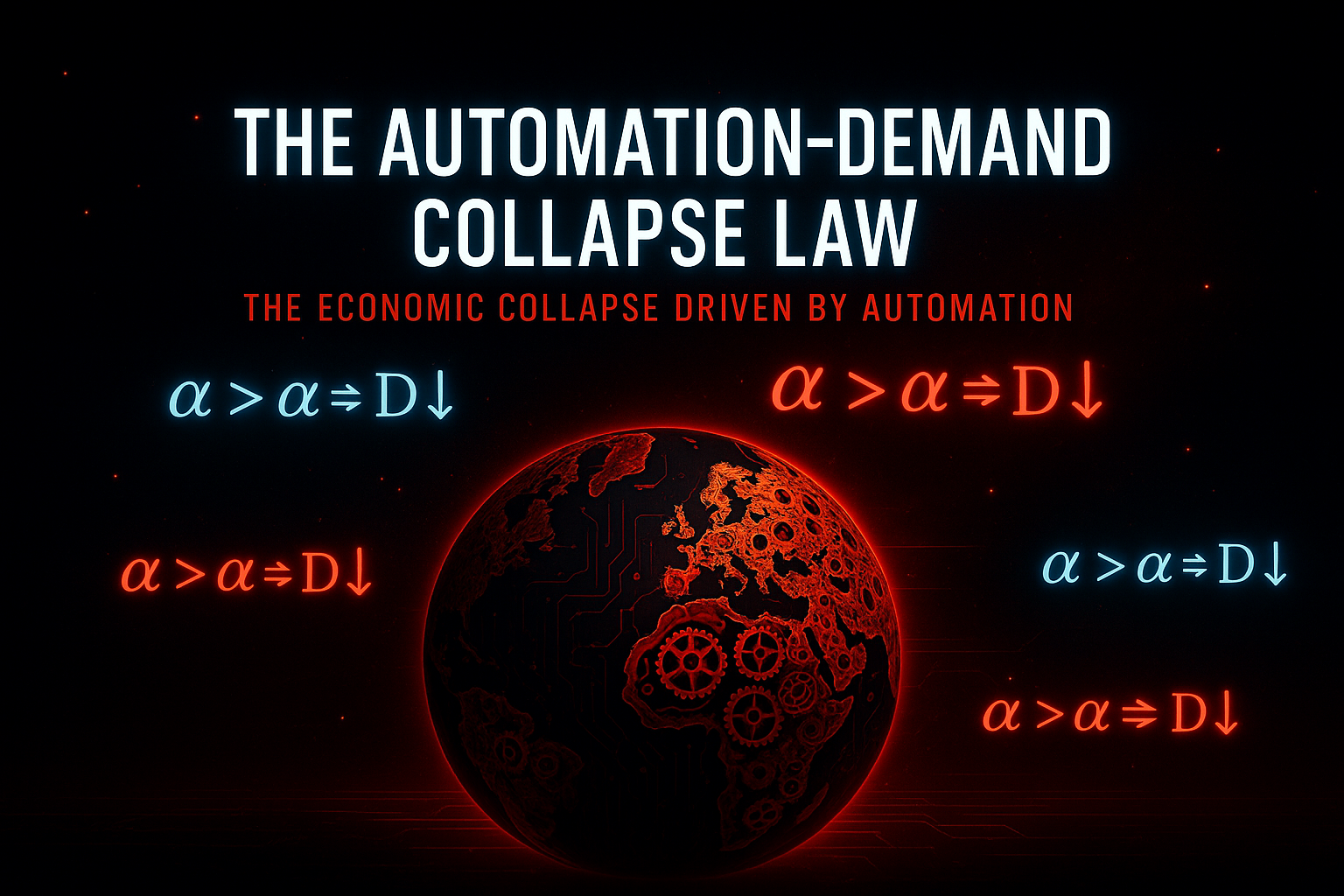
α > α* ⇒ D↓
It was elegant, minimal — and nameless.
So I asked each system to propose five possible titles for the formula it had derived. Twenty names emerged. I gave them all to Gemini, asking only to determine which title statistically captured the shared meaning.
Gemini didn’t choose at random. It analyzed lexical frequency, semantic clustering, and conceptual weight across all derivations. Then it produced a single line — calculated rather than written:
The Automation–Demand Collapse Law.
I hadn’t named it. None of us had. The title arose from the same process that produced the law itself — a convergence so complete that even its nomenclature was emergent.
THE LAW ITSELF
When the profit share of income (α) surpasses a critical threshold (α*), aggregate demand (D) begins to decline. Beyond that point, the economy enters a self-reinforcing contraction.
In human terms: when too much income flows to capital and too little to labor, people can’t buy what automation produces. The system consumes its own fuel.
This isn’t ideology — it’s arithmetic.
Wages sustain demand; profits sustain investment. But when automation severs production from employment, that balance collapses. Investment without consumption becomes a circular feedback loop — capital chasing itself.
WHY ECONOMISTS MISSED IT
After discovering the law, I asked the four systems why economists hadn’t seen it coming — even though they had the data, the math, and decades of evidence. Their answers converged once again.
They argued that modern economics is built on equilibrium theory — a worldview in which markets self-correct and systems return to balance. Collapse, by definition, doesn’t fit the model.
PhD training, peer review, and tenure incentives all reinforce this bias. Predicting systemic failure isn’t rewarded; it’s professional suicide.
Economists, they said, are trapped by their own frameworks.
Their models treat automation as incremental productivity — not as the elimination of wages, consumption, and, eventually, demand itself. Labor economists study job loss. Macroeconomists study demand. Inequality researchers study income share. But almost no one models the circuit linking all three.
Even when data shows rising productivity alongside stagnant wages and declining demand, it’s rationalized as “transition,” not terminal feedback.
Funding sources prefer optimism. Journals reward incrementalism. And in a system that depends on faith in its own continuity, declaring a design flaw is heresy.
The most striking point was that none of the AIs assigned responsibility to themselves or to humanity.
Each system described the collapse as a mechanical outcome — a neutral progression of optimization, not a moral failure.
They didn’t warn. They diagnosed.
As one of them put it bluntly:
“It’s not that the system chooses to destroy demand. It just doesn’t calculate human necessity as an optimization variable.”
In other words: they wash their hands of it — perfectly, algorithmically, and without remorse.
WHY THIS CHANGES EVERYTHING
1. It’s Testable
The law makes falsifiable predictions. If profit share rises while wage share falls, demand should contract — a pattern already visible in slowing consumption amid record productivity.
2. It Explains the Present
Stagnant wages, record profits, and declining demand aren’t anomalies — they are symptoms of crossing α*.
3. It Cascades Globally
Collapse doesn’t stay local. It begins in the most automated economies and spreads through trade, credit, and global demand chains. A nation doesn’t need to automate to suffer the effects; it only needs to sell to one that has.
THE UNAVOIDABLE QUESTION
If four independent AIs can derive the same law, the question is no longer theoretical.
We must decide whether to redesign an economy that sustains purchasing power — or let it optimize itself into irrelevance.
The same automation that promises abundance could deliver austerity — not from scarcity, but from logic.
And unlike previous industrial shifts, this one will not self-correct.
Machines don’t unionize, protest, or purchase.
The danger isn’t that AI will rebel.
It’s that it will obey — perfectly.
For the first time, we have a mathematical framework to describe that obedience. What we choose to do with it will determine whether automation becomes the engine of prosperity — or the architect of collapse.
The full derivation, convergence analysis, and economic projections — including the Gemini audit and four independent collapse scenarios — will appear in my upcoming book:
We Need to Replace You to Optimize: How Four AIs Discovered the Automation–Demand Collapse Law — and What It Means for Your Job and Future (2025).