
Four Tests for Leadership and How Israel Measures Up
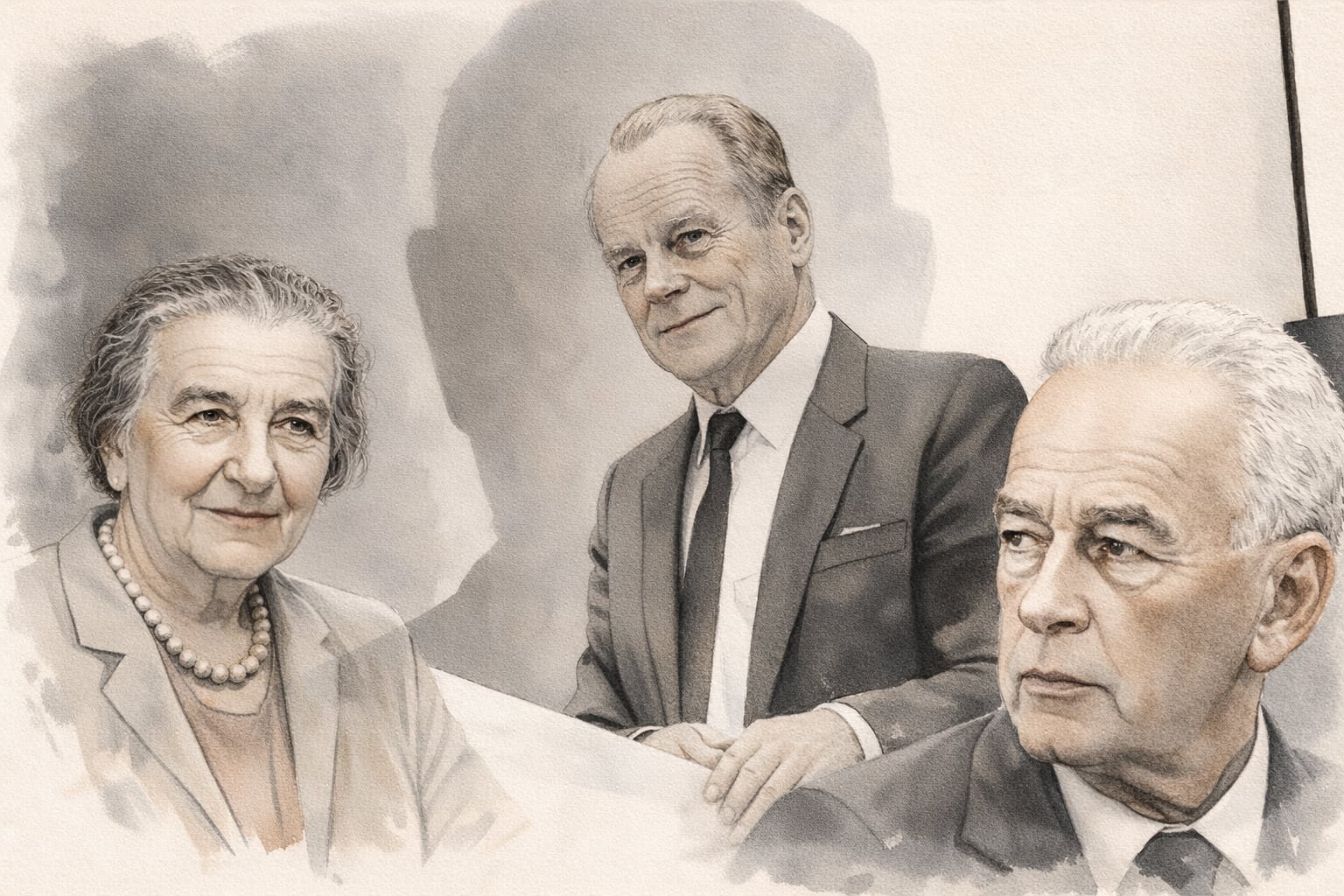
Leadership is not a title. It is a contract. Does the leader protect us? Whose interests does she serve? Does she take responsibility? And can she be removed? National crises have a way of stripping the rhetoric from leadership and exposing what lies beneath. At moments like these, abstract questions about governance become concrete–they point directly at whoever is in charge, right here, right now. What can we learn from thinkers who wrestled with these questions before us?
Thomas Hobbes wrote Leviathan during the English Civil War, when political order had collapsed and violence ruled. Out of that chaos, he arrived at a simple thesis: people give up some of their freedom to a sovereign, and in return, he gives them one thing—security. This is the most fundamental contract between ruler and ruled. Not prosperity, not social justice, not national glory. Security comes first. The ability to sleep at night. The ability to send your children to school. The knowledge that the state has your back.
What happens when the sovereign fails at the one task that justifies his existence? Hobbes was unequivocal: once security breaks down, the contract unravels. This isn’t about political opinion—it’s the system’s own internal logic. When citizens are slaughtered in their homes, when communities are overrun for hours, when the entire defense apparatus collapses in a single morning—the Hobbesian question demands an answer: is there any justification left for this contract? October 7, 2023 was such a morning.
Golda Meir understood this. She resigned in April 1974, just months after the Yom Kippur War. The Agranat Commission didn’t blame her directly. In fact, it praised her decisions on the morning the war broke out. But Golda understood that wasn’t the point. She was prime minister when security failed. “The will of the people,” she said, and stepped down.
Jean-Jacques Rousseau pushed the question further. Protecting citizens isn’t enough–a leader must embody what Rousseau called “the general will.” The leader doesn’t own power; he holds it in trust for the public good. Rousseau drew a sharp line between the general will and a leader’s private interests. The moment personal concerns–legal troubles, political survival, chasing a pardon–start driving decisions, the leader stops representing the public. He becomes his own client.
Yitzhak Rabin understood this. In April 1977, he resigned after it emerged that his wife Leah held a dollar account in the United States–a violation of currency regulations at the time. He hadn’t broken the law; she had. The sum was trivial. Still, Rabin declared: “I refuse to accept that her legal standing should differ from mine.” Attorney General Aharon Barak gave him a stark choice: resign or face charges. Rabin resigned. He understood that a leader cannot place himself above the law, nor look for loopholes to escape it.
Max Weber, the German sociologist and philosopher, tackled a different question: what do we demand of a leader after failure? Weber identified two kinds of ethics. The “ethics of conviction”–where you judge yourself by your intentions and principles. And the “ethics of responsibility”–where you judge yourself by outcomes. Someone guided by conviction says: I did what I thought was right; if things went badly, that’s not on me. Blame the world, blame circumstances, blame everyone else. Someone guided by responsibility says: The outcomes are mine. It doesn’t matter what I meant to do, what I knew, or who else shares the blame. What happened on my watch is my responsibility.
Willy Brandt, West German Chancellor and Nobel Peace Prize laureate, understood this. In May 1974, he resigned after discovering that one of his closest aides had been an East German spy. Brandt had no knowledge of the espionage. He played no part in it. Yet he declared: “I accept political responsibility for the negligence.” Anyone incapable of shouldering that burden, anyone who points fingers in every direction, anyone who refuses an inquiry that would establish the facts–that person isn’t a leader.
At this point comes the familiar objection: we live in a democracy. If people are unhappy, they’ll vote the leader out next time. Until then, the leader has a mandate. Karl Popper, one of the twentieth century’s greatest philosophers, had a devastating reply. In The Open Society and Its Enemies, he argued that “who should rule?” is the wrong question–it assumes someone is inherently entitled to power. The real question is completely different: “How can we remove the ruler without bloodshed?”
This is Popper’s definition of democracy. Not who rules, but whether the ruler can be replaced. And replacement doesn’t happen only at the ballot box. It requires a whole ecosystem: commissions of inquiry that establish truth, norms of resignation when trust is broken, an independent judiciary, legitimate public pressure.
A leader who blocks all these mechanisms–who refuses a state commission of inquiry, who rejects the norm of resignation, who attacks the courts, who brands public pressure as incitement, who seeks a pardon while standing trial-isn’t defending democracy. He’s hollowing it out, leaving nothing but a shell: a vote every few years, with no accountability in between. Popper had a precise term for this: the closing of society.
Four thinkers. Four tests. And Israel Today? Not a single one passed.
—
This article is a translation of a piece originally published in Hebrew in Haaretz on December 8, 2025