


France Created Its Own Competitor
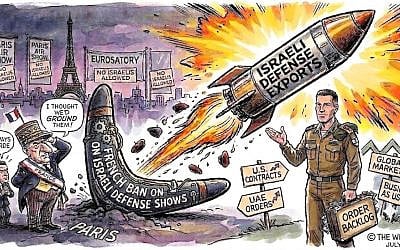
How Charles de Gaulle’s embargo transformed Israel from a customer into a competitor.
France did not intend to build one of the world’s most successful defense industries.
Yet, in an important sense, it helped do exactly that.
The story begins with France.
The decade following the Suez Crisis of 1956 found President Charles de Gaulle determined to restore France’s standing as an independent global power. The trauma of Algeria convinced him that France could no longer define its foreign policy solely through traditional Western alliances. Paris would pursue its own interests, cultivate its own relationships, and reclaim its influence throughout the Arab world. At precisely the same time, Israel reached a very different conclusion. Under the leadership of Ezer Weizman, the Israeli Air Force decided that the nation’s survival depended upon unquestioned air superiority. To achieve it, Israel turned to France and, in particular, Dassault Aviation.
The partnership proved remarkably successful for both countries. Israel acquired the Mirage III, while France gained an enthusiastic customer whose pilots would soon demonstrate the aircraft’s capabilities under the most demanding combat conditions imaginable. When the Six-Day War erupted in June 1967, the Israeli Air Force destroyed much of the Egyptian Air Force before it ever left the ground. The Mirage III became one of the most admired fighter aircraft in the world, and Dassault emerged as one of the great names in military aviation. Israel had acquired the aircraft it needed. France had acquired something equally valuable—international prestige.
Almost immediately after Israel’s victory, Charles de Gaulle imposed an arms embargo, freezing the delivery of aircraft and military equipment that Israel had already ordered and, in many cases, already paid for. France was pursuing its own strategic interests. Having emerged from the Algerian War, Paris sought closer relations with the Arab world and greater independence from both Washington and Moscow. The embargo reflected those ambitions. It also reflected something else that has appeared repeatedly throughout history: the assumption that great powers possess leverage over smaller nations because dependence ultimately produces compliance.
Israel’s response was neither immediate nor compliant.
If a nation’s security could be altered by the signature of a foreign president, then national survival could never again depend upon the political calculations of another capital. The embargo became a permanent lesson. Israeli military planners, engineers and political leaders reached a conclusion that would shape the next half century: no single supplier should ever become a single point of failure.
That lesson would be tested sooner than anyone expected.
In January 1969, France extended its embargo, refusing to deliver the five Sa’ar-class missile boats that Israel had already purchased and paid for. For most countries, the story would have ended there. Israel chose another course. Through an elaborate commercial arrangement involving a Norwegian front company, Israeli operatives quietly positioned themselves to recover the vessels. Then, on Christmas Eve, while much of Europe celebrated the holiday and a winter storm swept across the English Channel, Israeli crews slipped the missile boats out of the French port of Cherbourg under the pretense of a routine sea trial.
By New Year’s Eve, the vessels had reached Haifa.
To Israel, the operation was the recovery of ships that had already been purchased and paid for but were now being withheld for political reasons. Much of the French press portrayed the episode as a robbery. Israelis saw it differently. Regardless of which description one prefers, the diplomatic effect was unmistakable. De Gaulle intended to wield French power. The Cherbourg Project instead revealed its limits.
The significance of Cherbourg was never the five missile boats.
It was the doctrine they left behind.
Israel concluded that national security could not rest upon the goodwill of even its closest allies. Alliances would remain essential, but dependence had become a strategic liability. The embargo redirected Israeli thinking. Engineers began solving problems that had previously been solved abroad. Military planners looked inward rather than outward. What had begun as a diplomatic crisis slowly evolved into a national industrial strategy.
The transformation did not occur overnight, nor was it the work of a single government. It unfolded over decades. Israel learned not merely to operate imported aircraft, but to modify them. It invested in indigenous avionics, electronic warfare, precision-guided weapons, missile defense, unmanned aircraft and increasingly sophisticated software.
Strategic independence was the objective.
Commercial success followed.
By the beginning of the twenty-first century, Israel was no longer simply adapting foreign technology. It was producing technologies that others sought to acquire. Israel Aerospace Industries, Rafael and Elbit Systems evolved into companies whose products competed in international markets not because Israel aspired to become an arms exporter, but because decades of necessity had produced world-class engineering. What began as a determination never again to become strategically dependent gradually developed into one of the world’s most innovative defense ecosystems.
The irony becomes even more striking when viewed through the F-35, the most sophisticated combat aircraft ever built. Few people realize that Israeli companies manufacture some of its essential components. Israel Aerospace Industries produces the aircraft’s outer wing assemblies. Elbit Systems manufactures the Helmet Mounted Display System worn by every F-35 pilot, along with numerous structural components, cockpit displays and composite assemblies. For Israel’s own F-35I Adir, Israeli engineers integrated indigenous electronic warfare systems, mission software and tactical communications that distinguish it from every other variant in service. The country that once depended almost entirely upon foreign military technology now contributes to the capabilities of many of the nations from which it once sought assistance.
Charles de Gaulle undoubtedly believed he was pursuing France’s national interests. Few would argue that a sovereign nation should do otherwise. The embargo was intended to weaken Israel militarily, strengthen France’s standing in the Arab world, and teach a small ally where leverage resided. Instead, it encouraged Israel to ensure that no future government—French, American or otherwise—would ever again possess quite the same degree of influence over its security.
That may be the embargo’s most enduring legacy. Israel did not eliminate its dependence on allies. It reduced its dependence on any single ally. Today, an off-the-cuff decision in Washington is no longer necessarily the final word. Today, Israel gets a vote.
Nearly sixty years after Charles de Gaulle signed the embargo, its significance is measured not by the aircraft that were never delivered or the missile boats that quietly departed Cherbourg on a winter’s night. It is measured by what followed. A decision intended to weaken Israel militarily instead accelerated its determination to become strategically independent. In the process, France helped create something it never intended to create: a competitor.
– Photo courtesy of The Witness Ledger
-for more articles follow us https://steventeplitsky.substack.com/