François Rastier Interview | Alexandre Gilbert #312
François Rastier, Research Director in Linguistics, specialist in contemporary identity discourses, from Nazism to decolonialism. this article was published on le ddv.fr on February 3, 2026 .
Conference “Palestine and Europe”: The Map Without the Territory
The ideological infiltration of the Muslim Brotherhood in Europe was recently illustrated by the organization, by the Arab Center for Research and Policy Studies (Carep), of a conference at the Collège de France. This event, which promoted an anti-Israeli militant objective under a veneer of academic legitimacy, ultimately could not be held within the historic academic institution. A look back at an event whose underlying motives and implications were discernible in the use, on this occasion, of a Roman map of Palestine that erased Judea and the Jewish homeland.
On January 22, 2026, the French National Assembly adopted a resolution seeking to place the Muslim Brotherhood movement on the European list of terrorist organizations. Two of its opening clauses read: “the transnational Muslim Brotherhood movement constitutes a structured ideological network advocating the establishment of a political order based on sharia law, wholly incompatible with democratic principles, secularism, and the rule of law”; and “this transnational organization, although often operating under the guise of associations, educational or religious activities, conducts influence operations based on institutional entryism, the diversion of fundamental freedoms for communitarian purposes, and the creation of religious counter-societies.”
How did matters reach this point? Challenged in numerous Arab countries, from Saudi Arabia to Egypt and Tunisia, the Muslim Brotherhood—backed by Qatar—has long undertaken efforts to re-Islamize emigrant communities in Europe and to disseminate its ideology within universities, notably to train future cadres. Their success has been such that in January 2025 the United Arab Emirates decided to cease granting scholarships to students wishing to study in the United Kingdom, to prevent their drifting toward Islamism. Muslim countries, hardly suspect of Islamophobia, appear in this respect more cautious and clear-sighted than European states.
The case of Tariq Ramadan exemplified such naivety all the more strikingly since, after a hagiographic dissertation devoted to his grandfather Hassan al-Banna, founder of the Brotherhood, he was appointed Professor of Islamic Studies at Cambridge, to a chair created for him and financed with more than ten million pounds by Qatar.
The objective remains the academic legitimization of Islamist discourse. As Clément Fayol wrote in 2020: “Recently, to compensate for the fall of Tariq Ramadan, Qatar persuaded former CNRS researcher François Burgat and Professor Bertrand Badie, one of the leading figures at Sciences Po Paris, to head the Arab Center for Research and Policy Studies (Carep), funded by the Doha Institute. Carep is in fact a branch of the think tank led by one of the preferred advisers of the Emir of Qatar, Azmi Bishara.” (1) Carep regularly organizes conferences on the humanities in Doha and maintains premises in Paris for its influence operations, of which the following is a recent example.
A Militant Conference
In November 2025, Carep sought to organize a conference at the Collège de France, in connection with Professor Henry Laurens’s chair: Palestine and Europe: The Weight of the Past and Contemporary Dynamics. It was in fact centered on Europe. The call for papers stated in particular: “Europe is thus caught between the burden of its colonial and imperial legacy, its cultural identification with Israel, the weight of its guilt in the destruction of Europe’s Jews during the Second World War, the importance of its economic, technological and scientific relations with the Hebrew state, and the growing indignation of part of its public opinion, marked by accusations of apartheid and now genocide in the Gaza war.”
Rarely has a conference prompted so many collective statements and petitions, both within the Collège de France itself and across universities.
Despite mitigating nuances, three theses were thus advanced: 1) Europe (and not the Nazi regime) is guilty of the extermination of the Jews; 2) It bears an “imperial and colonial legacy” that explains “its cultural identification with Israel”; 3) Its public opinion is marked “by accusations of apartheid and now genocide.” These key terms—apartheid and genocide—serve as accusatory rallying cries. The aim was to weaken Europe’s support for Israel, however measured and critical that support may be. Panel titles reflected this intent: “Zionism as a European Project of Colonial Expansion”; “The Instrumentalization of the Shoah in Denying Palestinian Suffering”; “Influence Networks and Economic Interests”; “From Rhetoric to Complicity: Europe and the Crisis of International Law in Gaza.”
Because of several troubling elements in the announced program, the Administrator of the Collège de France, Thomas Römer, ultimately withdrew his support. The conference was nevertheless held on the scheduled dates, but at Carep’s Paris premises. The newspaper L’Humanité, apparently committed to scientific information, obligingly broadcast all presentations in full on its website.
Rarely has a conference generated so many collective statements and petitions, with more than 300 academics declaring that the alleged ban “paves the way for institutional censorship,” and hundreds signing a petition against the “cancellation” and calling for the minister’s resignation.
Meanwhile, the journal Le Droit de Vivre published four successive articles presenting numerous speakers whose academic credentials appeared all the more vague as their records suggested rather agents of influence for Qatar, Hamas, or even Iran—what Ayatollah Khamenei calls the “Axis of Resistance.” Finally, the review Mézetulle published a meticulous analysis by Benjamin Straehli discussing, without partisanship, the scholarly status of the presentations—ultimately secondary, since the militant objective prevailed over the scientific subject, and academic discourse seemed primarily intended to legitimize ideological claims.
An Enigmatic Map
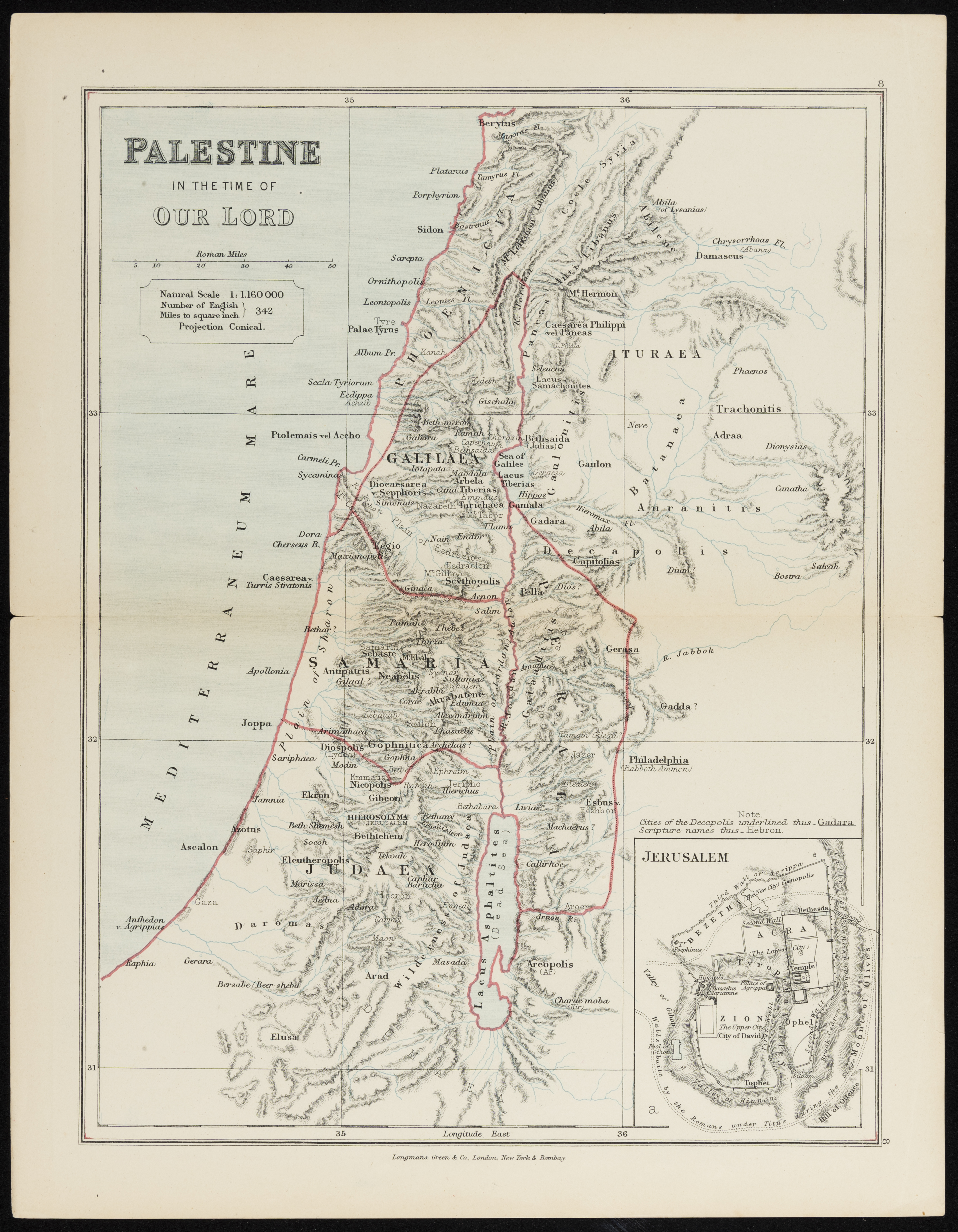
The map of Mandatory Palestine displayed on the conference homepage—still online on the Collège de France website—is captioned: “Map of Palestine under the British Mandate (detail), coll. Amjad Ghannam – © The Palestinian Museum Digital Archive.” This map deserves attention, as it was reproduced on posters and projected as a backdrop throughout the conference.
Strangely, it corresponds to neither of the two recognized maps of Mandatory Palestine and the Jewish national home—neither the 1920 version encompassing present-day Jordan and part of southern Syria up to Iraq, nor the 1922 version restricting the national home to present-day Israel plus the West Bank and Gaza, a territory extending “from the river to the sea.” Instead, an English map of the Roman province of Palestine is presented, titled Palestine in the Time of our Lord; its toponyms are in Latin, and its scale is measured in Roman leagues (2).
The use of a map from the Roman era makes it possible to erase both Mandatory Palestine and the Jewish national home.
The term “Palestine” here reflects a certain anachronism. In the first century, the region was not called Palaestina but Judea. It was Emperor Hadrian who, in the following century, pursued an anti-Jewish policy: he renamed Jerusalem (Hierosolyma) as Aelia Capitolina, in honor of himself (Aelius) and the gods of the Capitoline; he established the cult of Jupiter on the Temple Mount and banned Jewish rites. After the ensuing Jewish revolt, he erased the customary name Judaea (then the official Roman provincial name, recorded as such by Strabo in his Geography) and replaced it with Palaestina, attaching the province to Syria. The name evoked the Philistines, not the Jews. The procedure remained in memory: in the fourth century, Epiphanius of Salamis still wrote, “Palestine, that is, Judea.” (3)
Two thousand years later, Judea was once again to be erased—retrospectively. Here is how. The portion of the map selected to illustrate the conference appears curiously fragmentary: it shows Galilee, but Judea and Samaria have been cut off. The historical heartland of ancient Judaism thus disappears. There are, of course, no borders, but red lines distinguish Roman prefectures governed by procurators or legates. Moreover, in terms of modern history, there is no mention of a Jewish national home, contrary to the caption provided by the organizers: using a Roman-era map erases both Mandatory Palestine and the Jewish national home.
This sets the tone for a conference claiming scientific exemplarity. The visual projected throughout—visible in the online video archives—removes any remaining ambiguity. Like the purloined letter in Edgar Allan Poe’s famous tale, it lies in plain sight without seeming to attract notice. Two thousand years after the erasure of Judea, it is now the name of Israel that is to be erased, and various political extremes—from Islamists to neo-Nazis—use the circumlocution “Zionist entity” to avoid it.
Under prestigious academic patronage, such geographical revisionism can scarcely be accidental. The conference’s logo map comes from the collection of Ahmad Ghannam, an anti-Israeli activist born in Jerusalem. And Carep’s treasurer, Mohamed al-Masri, a Qatar resident and key organizer of the conference, makes no secret of his orientation: his interview titled “Arab Public Opinions Support Any Movement That Defends the Palestinian Cause” is illustrated on Carep’s website with a photograph of Hamas’s eliminationist slogan, “Palestine will be free from the river to the sea.” Once again, the image illuminates the discourse and dispels the ambiguities of double speech.
Notes: