From Ashes to Renewal: A reflection on our Kristallnacht mission to Berlin
Adapted from remarks I gave at the Axel Springer dinner in Berlin on November 8, 2026.
My mother was born in Berlin in February 1938. On the night of November 9, she was 10 months old and sick, so she was in the local hospital in the area, and her family was with her. That is probably why they were left alone that night.
This past Shabbat, walking back from shul in Berlin, I took a wrong turn and found myself on Weinbergsweg. I wasn’t looking for it.
I grew up believing there could be no day after that period of night in Europe. We didn’t buy German cars, German pens, or German washing machines. Then, in 1999, my wife and I moved to Frankfurt, and for six years I ran programs across Germany for Ronald Lauder, who was US ambassador to Austria in the 1980s and had been moved to start a foundation to rebuild Jewish life in Central and Eastern Europe. Three of my five children were born there. We left in 2005, when our oldest turned five, because we didn’t think a Jewish child could grow up in Germany.
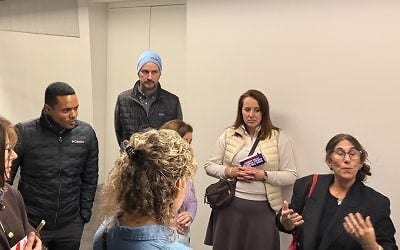
I brought a group of 15 people to Berlin this past week, most of them from Riverdale, to find out whether my wife and I were right. Rabbi Steven Exler of the Hebrew Institute of Riverdale came, as did two Holocaust scholars. So did one of SAR’s middle school teachers, who runs Names Not Numbers®, the program in which SAR eighth graders interview Holocaust survivors and turn the interviews into a documentary film, and the sponsor of that program, who volunteers to lead it alongside her. Her father was a Nazi hunter, and she told his story to the Olami (a German Jewish student organization) students at dinner on our last night. Several in the group had never been to Germany, and a few had decided long ago that they never would.
- • •
Two of the young women who came through The Ronald S. Lauder Foundation (the “Foundation”) programs we had been running in the early 2000s were Olga, from Osnabrück, and Anna, from Leipzig. They showed up at seminars in Munich and Würzburg, then both joined the midrasha we had started in Frankfurt. Olga is now Golda Ita Afanasev: a lawyer, a Harvard Business School certificate program graduate, a mother of five, and the person who runs the Foundation’s educational programs across Germany. Anna is married to Pasha Segal, who runs the Foundation’s work on the ground, and she leads the Kahal Adass Jisroel community in Berlin. Their children go to a fully Orthodox Jewish school in Berlin, the one our group visited on Monday morning. They lead full Jewish lives there as a matter of course. Earlier this year, Golda asked me to bring a group around the anniversary of Kristallnacht: people who could see what she and her colleagues have built and carry the story home.
Congressman Ritchie Torres came with us. We’ve traveled to Israel together with Riverdale’s clergy and elected officials, and I asked him to join us in Berlin. He had never been to Germany. Few elected officials anywhere speak about antisemitism as plainly as he does, and his German counterparts, in the Bundestag and at the Rotes Rathaus (City Hall), already knew him for it. They received him with tremendous respect. We’re grateful he came, and it’s in line with who he is. He had votes in Washington on Monday the 9th, so we held our commemoration on the evening of the 8th. In our tradition, the day begins the night before. Vayehi erev, vayehi boker: there was evening, and there was morning. First the night, then the day. I grew up certain that after the night of November 9, 1938, there would be no morning. What I learned on this trip is that there is a day, even in Berlin, after that long dark night. November 8 was erev November 9.
• • •
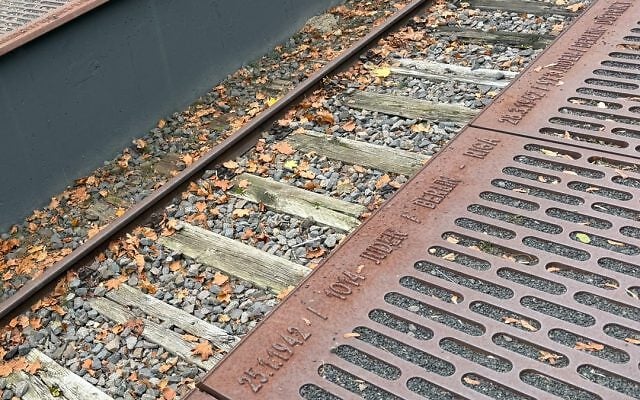
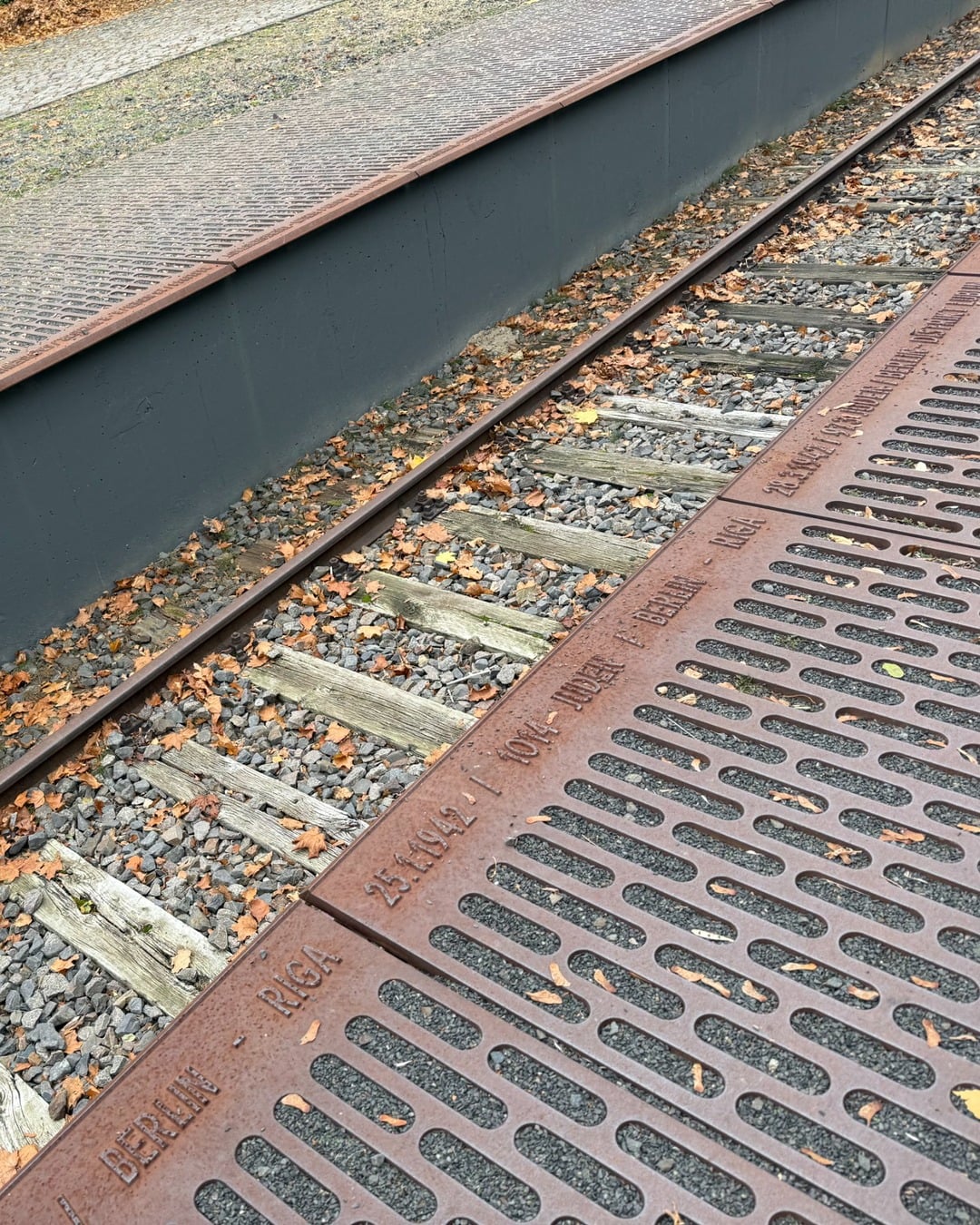
We davened on Brunnenstrasse, in a synagogue recently restored to look exactly as it did before Kristallnacht, and ate Friday night dinner with the students of Olami Berlin, young Jews in their 20s. We stood in the villa at Wannsee, where the Final Solution was coordinated, in a 90-minute meeting, followed by breakfast. We stood on the platform at Gleis 17, from which Berlin’s Jews were deported. We toured the Bundestag, met the Mayor, spent a morning in the Jewish school, and sat in the Neue Synagoge on the anniversary itself.
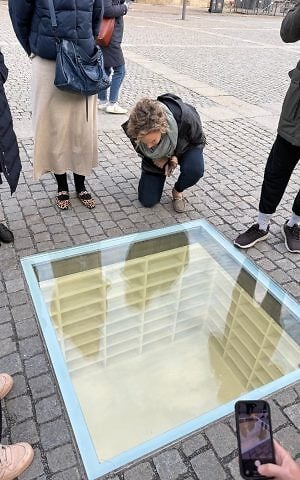
Berlin’s sidewalks hold thousands of Stolpersteine, small brass plaques set into the pavement in front of the buildings where Jews lived, with their names and the dates they were taken. On the night of November 9, we saw what Berliners do with them on Kristallnacht (Germans don’t use that word; they call it Reichspogromnacht, the night of the pogrom): people across the city, and across Germany, go out and light candles beside the stones on their own streets.
- • •
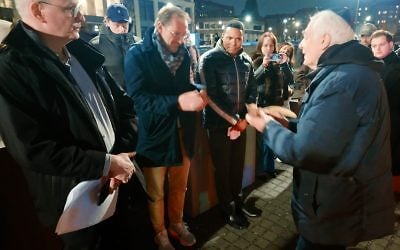
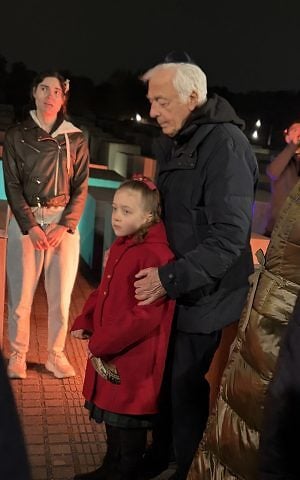
On the evening of November 8, we went to the Memorial to the Murdered Jews of Europe, the field of 2,711 concrete slabs near the Brandenburg Gate. The students of Olami led a short program explaining what the place is and what it means. Then a shofar was passed, hand to hand, through the crowd. It started with Dr. Boris Zabarko and ended with Golda’s youngest daughter, who blew it. We said Kaddish and sang Hatikvah, and people who happened to be walking through the memorial stopped and joined in.
Dr. Zabarko turns 91 this month. He survived the Shoah as a child in Ukraine, and he lives in Kyiv, which means he is now living through a war for the second time. There are no flights out of Ukraine, so he came to Berlin the only way you can, by car to the border and onward from there. He spoke to us afterward. But his being there, at that memorial, holding that shofar, said more than any speech.
In our tradition, the shofar is the sound of crying, even of wailing. It is also the sound of freedom, the blast that proclaims the Jubilee year. It went from a man who survived the ghetto as a child to a girl whose mother was my student. She blew it in Berlin, on erev November 9.
- • •
The dinner that followed was at Axel Springer, one of Germany’s largest newspaper publishers, hosted by Marion Horn, editor-in-chief of Bild. The company has a set of founding principles that every employee agrees to. Axel Springer first wrote them in 1967, and from the start one of them has been support for the Jewish people and Israel’s right to exist.
At that dinner, Marion told us her daughter had to leave her school after classmates and teachers held her responsible, as the child of a journalist who defends Israel, for the children of Gaza. The deputy Israeli ambassador told us that some Jews in Berlin are quietly making plans to leave. Synagogues and Jewish schools here have police at the door. For all the renewal, this community faces much of what we face in New York.
The people we met know all of that. They’re building anyway.
- • •
When I left in 2005, I was sure that raising a Jewish child here meant settling for less. I was wrong, and I have rarely been so glad to be wrong.
The people I brought saw the same thing. Ask them now to name a growing Jewish community in Europe, and they’ll say Berlin. They’re going home to tell their shuls and their friends.
- • •
The day after we landed, SAR had a staff in-service day, and Fred Smith and Richard Baum came to speak to our teachers. A few minutes from school, the Kingsbridge Jewish Center is becoming a church, and 320 memorial plaques were still on its wall. Fred grew up in that shul and found them; he and Richard, another former member, are tracking down the families. The plaques are at SAR now, and our 8th graders have been sorting and cataloging them, one name at a time. Where we can find a family, the plaque goes home. Where we can’t, we’ll find a shul that will give it a place on its wall. Same week, same work as the stones in Berlin, and our kids in the middle of it.
- • •
The Ronald S. Lauder Foundation has carried Jewish education in this part of the world since 1987, and it is now winding down its programs in Europe. More than 1,200 students and young adults in Germany are at risk of losing the framework that connected them to Jewish life. They won’t, because Golda is taking on the responsibility of keeping the outreach programs going. She and Pasha have founded a new organization for it, Aleinu, “it is upon us,” registered this week. The students we ate with are its first responsibility.
- • •
Nothing erases what was done in this city, and from this city, to the Jews of Europe. Standing on Weinbergsweg didn’t change 1938.
But there was evening, and there was morning. Last week I saw the morning: a girl with a shofar, a Friday night table full of 20-year-olds, a school full of Jewish children, candles on the sidewalk. We spent four days with the people who are bringing the day, and I came home as their student.