


From Challenger to October 7: Israel Needs More Than a Commission of Inquiry
On January 28, 1986, the space shuttle Challenger exploded 73 seconds after liftoff, killing all seven astronauts aboard. The disaster was not simply a technical failure. Engineers had warned about the dangers posed by the shuttle’s solid rocket booster O-rings, particularly in unusually cold temperatures. Yet the launch proceeded.
On October 7, 2023, Israel experienced a catastrophe of an entirely different kind. Hamas terrorists breached Israel’s defenses, murdered approximately 1,200 people, and abducted 251 hostages. Subsequent investigations and disclosures have raised troubling questions about warnings, assumptions, preparedness, and the failure to translate available information into effective preventive action.
The two tragedies are not equivalent. But they raise a common institutional question: What happens when organizations recognize dangers but fail to ensure that those dangers are adequately addressed?
That question should be at the center of Israel’s national debate over establishing a commission of inquiry into October 7.
The lesson of Challenger
The presidential Rogers Commission, established after Challenger, examined both the physical cause of the disaster and the organizational decision-making failures that allowed the launch to proceed.
Allan McDonald, an engineer and senior representative of Morton Thiokol, the contractor responsible for the solid rocket boosters, opposed launching under the prevailing cold-weather conditions. Other Thiokol engineers also expressed serious concerns during discussions the night before the launch. Nevertheless, the decision was made to proceed.
The Rogers Commission revealed deficiencies in communication, management judgment, and the treatment of technical warnings. Its findings illustrate a critical principle: Identifying a risk is not the same as managing it.
An organization can receive warnings, conduct meetings, prepare reports, and still fail catastrophically if no one ensures that the underlying danger has been reduced.
DoD 5000: A framework that preceded Challenger
Years before Challenger, the United States Department of Defense had established the DoD 5000 acquisition-management framework, incorporating structured requirements, technical reviews, testing, documentation, and formal decision points.
The framework was intended to impose discipline on complex defense programs and provide decision-makers with reliable information before major commitments were made. It did not govern NASA’s shuttle launch decisions, and it would be incorrect to claim that the Rogers Commission created DoD 5000. The framework already existed.
But the principles underlying disciplined defense systems engineering offer an important lesson. A serious risk must be identified, evaluated, assigned to a responsible official, and addressed through specific mitigation actions. Those actions must be tracked, and their effectiveness verified.
Where significant risks remain unresolved, senior decision-makers must understand the potential consequences and explicitly determine whether the remaining exposure is acceptable. This is the distinction between maintaining a reporting system and operating a genuine risk-management system.
What Israel’s commission must investigate
Much of the controversy surrounding an October 7 commission of inquiry concerns its composition, independence, authority, and potential political consequences. These questions are important. Public confidence requires a credible investigation capable of examining decisions at every level, including political, military, and intelligence leadership.
But the commission must do more than determine who knew what and when. It must examine what happened to the warnings after they were received.
Were Hamas’s intentions and capabilities correctly assessed? Were the potential consequences of a coordinated attack adequately understood? Were dissenting assessments elevated to senior leadership?
Who was responsible for reducing the identified vulnerabilities? Were corrective actions assigned, scheduled, and completed? Did anyone independently verify that the dangers had actually diminished? And when significant risks remained unresolved, who had the authority to accept them?
These are among the questions I propose in Appendix B of my book, Ignored Warnings: How Israel’s Failure to Apply DoD 5000 Risk Governance Enabled the October 7 Massacre.
The commission should reconstruct the entire chain from intelligence warning to risk assessment, decision, mitigation, and verification. This would not replace the determination of individual responsibility. It would make that determination more meaningful.
Israel needs a National Risk Management Board
A commission of inquiry is principally retrospective. It examines what happened and why. But Israel also needs a permanent mechanism designed to prevent the recurrence of institutional failures.
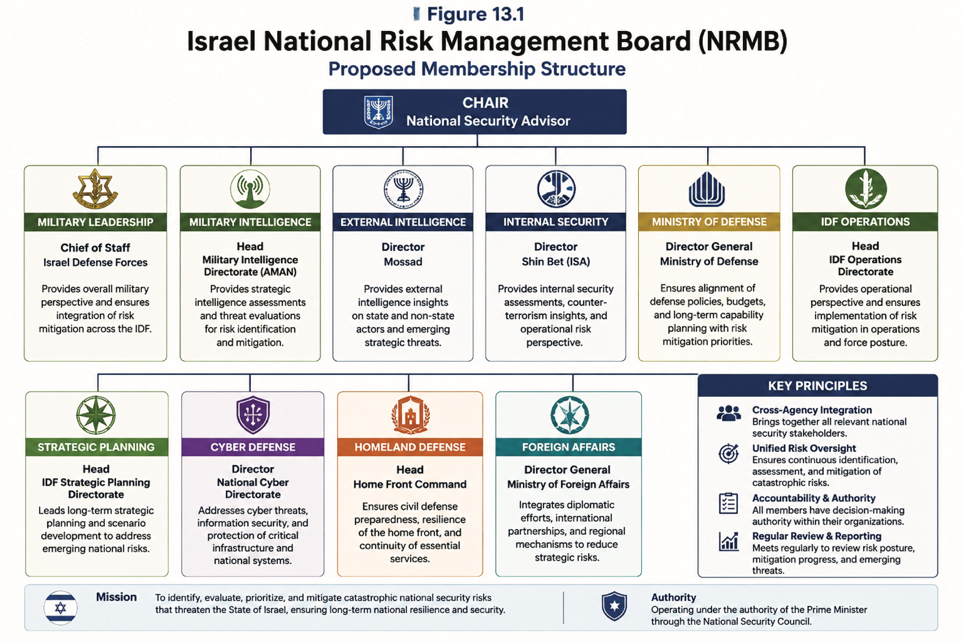
In Chapter 13 of Ignored Warnings, I propose establishing an Israel National Risk Management Board, drawing on the disciplines of DoD 5000 and adapting them to Israel’s national-security environment. Figure 13.1 illustrates a proposed membership structure bringing together principal national-security institutions under coordinated risk governance.
Such a board would not replace the IDF, Shin Bet, Mossad, or existing national-security decision-making institutions. Rather, it would provide an integrated mechanism for identifying, assessing, escalating, and tracking major risks that cross organizational boundaries.
Every significant national-security risk should have a designated owner, a documented assessment of potential consequences, measurable mitigation actions, and established deadlines. Those actions should be incorporated into an integrated master schedule, enabling senior officials to identify delays, dependencies, and incomplete corrective measures.
Independent review should challenge optimistic assumptions and determine whether reported progress represents genuine risk reduction. Most importantly, unresolved high-consequence risks must be brought before officials with the authority to demand further action or explicitly accept the remaining exposure.
A risk must never be considered resolved simply because a meeting was held, a report was submitted, or an action was announced.
The essential ingredient: Leadership that believes in risk management
During my more than four decades working in American defense systems engineering and national-security risk management, I learned that even the best-designed process is ineffective without committed leadership.
Risk managers can maintain registers, identify vulnerabilities, prepare schedules, and report deficiencies. But unless senior leadership believes that risk management is essential to mission success, the process becomes another bureaucratic exercise.
The proposed Israeli board must therefore be led by someone with sufficient authority, independence, and personal commitment to insist that identified risks are addressed. Its chairman must be willing to challenge senior officials, demand evidence, and elevate unresolved dangers even when doing so is inconvenient.
The leader must genuinely believe in the system and be prepared to say: “I want this system. I expect it to be used. And I will not allow unresolved risks to disappear into reports, meetings, or assumptions.”
The real test of an inquiry
The Rogers Commission did more than identify a defective O-ring. It exposed institutional weaknesses that allowed known engineering concerns to be overridden.
Israel’s commission must likewise examine not only individual failures but also the processes and organizational culture that permitted dangerous vulnerabilities to persist.
The ultimate test will not be the number of witnesses interviewed, documents collected, or officials criticized. It will be whether the investigation produces institutional reforms that are implemented, independently verified, and sustained.
The questions proposed in Appendix B of Ignored Warnings provide a starting point for that investigation. The National Risk Management Board proposed in Chapter 13 offers a potential mechanism for ensuring that its lessons become part of Israel’s permanent national-security governance.
A warning does not reduce a risk. A meeting does not reduce a risk. A report does not reduce a risk.
Risk is reduced when responsible officials take measurable action, verify that the action worked, and ensure that any remaining exposure is understood and explicitly addressed.
Israel owes the victims of October 7, their families, and future generations more than an explanation of what went wrong. It owes them a national-security system capable of acting on the warnings before the next catastrophe occurs.