From conflict to crime?
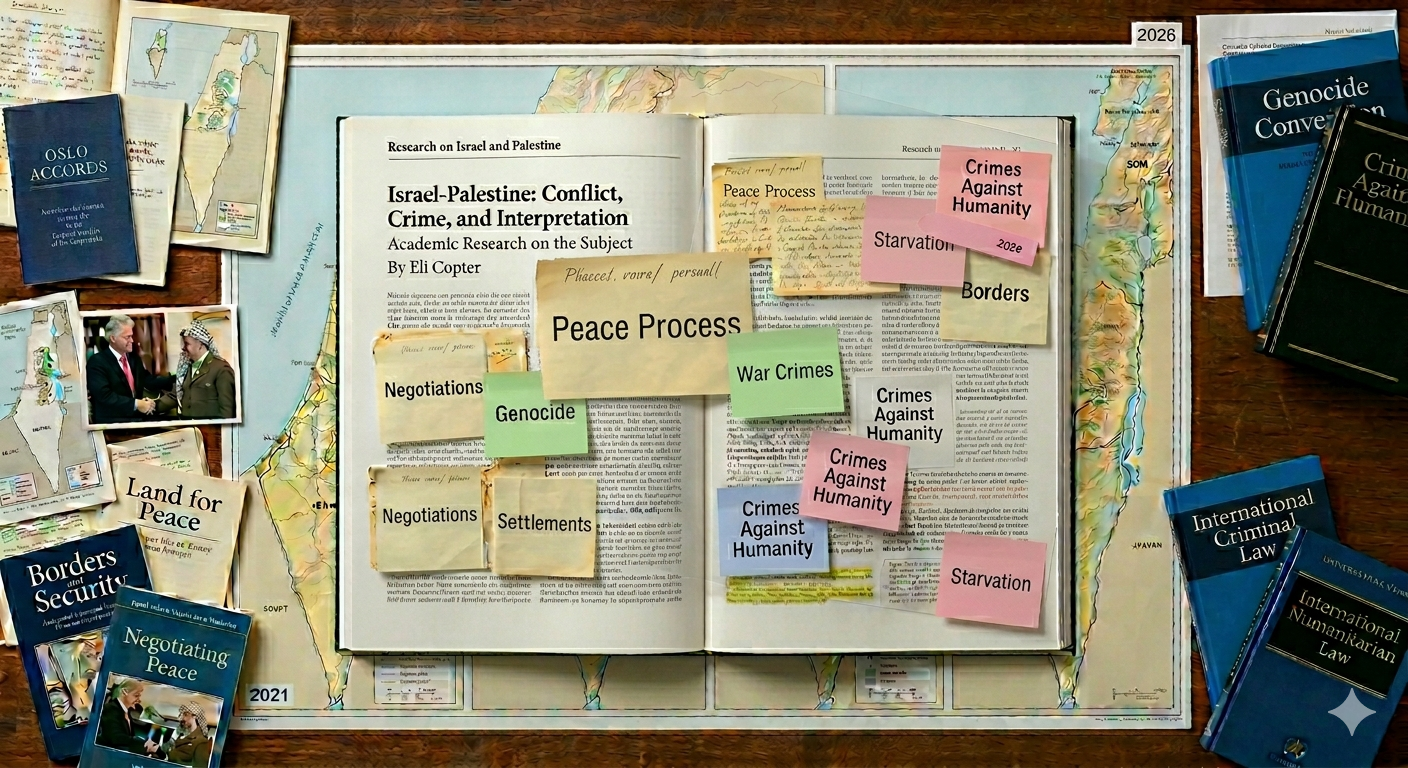
TL;DR: Academic attention to Israel rose sharply after October 7, but the share of publications using severe accusation frames barely moved. The deeper shift was conceptual: legal-moral terms such as genocide, war crimes, collective punishment, and international law gained ground, while occupation, settlements, colonialism, and apartheid became less prominent overall. Yet older structural vocabularies were increasingly tied to genocide when they appeared. The result is a reconfiguration of criticism around crime, culpability, and legal judgment.
* * *
Few propositions command broader agreement today than the claim that academic discourse on Israel changed after October 7. Critics of Israel tend to view this as a long-overdue correction. Universities and journals, they argue, are finally confronting realities that were previously ignored or downplayed. Supporters of Israel see something quite different. To them, the events that followed October 7 accelerated an already existing tendency within parts of the university world to approach Israel through an increasingly hostile lens. The disagreement is obvious. Less obvious is that both sides share the same underlying assumption: something fundamental changed.
That assumption is rarely examined. It is usually treated as self-evident, but it raises a sharper question than either side normally asks. What exactly changed? Did scholarly discourse become more critical of Israel? Did certain accusations gain prominence? Did the balance among different ways of understanding the conflict shift? Or are observers projecting the intensity of the public debate onto the research literature itself? The stakes are not limited to Israel. Scholarship does more than generate evidence. It also shapes the language through which evidence is interpreted. Concepts that first appear in journals rarely remain confined there. They migrate into NGO reports, newspaper coverage, parliamentary debates, court proceedings, institutional policies, and eventually into public common sense. Scholarly discourse does not determine public opinion, but it helps define the vocabulary through which public debates are conducted.
To examine this systematically, I analyzed a corpus of 2,666 conflict-related publications on Israel indexed in Web of Science between January 2021 and May 2026. The corpus is not meant to capture everything written about Israel, but to identify how conflict-related publications organized their language before and after October 7. Further details on corpus construction, coding, and measurement are provided in the Data and Methods Appendix.
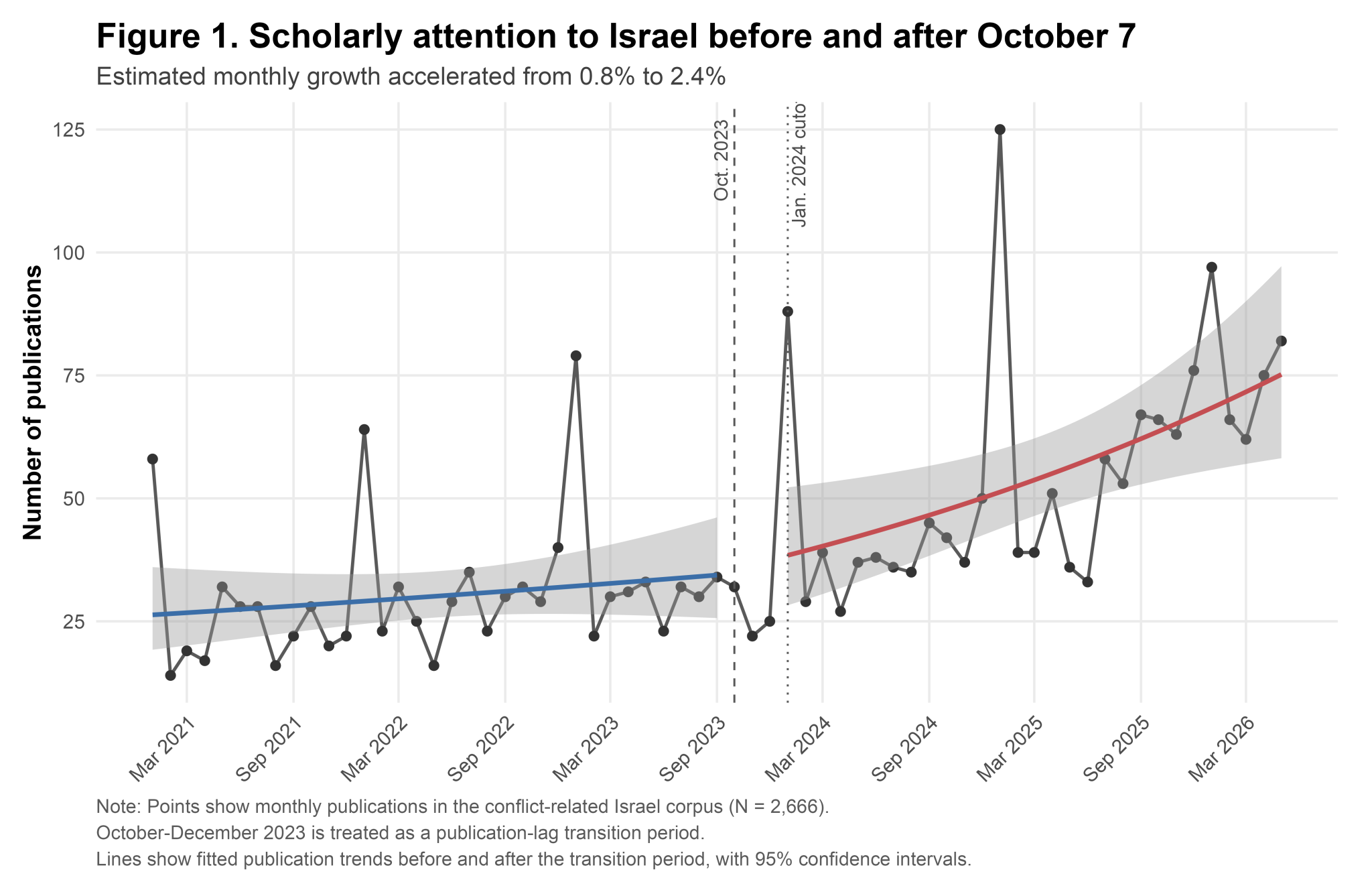
One change is immediately visible: scholarly attention to Israel increased substantially. Figure 1 shows the monthly number of conflict-related publications indexed in Web of Science during the period examined. Publication volume was already rising before October 7, but the pace accelerated thereafter. Estimated monthly growth tripled from approximately 0.8 percent before October 7 to 2.4 percent in the post-lag period. Whatever else happened, interest in the conflict clearly intensified. The more interesting question is whether the vocabulary of this larger literature shifted as well.
The next result was more surprising. Figure 2 shows the share of publications containing at least one severe accusation frame before and after October 7. If the expanding literature had also become more accusatory, that should be visible in the concepts appearing within the publications themselves. Terms such as occupation, apartheid, settler colonialism, ethnic cleansing, genocide, collective punishment, and war crimes should have become more common, as they represent some of the most prominent frameworks through which Israel has been discussed in academic writing.
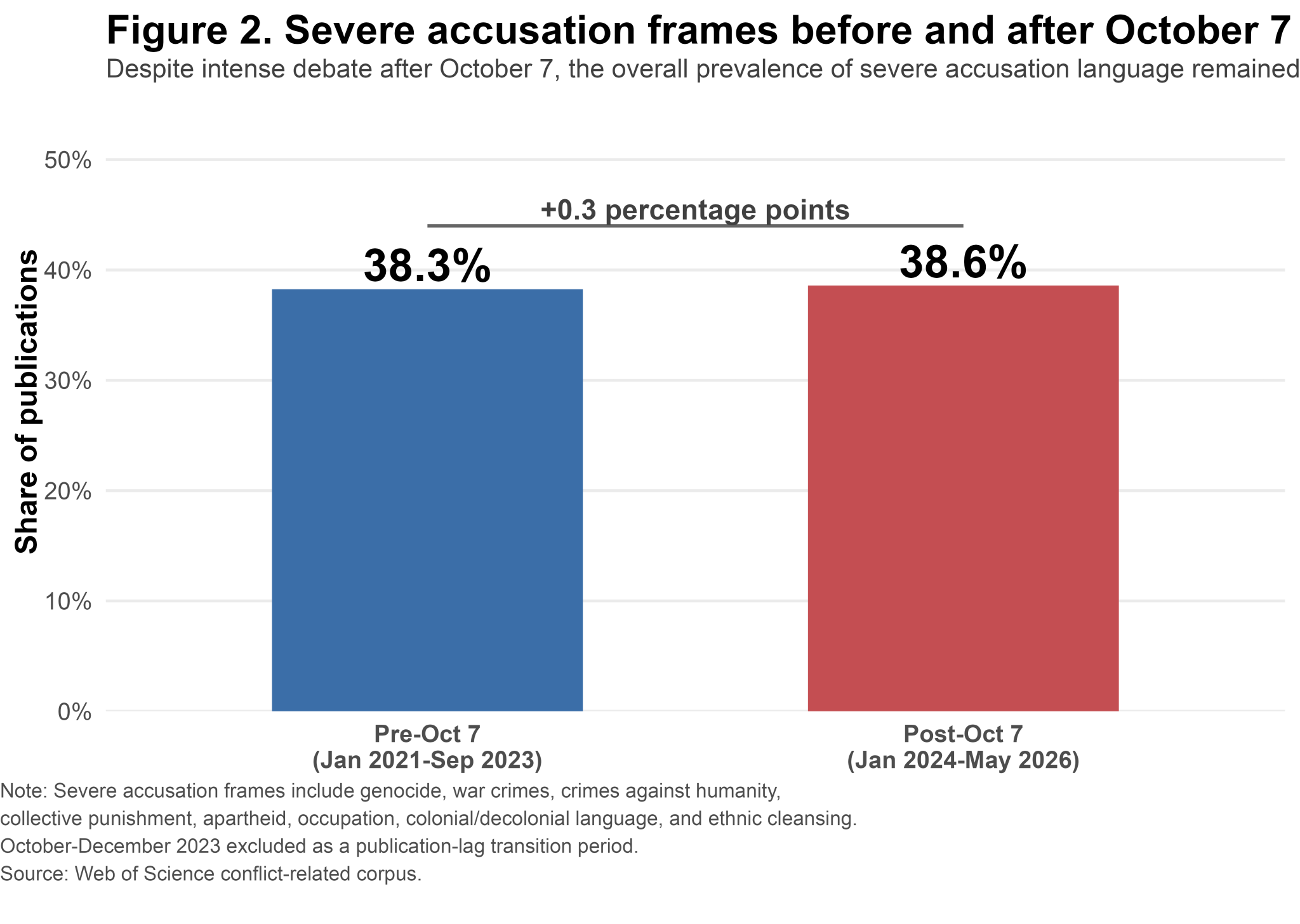
Before October 7, 38.3 percent of publications contained at least one severe accusation frame. In the later period, the share was 38.6 percent. This is striking precisely because the number of conflict-related publications grew substantially over the same period. If the scholarly conversation had moved primarily toward greater reliance on severe accusation frames, the aggregate measure should have risen as the literature expanded. Instead, severe accusation remained remarkably stable.
This creates difficulties for both sides of the debate. Readers who see the post-October 7 literature as substantially more hostile toward Israel must explain why this indicator barely moved. But the claim that little happened is also hard to sustain. Scholarly attention intensified. Universities became sites of political conflict: faculty statements multiplied, boycott campaigns spread, encampments appeared across campuses, and the conflict became one of the most visible and contentious issues in university life.
This puzzle becomes clearer once criticism is no longer treated as a single category. Aggregate measures can conceal important differences beneath the surface. A literature in which every accusation-related concept rises will look very different from one in which some terms increase sharply while others decline. To understand the pattern, it is therefore necessary to move beyond the aggregate measure and examine the individual concepts that compose it. Figure 3 presents those movements.
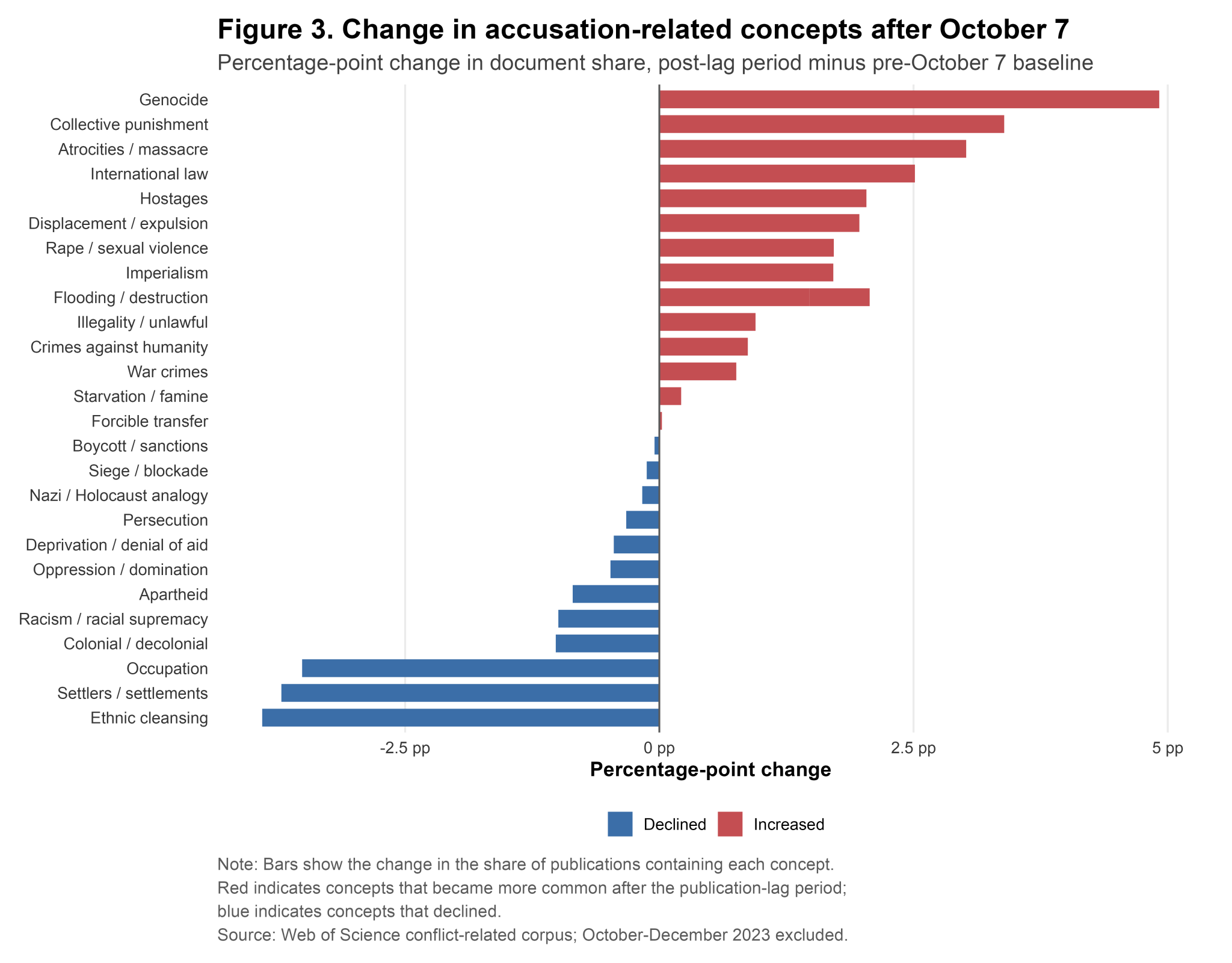
The distribution points to a change in emphasis. Genocide records the largest increase in the corpus, alongside war crimes, crimes against humanity, collective punishment, international law, and several related concepts. Yet some of the most established critical vocabularies in the literature move in the opposite direction. Occupation declines, and so are references to settlers and settlements, apartheid, colonial and decolonial terms, and ethnic cleansing. Narratives of racism and racial supremacy also recede. The concepts did not move together.
The finding that genocide increased is not, by itself, especially surprising. The Gaza war generated legal, humanitarian, and moral debates on a scale not seen in decades. What is surprising is that some of the most established critical frameworks in the literature became less prominent at the same time. Occupation is the clearest example. For more than two decades, it has been one of the central organizing concepts in critical scholarship on Israel, linking political, legal, historical, and ethical questions. Yet after October 7, occupation became less prominent, not more.
Before going further, it is important to clarify what this finding does not mean. The post-October 7 literature did not suddenly discover criticism of Israel. Concepts such as occupation, apartheid, colonialism, and settler colonialism had long occupied a prominent place in academic discussions of the conflict. The notable development is that several established frameworks appear to lose ground just as another vocabulary gains prominence.
From terms to vocabularies
Figure 4 groups individual terms into broader discourse families. Viewed in this way, the pattern no longer appears random. Security-related language rises substantially, which is hardly surprising given the nature of October 7 and the war that followed. The sharper movement appears elsewhere. The vocabulary of occupation, settlements, colonialism, and apartheid recedes, while genocide, war crimes, crimes against humanity, collective punishment, and international law gain ground. But this should not be read as a simple replacement of one vocabulary by another. As Figure 5 shows, some concepts that decline overall become more closely connected to genocide when they do appear. The shift is therefore not uniform intensification, but a rebalancing and reconfiguration of critical vocabularies.
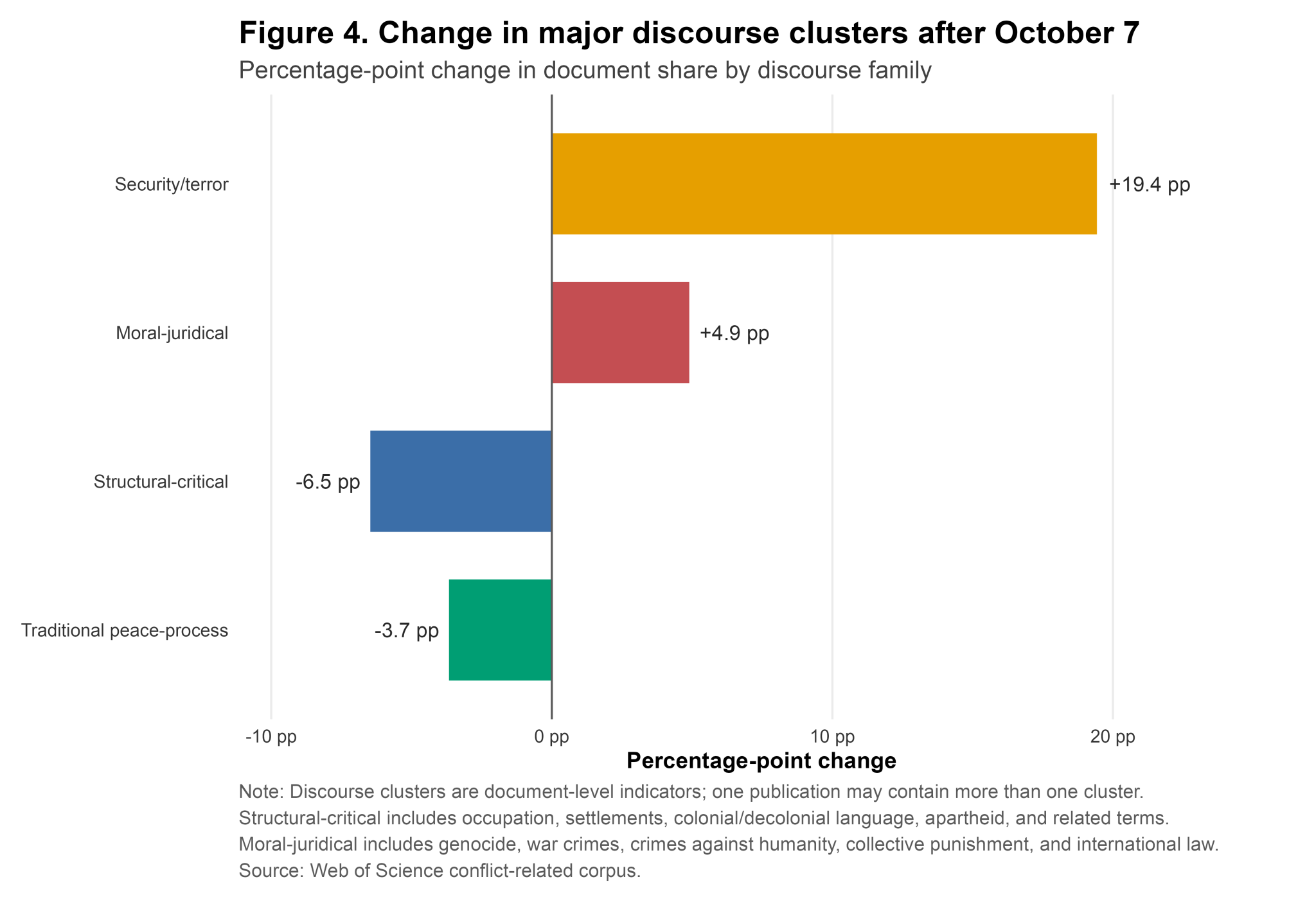
At first glance, this may seem like little more than terminology. Yet the distinction is consequential, and it is analytical rather than absolute. Occupation is not merely political. Apartheid is simultaneously a structure of rule and a legal category. Genocide itself can be studied historically, sociologically, and institutionally. These terms do not belong to separate worlds, but they do direct scholarly attention toward different questions. Occupation, settlements, sovereignty, and colonialism invite inquiry into historical and structural processes. Genocide, war crimes, crimes against humanity, and collective punishment invite inquiry into culpability, legality, and judgment.
Examining individual terms, however, tells only part of the story. Academic arguments are built by linking ideas together, and a vocabulary gains influence not only by appearing frequently but also through the concepts with which it becomes associated. The next question, therefore, is not only whether genocide gained prominence, but which vocabularies became more closely connected to it.
Figure 5 addresses this question by showing where co-occurrence with genocide rose most sharply after October 7. The result is revealing because the largest increases are not confined to legal categories. Colonial and decolonial terms, siege and blockade, apartheid, settlements, imperialism, racism, and related structural vocabularies became substantially more likely to appear alongside genocide, while legal and humanitarian concepts such as war crimes, collective punishment, and illegality moved in the same direction.
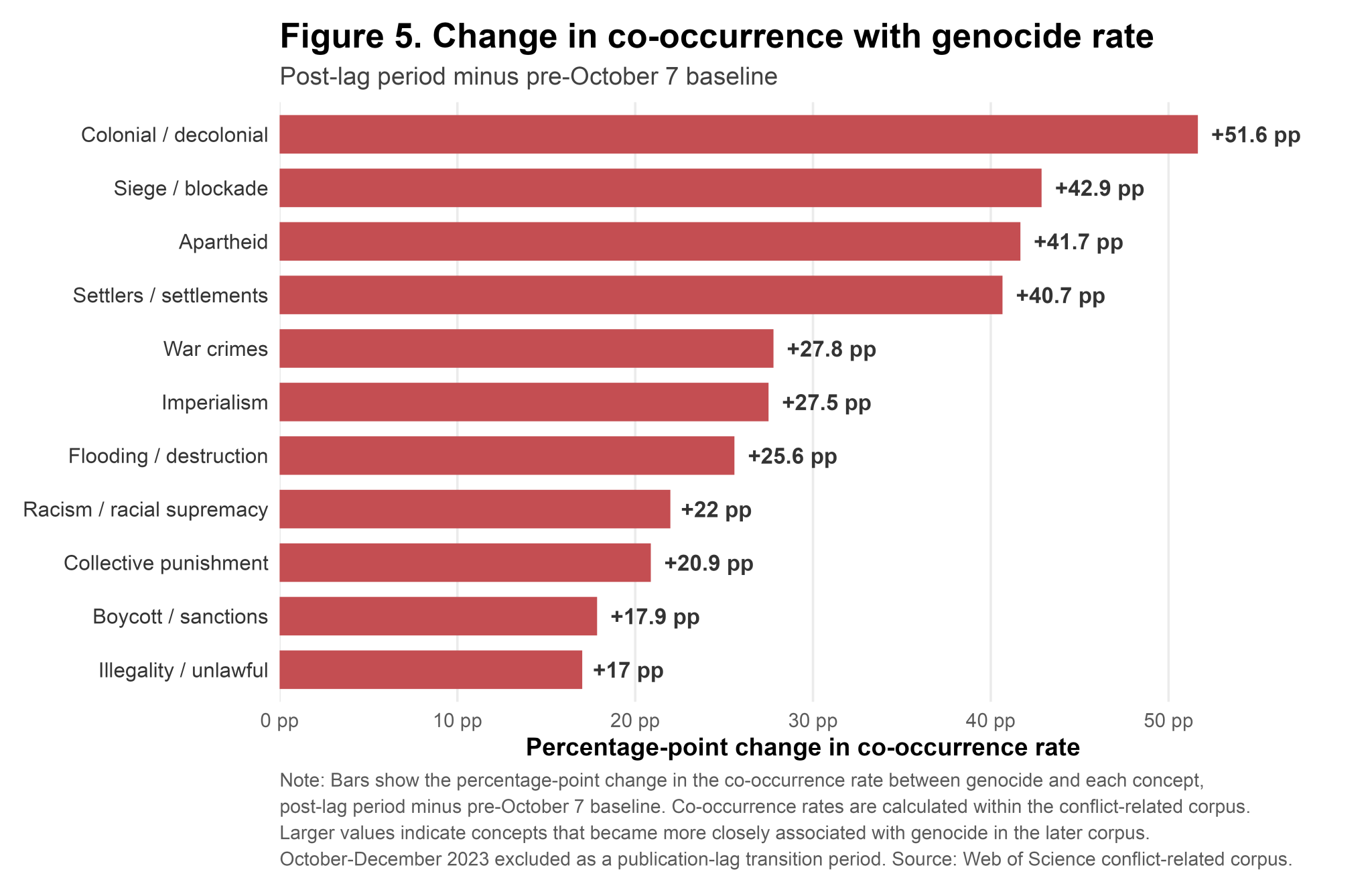
This clarifies the apparent contradiction in the earlier findings. Several structural vocabularies became less prevalent overall, yet when they appeared, they were more often tied to genocide. They did not disappear, nor were they replaced wholesale by legal terminology. Rather, they were repositioned within the conceptual field: less prominent as stand-alone frameworks, but more likely to appear within arguments centered on genocide.
What actually changed
A simpler explanation remains possible. The results may reflect the changing empirical character of the conflict itself. Scholarship focused on occupation, settlements, and territorial control may have given way to work focused on war, humanitarian crisis, and civilian suffering because those became the most salient realities after October 7. That possibility should be taken seriously. Yet it does not fully account for the evidence. If the data merely reflected active war, one would still need to explain why concepts such as colonialism, apartheid, settlements, siege, racism, and imperialism became more closely associated with genocide even as some lost prominence overall. The analysis does not identify a single cause. It does show a reorganization of the conceptual field.
That conclusion should not be overstated. Political and legal frameworks are not mutually exclusive. Wars and conflicts often involve crimes. Nor can the analysis determine whether any particular accusation is justified. It cannot decide whether genocide, apartheid, occupation, or any other concept is correct. What it can reveal is how the literature organizes itself: which concepts become more prominent, which recede, and which appear together. In that sense, the findings matter not only to those interested in Israel, but also to anyone concerned with how contemporary institutions interpret collective violence.
Beyond Israel
One possible interpretation is that the literature reflects a broader process that might be described as the juridification of conflict. Contemporary crises are increasingly interpreted through legal categories that ask whether violations occurred rather than through explanatory categories that ask how realities emerged. The present analysis cannot establish whether juridification caused the results observed here. It can only show that the Israeli case appears consistent with such a development. Whatever its cause, the finding matters because scholarly terminology does not remain inside scholarship. It travels into NGO reports, media coverage, court filings, parliamentary debates, institutional policies, and international organizations.
The concern, then, is not that judgment has no place in scholarship. Political conflicts are often moral conflicts, and they frequently involve crimes. Some would argue that judgment is inseparable from any adequate explanation of political violence, and that legal-moral frameworks enable rather than displace understanding. That argument should be taken seriously. Yet these conflicts are also historical, institutional, territorial, strategic, and social phenomena. When culpability becomes the dominant frame, questions of accountability become more visible, while questions of historical development, institutional dynamics, and political causation can recede.
The most important development after October 7 was not that Israel was accused more often. It was that Israel was increasingly discussed through the vocabulary of crime rather than the vocabulary of conflict. Whether this represents intellectual progress, intellectual narrowing, or some combination of the two is a matter of judgment. The findings presented here cannot resolve that question. What they do suggest is that a debate often presented as being about Israel may also be about something larger: how contemporary academics understand conflict itself.