
Former Jewish Prison Chaplain / Co-Founder: L’chaim
From Death Penalties to Hanging Effigies: Executions Feed the Cycle of Violence
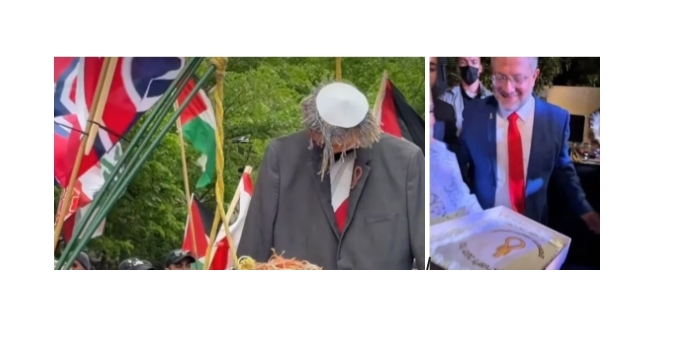
Composite Image: Left - A hanging effigy of Israel’s National Security Minister Itamar Ben Gvir - wearing his trademark noose lapel pin - at a pro-Palestine protest in Montreal on May 24, 2026. (Credit: Screenshot of an Instagram story by Montreal for Palestine/ @mtl4pal) Right - A birthday cake featuring a golden noose and guns is presented to Ben Gvir, who sports the same noose lapel at his 50th birthday party, on May 2, 2026. (Screenshot: Itamar Ben Gvir via Instagram)
The hanging effigies of Israeli National Security Minister Itamar Ben Gvir, Prime Minister Benjamin Netanyahu, and President Donald Trump on display at a recent pro-Palestinian rally in Montreal serve as the latest nauseating reminder that calling for executions only feeds the cycle of violence. In this case, as with Hamas’ recent threatening response to Israel’s new capital punishment laws, it also unmistakably fuels antisemitic fervor. The thousands of members of “L’chaim! Jews Against the Death Penalty” across Israel and the world, including this author, have been keenly aware of this reality in advocating for years to end capital punishment in the United States, Israel, Iran and globally, without exception.
To be abundantly clear: there is no excuse for anyone to regurgitate the antisemitic filth that this recent display in my Canadian country of residence demonstrates. Yet, there can also be no doubt that Israel’s passage of two laws calling for the death penalty for terrorists only ripens the environment for this insidious form of hate to take root and fester. The fact that the executed effigies of Ben Gvir and Netanyahu feature the same noose lapel pin that Ben Gvir has worn for months as he championed these death penalty laws through the Knesset underscores this point.
The lesson is simple: the call for death only fuels the urge for more killing. Once any society exposes itself to the Pandora’s Box of state-sponsored killings of prisoners, all bets on civilized humanity are off. This includes Ben Gvir’s pre-Passover celebration of death, Hamas’ reciprocal call for violence against IDF soldiers, and now this veritable danse macabre in Montreal. It is for this reason that Elie Wiesel prophetically stated of capital punishment: “Death should never be the answer in a civilized society.”
Hanging Effigies: A Violation of Human Dignity and Jewish Values
The effigies — captured in videos posted on social media — became the subject of a hate crimes investigation on Tuesday and drew widespread condemnation from both local and provincial politicians across Canada who called the effigies “unacceptable” and Jewish groups who deemed them “antisemitic.” Montreal4Palestine, the group that hosted the mobilization where the effigies were most recently filmed, denied these accusations, writing on Instagram that it “strongly condemns the defamatory accusations and deliberate distortion of events.” Montreal4Palestine added that it has spent years raising awareness in Montreal, regularly striving to “unite Montrealers of all religious backgrounds.” It held that it has “stood firmly against all forms of hate, including antisemitism,” and continued that it seeks to uphold “values of human dignity, freedom of expression and solidarity among communities.” (Italics are my own.) The group stated that the effigies in question “were directed specifically at political figures” and “at no point were [they] intended to represent Judaism, Jewish people, or any religious, ethnic, or identifiable community.”
The effigies have understandably been condemned by Israeli media and Jewish groups. Paola Samuel, B’nai Brith’s regional director for Quebec and Atlantic Canada, called the images a “shocking, blatant display of antisemitism.” The Centre for Israel and Jewish Affairs (CIJA) — which represents Jewish federations across Canada — wrote “this is not a debate about the Middle East. They added that “hanging effigies of Jews in the streets of Montreal evokes some of the darkest antisemitic imagery in history and is completely unacceptable….This is not ‘peaceful activism.’ It is the promotion of hatred and the incitement of violence that fuels the radicalization of our social climate.”
Determining the extent to which this disgusting spectacle constituted an act of antisemitism is indeed important, now more than ever in this fraught world where Jews are easy targets for such vitriol. Focusing solely on that question, however, results in the obscuring of another equally important point: the reality that any call for execution – whether by Israel or by pro-Palestinian protesters is a direct violation of the very same value of “human dignity” that Montreal4Palestine claims to uphold, and that is so central to Judaism and its inherent affirmation of and reverence for life. Israel’s death penalty laws are monstrous, by any degree of the imagination. The decision of protestors to respond with a depiction of the execution of proponents of the death penalty, like Ben Gvir, Netanyahu, and Trump, is also horrific and unacceptable.
Hamas’ Renewed Calls for Violence After Israel’s Death Penalty Laws
The shameful Montreal event is reminiscent of the fact that Hamas leadership has called for the kidnapping of IDF soldiers following the two death penalty laws for convicted terrorists that the Knesset passed since the start of the year. Tragically, and as expected, that development, like the effigies, only confirms the worst fears that opponents of Israel’s renewed execution push have articulated time and again. It is horrendous proof positive that these laws jeopardize the safety and security of Jews across the globe.
Despite the clear-cut evidence that judicial state killings would only encourage reprisal, many proponents of Israel’s execution laws have since doubled down on their pro-death stance. Various advocates of execution have responded to Hamas’ threats by stating that Israel, therefore, should hang all imprisoned terrorists. In doing so, they fail to consider how such actions would only further perpetuate the cycle of violence. A closer examination of Hamas’ recent threats unequivocally demonstrates this fact.
In the document that was released, Hamas leadership stated clearly that it is planning to intensify efforts to kidnap Israeli soldiers. The terrorist group framed these proposed kidnappings as the only effective means of securing the release of Palestinian prisoners facing state violence, according to an internal message published Monday by Israeli Public Broadcaster KAN News. The letter, circulated internally among Hamas operatives in Gaza, came after the Knesset passed the second of two laws that would impose the death penalty on convicted terrorists.
Hamas described the most recent of these death penalty laws as a “fascist law,” and urged members of the organization’s military wing to escalate and carry out “active operations.” The internal communique reportedly emphasized what Hamas described as the strategic importance of abducting Israeli soldiers, calling it “the only path” to securing the release of Palestinian prisoners facing violence by Israel. Crucially, Hamas further warned that the execution of Palestinian prisoners could trigger broader escalation with soldiers in the Gaza envelope. “Any harm to the life of a prisoner is an explosive that will lead to the eruption of a volcano,” the letter read.
These developments underscore how the upcoming debate in the Israeli Supreme Court about the legality of the “Death Penalty for Terrorists” Law (the first of Israel’s two new execution-related laws) is one of the most consequential to come before that esteemed judicial body in the twenty-first century. Its outcome impacts not only the State of Israel but Jews everywhere. If the Supreme Court fails to repeal the law – if the unconscionable stain of executions succeeds in darkening the moral fabric of Israeli society – antisemitic extremists will assuredly blame all Jews for their state’s sponsored murder program, neatly fitting it into their warped view of Israel – and, by extension, Judaism – as a so-called “Death Cult.” For such extremists, that may very well be all it takes to replace hanging effigies with hanging human beings.
If repeal at the Supreme Court level succeeds, however, then it might set a precedent for the eventual repeal of the second death penalty law that Israel subsequently passed, specifically targeting convicted terrorists who carried out the reprehensible Oct. 7, 2023, massacres across Israel. For this reason alone, amidst many others, Israeli Supreme Court justices must redeem Israel by casting a resounding “No!” in response to the first of these death penalty laws now before them. They should unconditionally repeal this law, encouraging Israel to return to the civilized, abolitionist path for which Wiesel called. Only then can Israel begin to halt the seemingly endless cycle of violence and killing, once and for all.
Cantor Michael J. Zoosman, MSM, BCC
Co-Founder: L’chaim! Jews Against the Death Penalty
Advisory Committee Member: Death Penalty Action
Note: An initial version of this article was published in the Forward on June 2, 2026.
Related Topics