From Dependence to Alliances: Israel’s Answer to Trump’s Pivot
The shameful surrender agreement signed by Trump at the Palace of Versailles (much like another failed agreement signed there nearly 100 years ago) has completely reshaped Trump’s narrative and image within Israeli society and the global Jewish community. From Israel’s savior—moving the embassy to Jerusalem, recognizing sovereignty over the Golan Heights, returning hostages, the bold leader who stood with Israel in two battles vs Iran and supported Israel even at the cost of domestic political backing—Trump has become the fearful president who turned tactical victory into strategic defeat; a Western leader who failed to understand the Middle East, who surrendered to a terrorist state precisely at the peak of its weakness, when it was economically and politically strangled.
If there is one positive outcome of Trump’s actions, it is the unification of the Israeli left and right against him. The consensus around him in Israel has perhaps never been clearer. The disappointment—and sense of insult—toward the so-called “Israel’s greatest friend,” once considered for lighting a torch on Yom Haatzmaut, for the Israel Prize, for the Presidential Medal of Honor, for IDF commendation, and for Israel’s “good governance award,” is immense, almost incomprehensible.
But there is more.
Trump’s sharp and embarrassing turn is another stone in a structure that has already been proving, time and again, that Israel’s dependence on the United States can serve both as salvation and as a liability. When Trump wants to—we can defeat Hamas in Gaza, return the hostages, devastate southern Lebanon, maintain operational control in Syria, rain fire on Iran, and reshape the Middle East. And when he does not want to, our hands are tied, the lives of northern Israelis are left exposed, and Israel is once again facing the Iranian threat.
In Israel, this American humiliation was received with deep disappointment. For many segments of the public, the United States is perceived as an almost absolute strategic partner—sometimes even the sole anchor of political and military security. When positions shift, even marginally, it is not only a specific policy that is shaken, but a deeper assumption: the sense of certainty about the nature of the alliance.
But beyond the immediate political emotion, this event raises a deeper question—not about loyalty, but about dependence.
Not Loyalty Is the Problem, but the Structure of Dependence
Public discourse tends to focus on the dynamic of “who stands with whom.” But the more important question is structural: to what extent is the relationship between Israel and the United States built on a single-point dependence, and to what extent does it allow Israel real flexibility in moments of crisis.
Israel relies on the United States across a wide range of critical areas: diplomatic backing, military aid, technological cooperation, and a broad strategic umbrella. At the same time, the United States operates within a global system in which economic, energy, and domestic political considerations directly shape foreign policy.
The problem is not the relationship itself—but its concentration.
When a single power center becomes too dominant, it inevitably creates vulnerabilities. Policy shifts, internal pressures, or broader strategic considerations can rapidly and sharply affect dependent states.
The World as a Network, Not a Hierarchy
To understand this reality, it is important to update how we think about international power.
In the past, power was defined mainly by military size or economic scale. Today, more and more scholars emphasize the concept of networks: a strong state is one positioned at key nodes of global systems—financial, technological, logistical, and diplomatic.
Research in international relations, such as the concept of “Weaponized Interdependence,” shows that states do not act only through direct power, but through control of connection points within networks. Whoever controls these nodes exerts influence even without direct military force.
The United States, for example, derives such power through the dollar, the international financial system, and control over key technological infrastructures. Other states exert influence through trade routes, energy, or strategic geography.
The Middle East also fits into this logic. Major maritime routes, especially critical energy transit zones, give certain states influence far beyond their economic or military size.
The implication is not that one state “wins” the system, but that the system itself operates under complex interdependence. In such a reality, even superpowers operate under constraints—economic, political, and strategic.
The conclusion is not a simplistic “weak versus strong” framework, but an understanding that every actor, including the United States, operates within a broad system of constraints that shapes its decisions.
What Is Israeli Power in Such an Era?
For Israel, the implication is not the need to “replace” the United States or reduce ties with it. Such a move is neither realistic nor desirable.
The real challenge is different: a shift from single-point dependence to a multi-centered network of strategic relationships.
Instead of relying on one source of support, Israel can—and is already gradually doing so—build a broader framework of cooperation with different regions and states: in the Middle East, Europe, Africa, and Asia.
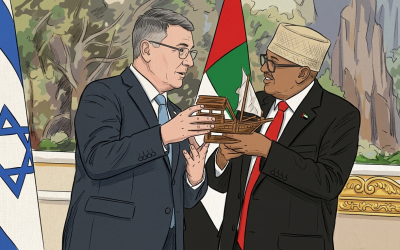
Countries such as Azerbaijan, Greece, Cyprus, several Abraham Accords states, and additional countries in Africa and Asia illustrate the potential of this model—where relations are based not only on security, but also on technology, water, agriculture, energy, and cyber.
From Consumer to Provider
The next stage in Israel’s strategic evolution is not only diversification of sources of support, but a deeper shift: moving from a consumer to a Provider.
A state does not need to be only “protected” within a network; it can become a necessary passage point within that same network.
Israel’s comparative advantages in cybersecurity, defense, water technologies, precision agriculture, and artificial intelligence allow it to become a player that other states depend on—not through coercion, but through mutual necessity.
This is a conceptual shift: no longer an attempt to balance dependence through isolation, but through the creation of broader mutual dependence.
The common mistake is to think that independence means reducing dependence. In practice, in the current global system, there is no state that is not dependent on others.
The difference between states is not whether they are dependent, but how that dependence is structured: whether it is concentrated in one place or distributed across a wide network of relationships.
When dependence is distributed—strategic flexibility increases. When it is concentrated—vulnerability increases.
Bottom Line
The central lesson from recent developments is not about the policy of any single state or leader, but about the structure of the system itself.
Israel’s power in the coming decades will not be measured only by deterrence capability, but by the degree to which it is integrated into global networks of mutual value.
Instead of trying to “replace” the United States—an unrealistic and undesirable move—the challenge is to turn the relationship with Washington into part of a broader system of connections, so that Israel is not dependent on a single axis but connected to multiple centers of power simultaneously.
The more countries see Israel as a critical strategic asset to their security, economy, or development, the greater Israel’s diplomatic freedom of action will become, and the lower the cost of disagreement with any single partner. This goal can be achieved through consistent investment in exporting water technologies, energy, agriculture, cyber, and artificial intelligence; expanding security and intelligence cooperation; promoting regional infrastructure projects; and building alliances with states located at key geographical and economic junctions.
In the 21st century, independence does not come from isolation, but from the ability to build a broad network of interests in which Israel is not merely a consumer of security and support—but a vital provider of value.