
From evasion to naming: How we forced Britain to face the IRGC
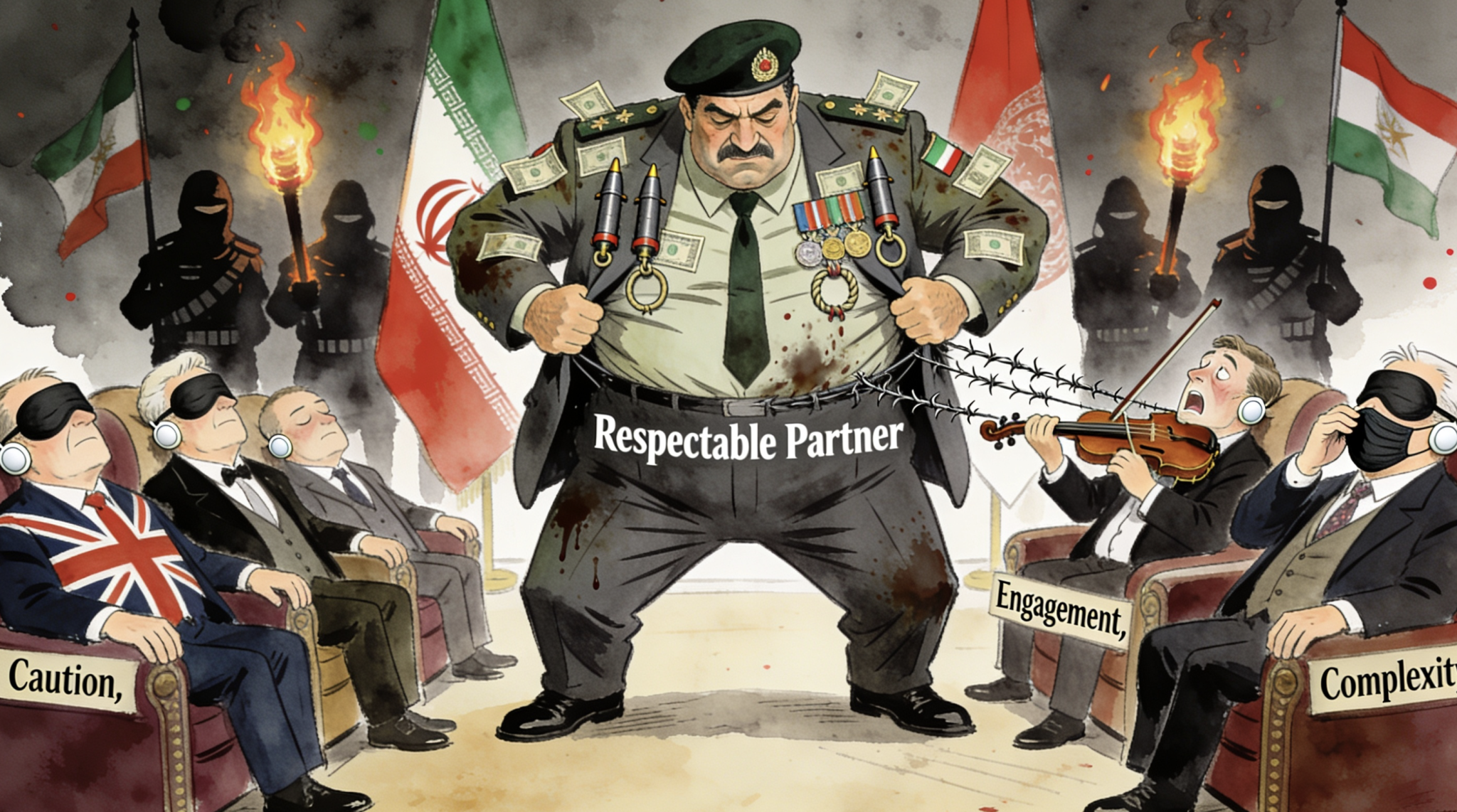
There are moments in public life when a government finally agrees to call a thing by its proper name. Sir Keir Starmer’s decision to bring the proscription of the Islamic Revolutionary Guard Corps before Parliament is one such moment – dilatory, hedged, overdue, but nonetheless significant. For once, Westminster seems prepared to admit that the IRGC is not a “complex actor” in some regional psychodrama, but the armed vanguard of a totalitarian project that has long since overflowed Iran’s borders and seeped into our own streets and institutions.
To grasp the importance of this, one must first abandon the polite fiction in which the IRGC is described as a mere branch of Iran’s armed forces. It is nothing of the kind. It is a state within a state: part praetorian guard, part expeditionary legion, part secret police, part mafia conglomerate. It strangles Iranian civil society at home and arms fanatics abroad, from Lebanon to Yemen, with a cheerfully ecumenical hatred of Jews, dissidents and democracies alike. To speak of it in the same breath as a normal army corps is like calling the Gestapo a law‑enforcement agency.
For years, Britain has indulged in precisely that sort of euphemism. Faced with mounting evidence of IRGC‑linked plots, intimidation and propaganda in the UK, ministers chose to wring their hands about “consequences” and “delicate diplomacy”. The result was a policy that managed to combine cowardice with self‑deception: we would condemn this armed clerical militia with great eloquence, yet decline to put it in the same legal category as other terrorist organisations whose sins are, frankly, minor by comparison.
It is here that We Believe in Israel – now reborn as We Believe Alliance – decided enough was enough. We did what our betters in Whitehall and King Charles Street had conspicuously failed to do: we laid out, in plain Anglo‑Saxon prose, what the IRGC is and what it does, and we placed that dossier in the hands of those whose job it is to make law rather than excuses.
The parliamentary briefing we presented with our partners was not an exercise in abstract indignation. It tracked, with depressing ease, the way in which the IRGC’s tentacles reach into Europe and the UK. It set out how this glorified death cult funds, trains and directs proxies that menace Jewish communities and Iranian dissidents on our own soil; how its “external operations” arm has regarded London not as a distant capital but as a convenient stage on which to send messages and settle scores. We did not ask our legislators to imagine a threat. We showed it to them.
To their credit – and one must take such credit where it can be found – the Lords listened. When the Upper House signalled that it was prepared to back proscription, it punctured the cosy illusion that this was a fringe demand of Zionist malcontents and security obsessives. Suddenly, the Labour leader and his colleagues could see that the grown‑ups in Parliament had understood what many in the intelligence world have been saying sotto voce for years: you cannot claim to oppose terrorism while treating the IRGC as a misunderstood regiment in need of “engagement”.
Under my leadership, We Believe Alliance has been busy stripping away the last shreds of that delusion. The change of name is not a marketing gimmick. It reflects a hard fact: that the enemies of Jewish safety and Israeli self‑determination are also the enemies of Iranians who want a normal life, of Arabs who wish to escape the suffocating embrace of Tehran’s clients, and of Europeans who labour under the quaint belief that their streets should not be arenas for foreign tyrannies. The IRGC sits at the junction of all these hatreds and ambitions. To proscribe it is not an eccentric Zionist priority; it is the minimum requirement of a state that claims to take its own security – and its own values – seriously.
Will proscription, when it finally happens, cause the mullahs to lay down their arms and take up yoga? Certainly not. It will, however, make it harder for them to raise money, to launder influence, to operate front organisations and to pretend that their chief instrument of mayhem is a respectable organ of a respectable state. It will give police and prosecutors sharper tools. It will tell the banks and charities and useful idiots who have treated IRGC‑adjacent entities as perfectly acceptable partners that the game is up.
Most importantly, it will send a signal to those who have dared to defy this clerical‑military monstrosity – Iranian women who remove their hijabs in public, Israelis and Jews who find themselves on the receiving end of its long‑distance malice, dissidents who have already buried too many friends – that Britain has, finally, looked the beast in the face and resolved to call it by its right name.
We should not flatter Sir Keir or anyone else by pretending this epiphany descended from the clouds. It is the product of years of argument and agitation by people who refused to have their intelligence insulted. We Believe Alliance has been among those voices, and we make no apology for saying so. It is our task to keep insisting that some institutions are not partners to be managed but threats to be confronted, and that the IRGC belongs emphatically in the latter category.
If Parliament now follows through – if proscription is not merely announced but enacted and enforced – it will have taken a necessary step, though not a sufficient one, in defending this country and those whom the IRGC most delights to torment. If, on the other hand, this moment is allowed to dissolve into yet another round of “consultations” and “concerns”, then Britain will have advertised once again that it prefers the narcotic of wishful thinking to the bracing draught of reality.
We Believe Alliance, for one, has had quite enough of the former.