

From Gulf Dominance to Multipolar Energy: Who Controls the Future of Oil?
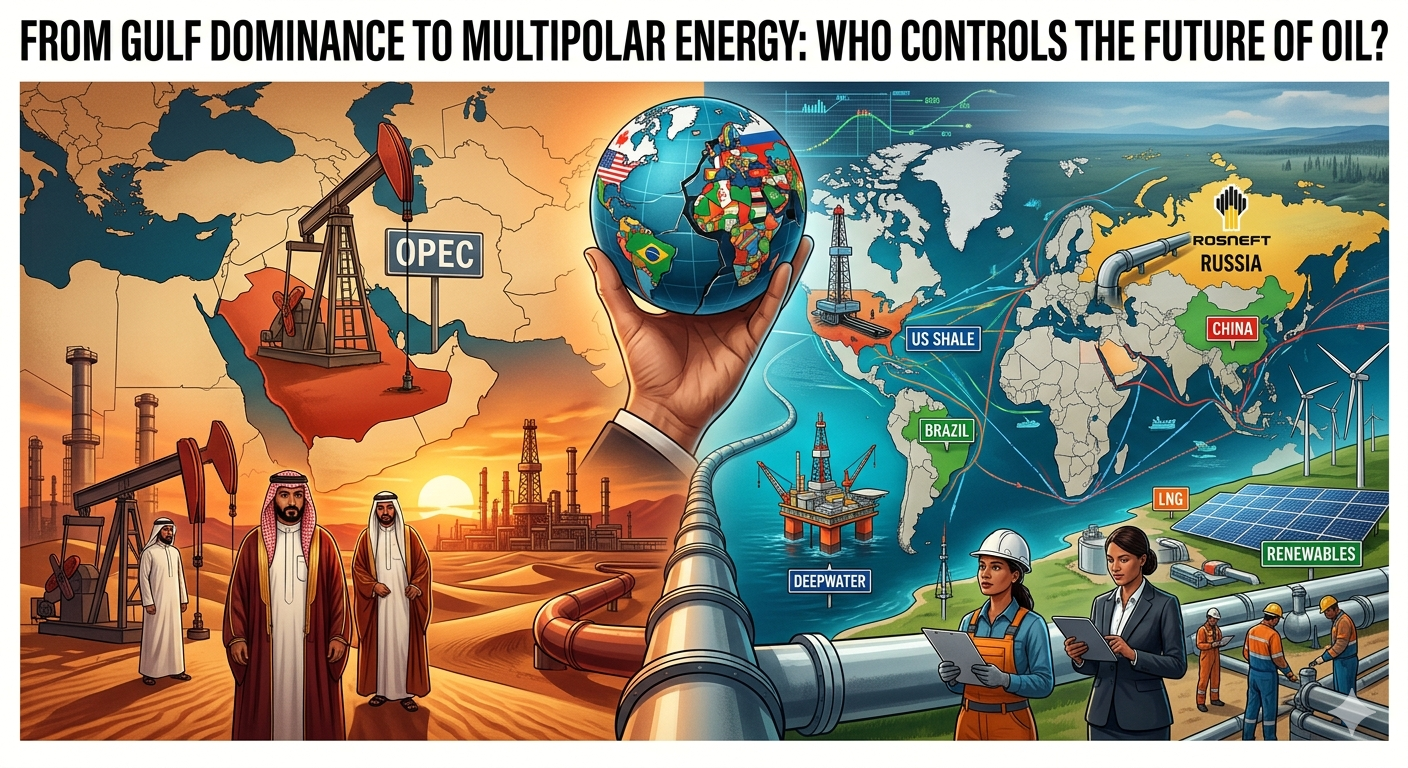
For decades, the global oil story has been shaped by a single, powerful axis: the Gulf. Countries like Saudi Arabia, the United Arab Emirates, and Kuwait have not only held vast reserves, but also mastered the art of influencing global supply and therefore global politics. Through institutions like OPEC, they turned oil into a strategic tool, shaping prices, alliances, and even conflicts.
But the world is changing. The era of singular dominance is slowly giving way to something more complex: a multipolar energy order.
Today, oil power is no longer concentrated in one region alone. New players have emerged, old players have adapted, and energy itself is evolving. Countries such as the United States, driven by the shale revolution, have transformed from major importers into leading producers. Russia continues to wield energy as a geopolitical instrument, especially in its relations with Europe and Asia. Meanwhile, African producers like Nigeria, Libya, and Algeria are increasingly relevant, not just for their reserves but for their strategic locations.
This shift is not simply about who has oil it is about who can control its flow, price, and political meaning.
The Gulf still matters a great deal. Saudi Arabia remains the world’s swing producer, capable of increasing or decreasing supply to stabilize (or disrupt) markets. Its partnership with Russia under the broader OPEC+ framework shows how old and new powers are now intertwined. This is not decline, it is adaptation.
Yet, the rise of multipolar energy introduces uncertainty. Unlike the past, where decisions could be traced back to a handful of Gulf capitals, today’s oil market is shaped by competing interests. The United States prioritizes energy independence. Russia uses energy for leverage. China—though not a major exporter controls demand as the world’s largest importer, giving China quiet but immense influence.
At the same time, global energy politics is no longer just about oil.
The transition toward renewables, climate pressures, and technological change are reshaping long-term demand. While oil will remain essential for decades, its dominance is no longer absolute. This creates a paradox: oil-producing countries must maximize profits today while preparing for a future where oil matters less.
In this emerging order, control is not defined by reserves alone. It is defined by flexibility, alliances, infrastructure, and geopolitical strategy.
So, who controls the future of oil?
No single country. No single region.
Instead, the future belongs to a network of power centers:
- The Gulf, with its reserves and spare capacity
- The United States, with its technological edge
- Russia, with its geopolitical strategy
- Emerging producers, with untapped potential
- Major consumers like China and India, with demand power
This is the essence of multipolar energy: influence is shared, contested, and constantly shifting.
For regions like the Horn of Africa, this transformation opens both risks and opportunities. Strategic geography near key shipping lanes like the Red Sea can become as valuable as oil itself. Ports, pipelines, and partnerships may define the next phase of energy geopolitics more than wells and rigs alone.
In the end, the story of oil is no longer about dominance it is about adaptation in a fragmented world. The question is not who will control oil forever, but who can navigate this new, multipolar landscape most effectively.
And in that contest, power will belong not just to those who produce energy but to those who understand it.