

From Hahams to Dayanim – family history and today
 From Hahams, Hazans, Ubercantors, Rabbis, Ministers, and Dayanim, to Knights, Generals, and Professors, my ancestors have held all of these titles across 1000+ years. Theirs are stories I’m beginning to explore in-depth and it’s become clear that themes implicit in my ancestral history have strong implications for today’s society. More widely, my family thrived and contributed to life in more than a dozen places.
Aide de Camp, David Salisbury Frank was charged with carrying the American Constitution to Benjamin Franklin in Paris so he could sign it. And Gershon Sirota, known as the Jewish Caruso, was cantor at Tłomackie Street Synagogue in Warsaw, while performing across Europe and the U.S. in places like Carnegie Hall.
But when I was growing up my grandmother’s father’s family was held above all other ancestry. The De Sola name is in every English-language Sephardi prayerbook, the family’s contribution to Judaism and the Sephardim, laced through the history of the Sephardi diaspora.
We’re poster children for migration and status as refugees. And this has made me think carefully about concepts like resilience, home, identity, nationhood and the other. I cannot ignore our persecution during the inquisition, 19th century pogroms, or the Holocaust. However, I also see a legacy of overwhelming privilege, prosperity, and indeed service to society in every country we lived in.
My grandmother Louisa De Sola was born in Canada to Rabbi Meldola De Sola, whose father, Abraham, had left Britain in 1846 to become a rabbi in Montreal. Invited to address the U.S. Congress by Ulysses S. Grant, he was the first British rabbi to do so. He was also a noted scholar writing widely on Jewish matters as well as on broader academic subjects ranging from zoology to cosmogeny to numismatics.
Abraham De Sola was sent to Montreal because his father, Hazan David Aaron De Sola, was still in position at Bevis Marks. D.A. De Sola had arrived in London in 1818, sent from Amsterdam to assist Haham Raphael Meldola. Himself from Livorno, Meldola had already instituted much change at Bevis Marks Synagogue, the oldest synagogue in Britain. This included improved relations between the Sephardi and Ashkenazi communities here, the institution of a choir at Bevis Marks, and numerous scholarly works on Jewish services and practices.
Marrying Meldola’s eldest daughter, Rica, D.A. De Sola soon began to make his own pioneering contributions. In 1831, he preached the first sermon in English at Bevis Marks (previously delivered in Spanish or Portuguese) and translated the Sephardi prayer book into English. The latter work was supported by Sir Moses Montefiore, and several artefacts given by him to D.A. De Sola will be on display at the new Bevis Marks Museum when it opens. Like his father-in-law, De Sola was passionate about music, publishing a book on ancient Jewish melodies and composing a melody for Adon Olam, still sung today. One of his younger sons, Samuel De Sola, eventually succeeded him at Bevis Marks.
So far, so straightforward. But when I started to think about writing about my ancestors, it became obvious that verifying sources was going to be a challenge. For starters, two family trees exist, both tracing the De Solas back to Spain when the family name was Ibn Daud. But one goes to the 9th century and one to the 6th.
Having spent 25+ years making historical documentaries after a previous role as an encyclopedia fact-checker, I love a historical challenge and am now in touch with genealogists as I continue to work through other sources.
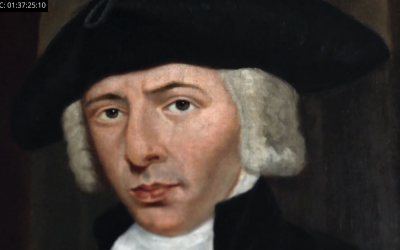
Abraham De Sola wrote a monograph about the family, which goes further back, detailing people like Benjamin De Sola, private physician to William V of Orange. I’m also interested in Isaac De Sola, who supposedly came to England from Amsterdam around 1670 as a lay preacher. Isaac is buried in the old cemetery in the East End, not too far from Abraham’s father, and I have a portrait of him, part of our collection of portraits of De Solas who lived in Britain.
Over time, I hope to dig out documents attesting to the lives and endeavors of Benjamin, Isaac, and others. Over a thousand plus years, in addition to rabbis and dayanim, we held high office under the Moorish Caliphs, practised medicine and science, and wrote famous books on philosophy and astronomy, among other things.
In the meantime, the next step on my De Sola journey will be to spend time in Spanish archives pulling out everything I can about the De Solas and Ibn Dauds. What I already know is that there are at least three streets in Spain named after the De Solas – in Toledo, Barcelona and Rojales. A Spanish road trip clearly beckons. I can think of worse things.