

From Herzl to Bibi: A Talmudic vision
In early July 1904, as Theodor Herzl lay dying in Austria, he had a strange vision. He asked God—the God in whom he never truly believed—why it had taken so many millennia to restore a Jewish state. God, answering in German, told him that the moment would come through a certain David Grün, under whom the Jewish State would finally be established.
“Master of the Universe, show him to me,” Herzl pleaded.
God replied: “Return behind you.”
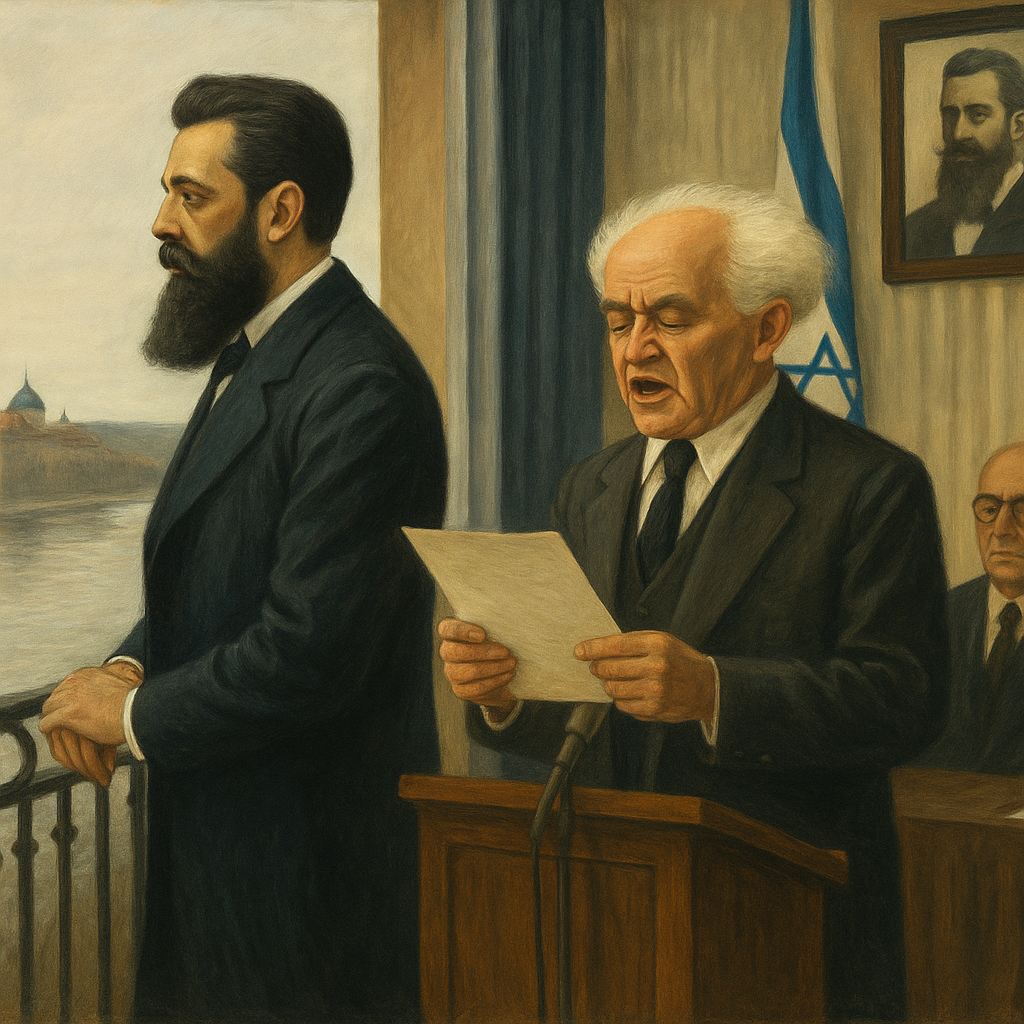
Suddenly Herzl was seated in the last of the 350 chairs arranged in Meir Dizengoff’s house. He looked around in confusion. [He was in Tel Aviv—a city not yet created before his death. The people spoke Hebrew, a language he did not know.] Finally, he saw a short man with wild hair, reading from small slips of paper. It was David Ben-Gurion, declaring independence. He spoke of kibbutzim, wars, Arab neighbors, British rule, clandestine immigration. Herzl understood none of it. This was not the state he had imagined in Altneuland.
At the close, after the Hatikvah, a reporter asked Ben-Gurion: “HaZaken—Old Man—where did you learn all this?” Ben-Gurion replied: “From Herzl, from Basel, when he said: ‘If you will it, it is no legend.’” Herzl, hearing his own words repeated, and seeing his portrait hanging behind the table, felt a measure of peace.
Yet soon another heart attack overtook him in that vision. Again he asked God: “You had such a man as this, and still you began Zionism with me?” God replied (as a good Hungarian might): “Be silent; this intention arose before Me.”
Herzl pressed again: “Show me the Zionism of David Ben-Gurion, and its reward.”
God again said: “Return behind you.”
Herzl was transported to 1973, to Sde Boker in the Negev, where Ben-Gurion lived out his last days, lonely and abandoned, his dream of repopulating the desert unfulfilled. From there Herzl was carried to 2025, to Hostages’ Square in Tel Aviv, where Binyamin Netanyahu and his colleagues governed the Jewish State. Herzl turned once more to the God in whom he did not believe: “Master of the Universe, this is Zionism and this is its reward?” And God replied: “Be silent; this intention arose before Me.”
The Talmudic Frame
You don’t need to be a great talmudist to recognize the literary frame. This midrash is modeled on one of the most famous aggadot of the Talmud, retold endlessly: the story of Moses and Rabbi Akiva (b. Menahot 29b).
Moses finds God adorning the Torah with tiny crowns (tagin). He asks why God spends time on such details. God responds that in the future a man named Akiva ben Yosef will derive endless laws from each crown. Moses asks to see him. Suddenly he is sitting at the back of Rabbi Akiva’s academy. He listens, but cannot understand a word. The Torah has evolved so much it feels like another Torah entirely. Moses despairs. But then Rabbi Akiva explains that what he is teaching is Halakha le-Moshe mi-Sinai—a teaching that goes back to Moses at Sinai. Comfort returns: he is part of the chain.
But Moses then asks what reward such a man will receive. God shows him Rabbi Akiva flayed alive by the Romans. Moses cries out: “This is Torah and this is its reward?” And God answers: “Be silent; this intention arose before Me.” It is a story of continuity and rupture, of vision and cruelty, of what it means to be part of a chain of tradition that always changes and yet remains.
Reimagining the Midrash with Zionism
For me, it is natural to retell this story with Herzl and Ben-Gurion, and even with Netanyahu. Zionism, like Torah, evolves through rupture and continuity. Since reading Altneuland, I have often imagined Herzl traveling through time to the streets of Tel Aviv in 1948. Almost nothing of what he dreamed would be there.
Instead of German, the language was Hebrew. Instead of harmony with Arabs, there was conflict. Instead of regulated capitalism, socialism. Instead of a wealthy, technological society, a poor country exporting oranges. Instead of a fully secular state, a fragile “status quo” with the ultra-Orthodox.
Like Moses in Rabbi Akiva’s academy, Herzl would have been bewildered. His strength would have failed. And yet, perhaps, seeing his portrait behind Ben-Gurion, hearing that a city had been named after him in 1924 (Herzliya), and listening to his own words—“If you will it, it is no legend”—repeated as mantra, Herzl’s spirit might have revived.
Like Moses, who wanted to know the fate of Akiva, Herzl would have wanted to know the fate of Ben-Gurion. He died young, at 44, without seeing his dream. Ben-Gurion, the man who made it real, ended in loneliness in the desert. And today, Herzl would see Netanyahu’s Israel, and ask: “Is this Zionism and is this its reward?”
The Chain of Zionism
Moses could not understand the Judaism of Rabbi Akiva. Rabbi Akiva could not understand ours. But in time the links become visible. So too with Zionism. Herzl could not understand Ben-Gurion’s Israel just 44 years after his death. Ben-Gurion could not understand Netanyahu’s Israel 52 years after his own. From Herzl the Viennese bourgeois, to Ben-Gurion the socialist-kibbutznik, to Netanyahu the liberal-nationalist militarist: three models, almost incomprehensible to one another.
And yet, just as Moses, Akiva, and today’s sages are part of one Torah, so Herzl, Ben-Gurion, and Netanyahu are part of one Zionism. Beneath rupture lies continuity. Simon Rawidowicz once called us “the ever-dying people”: every generation feels it will be the last. And yet, always, we are reborn. Each resurrection brings change, but in change there is continuity.
Today’s Israel is not the Israel imagined in Vienna in 1897. It is not the Israel of kibbutz idealists in the 1920s, nor of the pacifists of Brit Shalom, nor even the religious universalism of Rav Kook. And yet it is Israel—the real Israel, the one that bleeds and dreams, the one we love and defend, the one we critique and worry about, the one that makes us cry both in joy and in despair. Unredeemed Israel. Israel at war.
And Its Reward?
When Moses saw Rabbi Akiva’s martyrdom, he asked: “This is Torah, and this is its reward?” The divine answer was silence. Herzl would ask of Zionism today: “Is this its reward?” And the divine answer would be the same after 77 years of a State still in a state of constant war.
We cannot comprehend it all. Zionism is greater than any of us. Its past, its present, and its future are bound together in ways we do not yet see. Netanyahu will not recognize the Israel our grandchildren will know. That future Israel will be radically different from what we imagine today. But it will still be Israel. And that is the mystery, the cruelty, and the beauty of being the ever-dying people—and the ever-reborn.