


Examining Extremism, Identity, and Influence
From Hormuz to Malacca: Why India Needs Great Nicobar Now
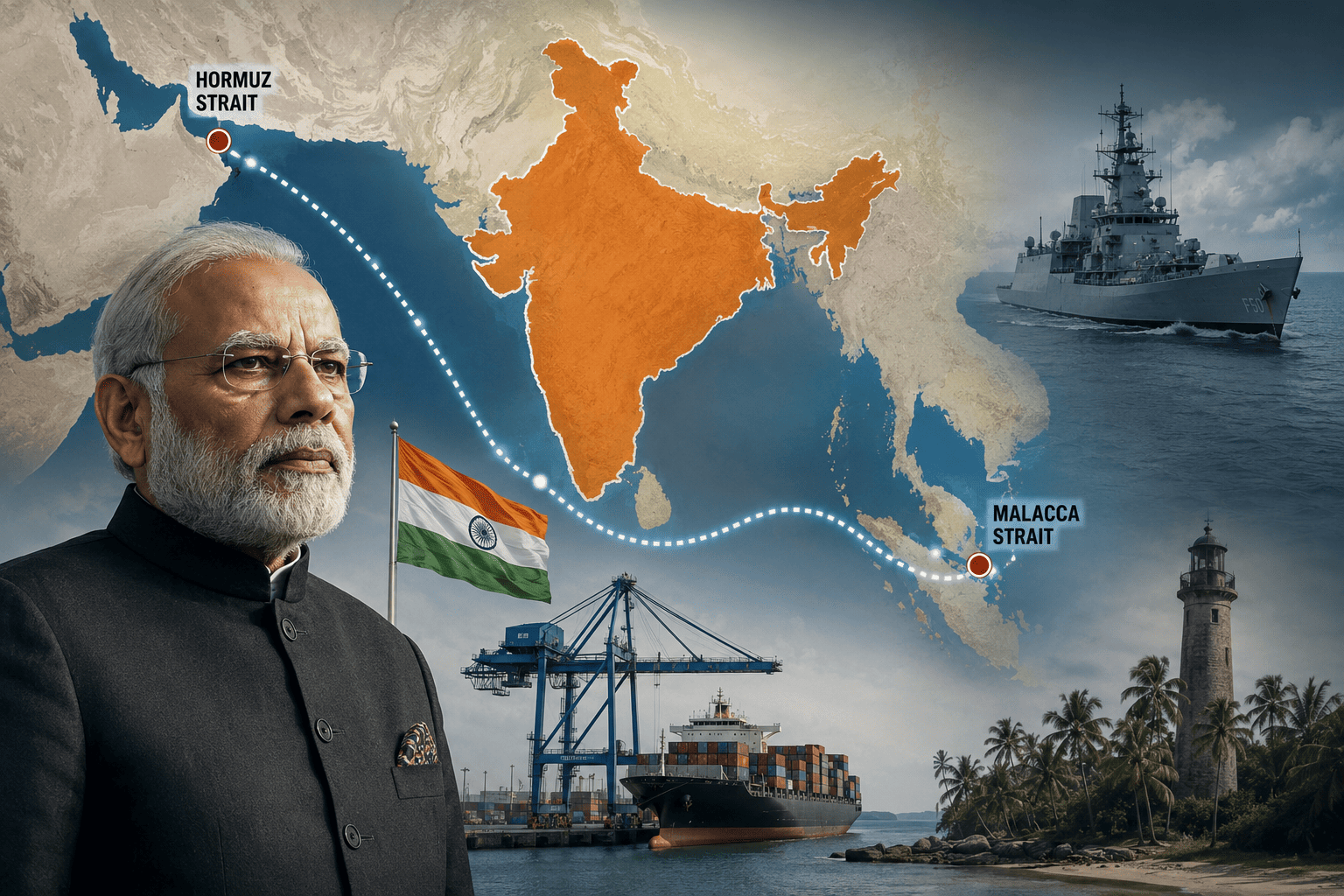
Photo illustration: Courtesy of Author
The project is about India’s role in the Indo-Pacific, its economic future, and its ability to shape its own strategic destiny.
The Great Nicobar Project has once again become a political flashpoint. Rahul Gandhi and several Congress leaders have strongly opposed it, while left-wing commentators and activists are circulating high-quality videos warning about environmental damage and risks to indigenous communities.
But this debate is unfolding at a time when the world itself is changing rapidly.
Trade routes are under stress, conflicts are disrupting supply chains, and control over key sea lanes is becoming more important than ever. This raises a larger question: can India afford to delay decisions that affect its long-term strategic position?
Beyond the politics, the Great Nicobar Project is not just another infrastructure plan. It is closely tied to how India secures its economic and strategic interests in an uncertain global environment.
A World of Vulnerable Trade Routes
Global trade depends heavily on a few narrow sea routes. When these routes are disrupted, the impact is felt worldwide. The Strait of Hormuz is a clear example.
Recent tensions between the United States and Iran in West Asia have once again shown how fragile this route can be. Moreover, Iran has repeatedly used it as a bargaining chip by threatening to block the strait.
Nearly 27 percent of the world’s seaborne oil passes through Hormuz, which is only about 21 nautical miles wide at its narrowest point. For India, which imports a large share of its energy, any disruption here can quickly affect prices and supply.
This dependence is not new, but it remains a major vulnerability.
Now compare this with the Strait of Malacca. Unlike Hormuz, Malacca lies close to India’s own maritime zone. It carries around $3.5 trillion worth of trade and handles a large portion of global shipping, including over 80 percent of China’s energy imports.
Despite this advantage, India has not fully utilized its position. Much of its cargo still passes through foreign ports like Colombo and Singapore. This means India pays other countries to handle its trade, losing both revenue and influence.
The Great Nicobar Project could become a game-changer in India’s favor.
Making Geography Work for India
The idea behind the project is simple: use India’s location to its advantage. The plan includes a deep-water transshipment port with a natural depth of over 20 meters, allowing it to handle large cargo ships.
If successful, the project could bring a significant portion of India’s trade back to Indian ports. This would reduce dependence on foreign hubs and save an estimated ₹2,000–3,500 crore in foreign exchange every year.
It would also create jobs and support new industries linked to shipping and logistics.
But the importance of Great Nicobar is not just economic. Its location—about 90 nautical miles from the Malacca Strait—gives it immense strategic value. A strong presence there would allow India to better monitor and engage with one of the world’s busiest shipping lanes.
This becomes even more important when viewed alongside China’s growing presence in the Indian Ocean through ports in places like Hambantota, Gwadar, and Kyaukpyu. In that context, strengthening India’s own position appears to be the need of the hour, not merely an ambitious idea.
The National Green Tribunal’s decision in February 2026 to uphold the project’s environmental clearance has also strengthened its case. The tribunal noted its “strategic importance” and did not find sufficient grounds to halt it.
The Political Debate
Despite this, opposition to the project continues.
Author of Land of the Wilted Rose, Anand Ranganathan, made an apt comparison. He wrote, “The Great Nicobar Island Project: China, Pakistan, and Rahul Gandhi are against it. The Indian Armed Forces, the National Green Tribunal, and Narendra Modi are for it.”
Rahul Gandhi and other Congress leaders have raised concerns about environmental damage and the impact on local tribal communities. These concerns are important. The Andaman and Nicobar Islands are ecologically sensitive, and communities like the Shompen and Nicobarese must be protected.
Development in such areas requires careful planning and strong safeguards.
At the same time, the political debate at this stage often appears opportunistic. The project is sometimes portrayed as entirely harmful, leaving little room for discussion on how it can be implemented responsibly.
Indian politics can often be strange, with major infrastructure and strategic projects turning into highly polarized issues. Instead of focusing on improving implementation and strengthening national capacity, the debate often shifts toward political point-scoring.
Finding the Balance
The real challenge is not choosing between development and conservation. It is about balancing both.
India needs to strengthen its position in global trade and reduce its dependence on external routes and infrastructure. In today’s world, where supply chains can be disrupted quickly, this is not optional—it is strategic.
At the same time, environmental protection and the rights of local communities cannot be ignored.
The success of the Great Nicobar Project will depend on how effectively these concerns are addressed. Strong environmental safeguards, transparency, and genuine engagement with local communities will be essential.
A Crucial Moment for India
The debate over Great Nicobar raises a larger question: can India take long-term strategic decisions while also managing internal concerns effectively?
Whether one supports or opposes the project, its importance cannot be denied. It is not just about one island.
The project is about India’s role in the Indo-Pacific, its economic future, and its ability to shape its own strategic destiny. That is why criticism of the project deserves careful consideration—not just strong opinions
About the Author
Zahack Tanvir, founder and editor of Milli Chronicle Media (UK), is an analyst and geopolitical commentator. He frequently appears on Indian and international media, offering insights on the Middle East, extremism, and the politics of South Asia.