
From Innovation to Control: AI’s Impact in a Nationalist Era
 A man’s drive for profit should be prompted by the desire to give charity – Rabbi Nachman of Breslov
In a world dominated by right-wing and nationalist leaders, the AI industry has the potential to reshape societies, economies, and global dynamics. While AI offers tools for innovation and efficiency, its deployment under such regimes might amplify authoritarian tendencies, economic protectionism, and social divisions.
Economic Impacts
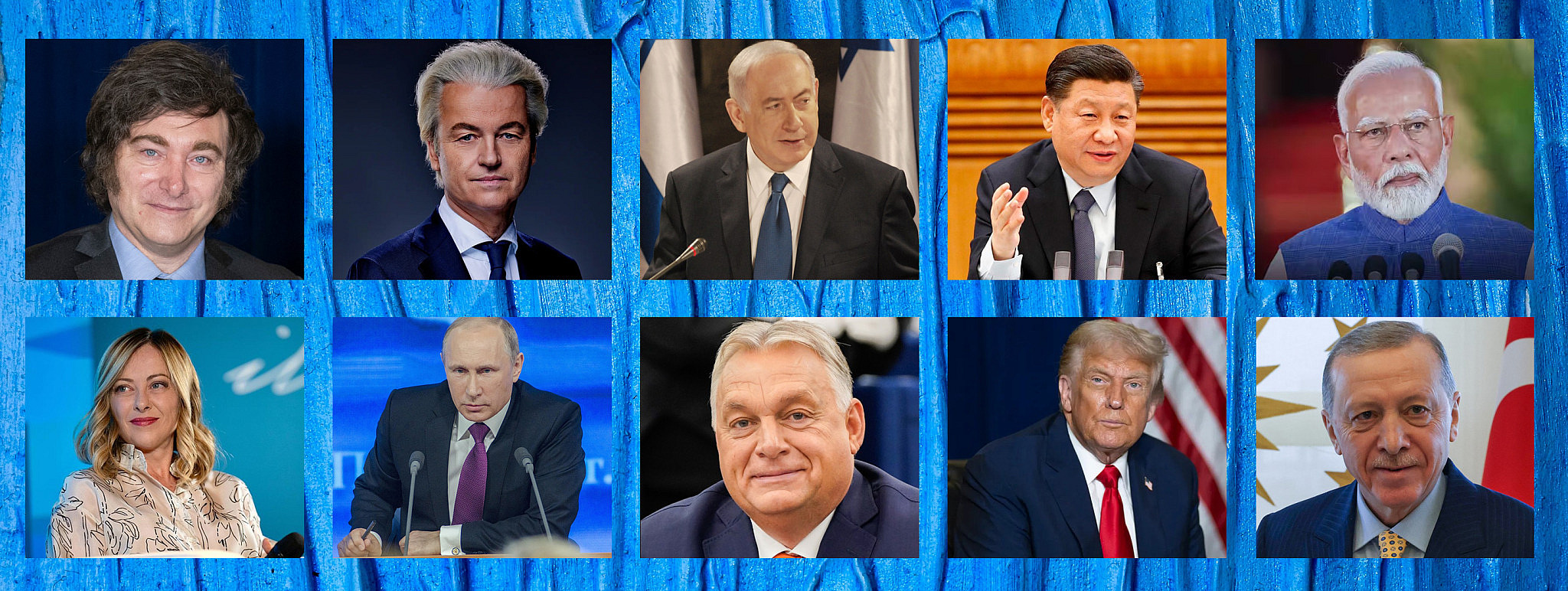
Under nationalist leaders like Xi Jinping in China, Vladimir Putin in Russia, Viktor Orbán in Hungary, Narendra Modi in India, Benjamin Netanyahu in Israel or Recep Erdogan in Turkey, countries are expected to prioritize domestic development over global collaboration.
This could manifest as heavy state investments in AI to boost industries like manufacturing, defense, and agriculture, but with protectionist barriers—such as tariffs on foreign AI tech or restrictions on data sharing—to prevent reliance on other.
- Job Displacement and Inequality: What stays critical for countries like Brazil, China, India, Russia, Turkey, and Hungary is job creation. These countries have a big chunk of global population. Jobs help ensure economic sustainability and a stable society. Let us not forget that these countries have 40% of global population. Automation driven by AI has been linked to rising support for far-right parties, as it exacerbates job losses in traditional sectors. In a nationalist-dominated world, leaders might downplay these effects, framing AI as a tool for “national rejuvenation” while implementing minimal social safety nets. This could widen wealth gaps, with AI profits concentrated among elites and corporations aligned with the regime, potentially leading to a “neo-feudal” underclass dependent on basic handouts. This in turn, might result in civil wars, rise of the far left and social unrest.
- Brain Drain and Talent Concentration: AI’s portability models can accelerate brain drain from unstable regions, as seen in developing countries like Bangladesh, India, Iran, Pakistan, Nepal, Sri Lanka, Nigeria, Somalia among others where digitization has not spurred local innovation due to governance failures and lack of reforms. Nationalist leaders in wealthier nations will attract global talent with incentives and top AI experts could flee from these developing countries, hollowing out local industries and reinforcing economic dependencies. India is one such country where poor governance, lack of social and judicial reforms and corruption in the public sector has devastated its hopes to stay consistent in the ladder to be among the top three leaders. Ten years of Manmohan Singh and another ten years of Narendra Modi have been a dismal failure to stop corruption, reform an obsolete and outdated judiciary and ensure social equality.
 Social and Political Impacts
Right-wing nationalists could harness AI to entrench power, often at the expense of civil liberties and marginalized groups.
- Surveillance and Control: AI would likely expand authoritarian tools like facial recognition, predictive policing, and digital IDs for monitoring dissent. These tools are helpful in implementing adequate safety measures and ensuring a stable government. However, misuse of such tools could harm daily business, make processes complex, and spread disinformation.
- Propaganda and Disinformation: Far-right groups as well as the far leftists are already weaponizing generative AI for deep fakes, memes, and targeted content to spread nationalist narratives, erode trust in institutions, and mobilize supporters. This impacts the ground reality, where the middle class and the poor suffer. In a politically dominated world, state-backed AI could amplify this, creating echo chambers that reinforce in-group preferences and cultural hierarchies, while suppressing progressive data. This might also make the local population lose its common sense, and promote hazardous practices, such as bursting of firecrackers during festivals, mass slaughter of animals as offerings to God and all this could lead to the downfall of that society.
- Immigration and Social Fragmentation: AI is a serious threat to countries with excess human population. USA, India and Russia will face serious challenges with respect to immigration. AI-driven automation and global connectivity will intensify migration pressures from failing states, prompting nationalists to use AI for border enforcement and profiling. This might lead to violent clashes, as declining native birth rates clash with influxes from high-population regions, eroding democratic norms in favor of strongman rule.
Geopolitical Impacts
A nationalist world would fragment AI development, turning it into a zero-sum competition.
- AI Arms Race: Leaders might accelerate AI for military and ideological purposes, as seen in China’s push for AI-powered global censorship, Russian push for AI based warfare and Israel’s push for AI based technological developments. The US and allies could counter with “Western values” encoded in models, while nationalists elsewhere fine-tune AI for propaganda, risking insidious misinformation spread via trusted AI assistants. This could undermine global stability, with less cooperation on ethical AI standards.
- Erosion of Democracy: Western elites might turn more authoritarian to compete with powers like China, investing in AI at the cost of freedom. Over time, this risks a rush toward a tech-enabled world government, but one favoring depopulation or control under nationalist pretexts, rather than equitable progress.
Overall, while AI could drive economic gains for nationalist regimes through innovation and efficiency, its impacts might lean dystopian: heightened surveillance, inequality, and conflict. Proactive policies like shared AI ownership, Universal Basic Income and other ethical regulations could mitigate this, but in a right-wing or even a left-wing dominated landscape, such measures seem unlikely without external pressures. These trends are already emerging in real-world contexts, suggesting acceleration if nationalist influence grows unchecked. AI demands a centrist leadership which is neither left nor right but a nationalist centrist force, which provides global governance, promotes sustainability and ensures that we prevent the climate crisis leading us all to the next holocene extinction and subsequently a human extinction.
Thanks to pixabay.com, geertwilders.nl, kormany.hu, casarosada.gob.ar and Wikimedia commons for these lovely royalty free images.