


Senior Research Fellow, S. Neaman Institute Technion
From Lab to Life: Apes Can Play Pretend
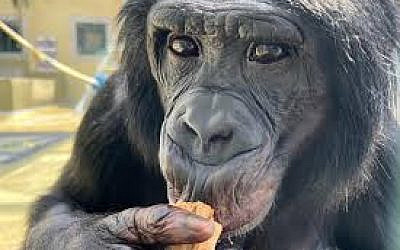
Some people believe that only humans have creative imaginations: The ability to perceive intangible things that do not exist physically, before their eyes. Children use imaginary play to develop language skills and to develop many crucial life skills. The pressure of parents on small children to engage in conventional schooling (e.g., early childhood prep schools in South Korea) may be misguided when it displaces time spent in play.
Research by Krupenye et al. at Johns Hopkins University has now shown that a bonobo named Kanzi has a strong imagination and is able to engage in imaginary play. [Bonobos (Pan paniscus) are endangered great apes and one of humans’ closest living relatives, sharing about 98.7% of our DNA. They are found only in the forests of the Democratic Republic of Congo]. The research is reported in Science Daily.
“A bonobo named Kanzi surprised scientists by successfully playing along in pretend tea party experiments, tracking imaginary juice and grapes as if they were real. He consistently pointed to the correct locations of pretend items, while still choosing real food when given the option. The results suggest that imagination may not be exclusive to humans after all.”
The researchers assert that the ability of primates to imagine, to perceive things that do not exist physically in front of their eyes, is evolutionary and dates back perhaps 6 or 7 million years – long before human beings emerged. If you can imagine things that don’t exist, you can plan, you can aspire, you can motivate yourself to attain, say, food, or a mate, even when they do not physically exist before you.
I think our two little dogs, Pixie and Lisi, have imaginations. When I take their empty food dishes down from the shelf, there is a flurry of tail wagging and ‘rondelas’ (frisky circles). They definitely imagine the food they are about to get. The more we study animals, the more we discover they have surprising cognitive skills, like ours. It should motivate us to stop using monkeys for cruel experiments, and maybe even to stop killing and eating animals. Perhaps – animals are people, too (?)
* Amalia P. M. Bastos, Christopher Krupenye. Evidence for representation of pretend objects by Kanzi, a language-trained bonobo. Science, 2026; 391 (6785): 583 DOI: 10.1126/science.adz0743