From Manisa to Manhattan –
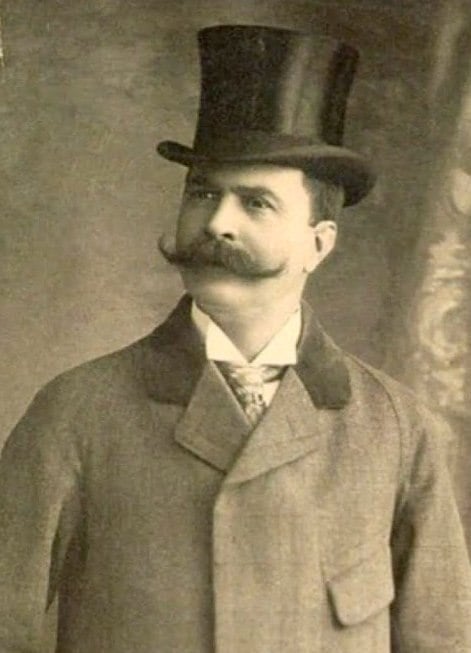
Morris Schinasi and the quiet legacy of Jewish–Muslim solidarity
Some life stories are about more than individual success. They open windows into a shared past in which coexistence was not an abstract idea, but part of everyday life. The story of Morris Schinasi is one such story. It is a narrative of migration, entrepreneurship, gratitude, and a Jewish–Muslim connection whose relevance has not faded with time.
Morris Schinasi was born in 1855 in Manisa, in the Ottoman Empire, under the name Musa Eskenazi, into a poor Sephardi Jewish family. His life took a decisive turn when, as a child, he contracted diphtheria, a disease that was often fatal in the 19th century. He survived thanks to the intervention of a Muslim doctor named Şinasi. What followed was neither a symbolic gesture nor a later mythologization, but a lifelong consequence. The family adopted the doctor’s name. Musa Eskenazi became Morris Schinasi.
This name was not a convenient pseudonym for life in the New World, but a conscious expression of gratitude. At a time when religious identity is often framed in terms of separation, this choice tells a different story. It speaks of recognition, respect, and the taken-for-granted humanity of everyday life in the Ottoman context. Anyone who claims today that Jewish–Muslim coexistence is historically fragile or inherently conflict-ridden must explain why a Jewish entrepreneur voluntarily carried a Muslim name for the rest of his life, not out of necessity, but out of conviction.
At the age of fifteen, Schinasi left his hometown. His journey took him first to Alexandria, then a major center of the Oriental tobacco trade, and eventually to New York. There he recognized the commercial potential of what Americans called “Turkish tobacco”, milder, more aromatic, and more natural than the Virginia tobacco that dominated the US market. Through the Schinasi Brothers Company, he introduced this tobacco to American consumers and positioned it as a premium, natural product long before concepts like sustainability or organic production entered marketing language.
Yet his success was never merely personal. In his factories, Schinasi employed many Sephardi Jews from Manisa and the surrounding region, providing jobs, stability, and new opportunities. Migration, in his case, did not mean uprooting, but collective advancement. Origin was not something to be shed, but something to be carried forward.
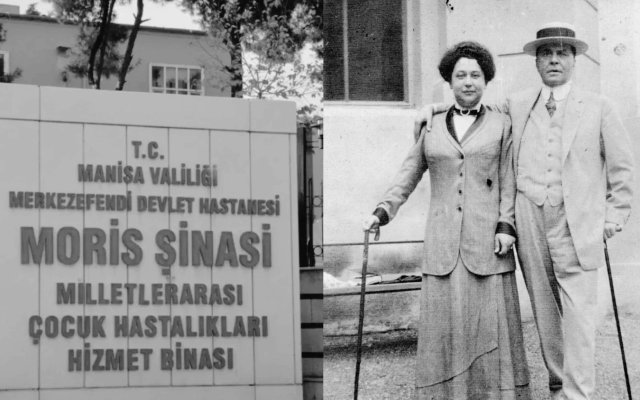
This attitude became most visible in his will. Morris Schinasi did not invest his fortune in a monument to himself, nor in an exclusive Jewish prestige project. Instead, he stipulated the construction of a modern children’s hospital in his birthplace of Manisa, a predominantly Muslim city. Opened in 1933, the Morris Schinasi International Children’s Hospital treated children for decades regardless of religion, background, or social status. A Jewish philanthropist from New York created a life-saving institution in Anatolia without conditions or religious labeling, guided by a universal understanding of humanity.
In 2018, the hospital was closed by the Turkish state, and the building has since been used for other purposes. At the same time, civil society initiatives continue to work to preserve Morris Schinasi’s legacy and to explore possibilities for reopening the institution or restoring a medical and social use in line with its original philanthropic mission.
When Jewish–Muslim dialogue is discussed today, it often takes the form of panels, conferences, and carefully worded statements. Schinasi’s life points to another dimension. It shows dialogue that is not spoken, but lived. A Muslim doctor saves a Jewish child. A Jewish man carries that doctor’s name until his death. A migrant invests his success in the future of children in his homeland. This is not symbolic dialogue. It is lived solidarity.
At a time of growing polarization, Morris Schinasi’s biography offers a quiet but firm counter-narrative. It reminds us that Jewish–Muslim relations have not only been shaped by conflict, but also by trust, mutual assistance, and shared responsibility. Perhaps what we need today is fewer grand declarations and more stories like this.
Morris Schinasi did not establish dialogue programs.
He left behind something more enduring: an example.