


From Military Discourse to Security Through State Craft
On October 7th, Israeli society was significantly altered in light of the unprecedented trauma. As a direct result, the Israeli political system, which has never excelled in developed civil discourse, also pushed aside the little that was left to the margins, as military discourse became almost monopolistic, including in the Israeli political center.
The right wing is appropriating the security discourse, despite the clear conclusions from the October 7th failure that their failed policy of avoiding diplomacy exploded in our face, and that a distorted perception of “Hamas is an asset,” along with the military and intelligence failure rooted in that same policy, resulted in our sophisticated army being unable to provide security. The “full-right” government talks a lot about security but does not provide it.
The leadership of the centrist parties is also huddled around the military tribal campfire, afraid to talk about a political solution, lest it diminish the perception of “security above all else” that it seeks to project to the public. Thus, Israeli discourse is becoming increasingly monotonous, 50 shades of olive green, with every argument thrown into the air immediately dressed in metaphorical uniforms, lest it not “resonate” with the Israeli public.
The Israeli center-left has been blessed with outstanding leaders who came from the ranks of the military – Yair Golan, Nimrod Sheffer, Gadi Eisenkot, and Noam Tibon – all brave officers who have become, or are on their way to becoming, political leaders. Precisely because they came from the ranks of the military, they understand the need to broaden the security discourse. They understand, perhaps more than others, that there is no security without a political strategy. They know that military power alone can never provide complete security.
It was Major General (Res.) Nimrod Sheffer who rightly said that an essential component is missing from the Israeli security concept. The concept formulated by Ben-Gurion, which includes deterrence, warning, and decisive victory, and the Meridor Committee, which added defense, missed the most significant component: political arrangements. For many decades, the political agreements with Egypt and Jordan have proven daily that they provide Israel with much more security than wars against them.
The security scaremongering has always been Netanyahu’s political insurance policy. Every time he felt his support was wavering, he would initiate another scare, another terrifying speech, about the “Iranian nuclear program” and the ring of threats around us. So focused was he on intimidation that he neglected security, and as a result, the most terrible event in the country’s history occurred on October 7th on his watch, and on his watch, Iran became a nuclear threshold state.
Netanyahu is the exact opposite of “Mr. Security.” His and his ministers’ deliberate and systematic dismantling of Israeli cohesion is a security blow to one of the most significant assets for the country’s security. The ongoing delegitimization of Israel among European countries, which harms national security and resilience, is a direct result of the policy he is responsible for.
Despite the military achievements, the war has not ended in a settlement in any arena and threatens to reignite sooner or later. Israel’s strategic position depends entirely on one person named Donald Trump. This is the opposite of confidence – it is the weakening of Israel by those who have the exaltation of security on their lips.
Right-wing governments led by Netanyahu have brought us to a reality that is bleeding from both outside and inside – not just the October 7 massacre, but also increasing crime in Arab society and beyond, which is growing due to the government’s deliberate neglect and lack of care.
The insecurity is also reflected in more and more deaths and injuries on the roads, in women murdered by domestic violence, in street violence, and more. Despite having a strong military and the world’s most advanced defense systems, Israeli citizens have never felt as insecure as they do today.
The rampant, unanswered Jewish terrorism is not only a matter that harms Palestinians on a human level but also leads to a security crisis in the West Bank and a growing global understanding that Israel is not fulfilling its obligations, which is another crisis that will blow up in our faces.
But in order for this message to sink in with citizens, it’s important that all center-left leaders, regardless of their military rank, work to expand the discourse, and within that framework, reiterate and clarify to the confused and exhausted citizens of the country that not only have Netanyahu and his people brought external insecurity upon the country, but they are also eroding internal security.
Political discourse should address the need for security in its broadest sense, security that is granted to everyone and not just Jews. Such a conversation, which conveys care and responsibility for the personal insecurity of a fifth of the country’s population, must be central to the security and political discourse that is so necessary here. This is also the way to strengthen the ability of Arab citizens of Israel to feel part of the Israeli society, and its purpose is also to clarify to moderate Palestinians that they are not the enemy, but a potential partner on the path to agreements that will guarantee true security here.
Most senior-ranking retirees from the military, Mossad, and Shin Bet understand this. For example, this is evident from the statements of “Commanders for the Security of Israel,” which explain why political action to promote regional arrangements that include a demilitarized Palestinian state would contribute more to the security of the State of Israel than the right-wing’s isolationist policy, in addition to the fact that this is the way to save Israel’s soul and identity as the national democratic home of the Jewish people.
The political alternative to the current government must, therefore, change the discourse and clarify that the answer to our security challenges is not on the right, not with Bibi, and certainly not with his corrupt, messianic, or draft-dodging partners.
The answer lies in political Zionism, which, alongside a strong army, aims – and practically works toward – completing the military process with political agreements with our neighbors, primarily the Palestinians.
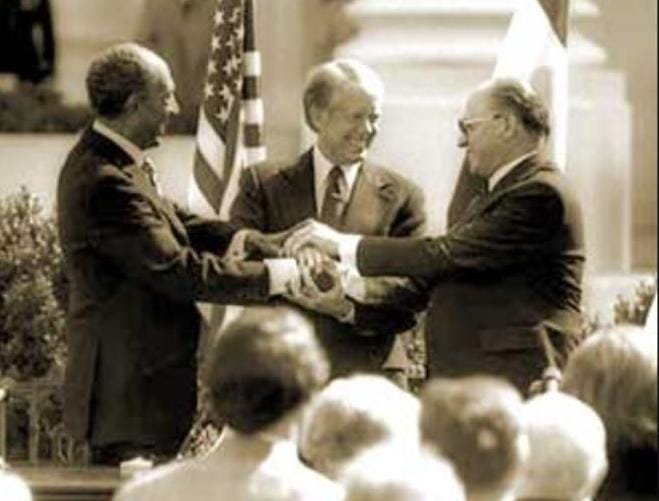
This policy characterized both the governments of the Zionist left and Begin’s government after he sobered up from his “no compromise” statements and signed the agreement with Egypt – the largest and most powerful Arab country in the world.
The entire public must understand that the “Iron Wall” of Jabotinsky and Ben Gurion cannot be only military but also, and primarily, statecraft and diplomacy.