
From Morocco to the Amazon: The Extraordinary Journey of Moroccan Jews in Brazil
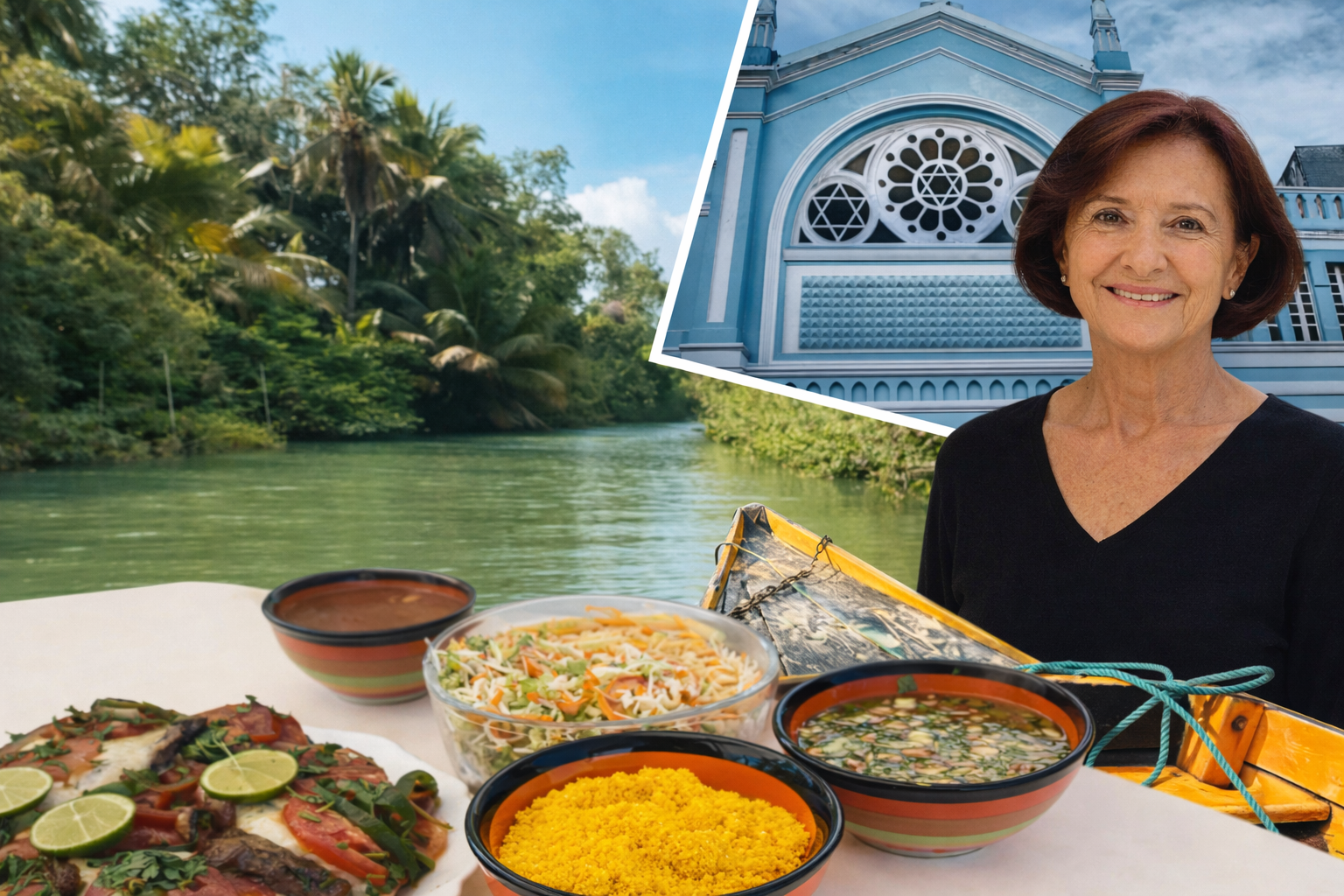
I invited journalist Celia Bensadon to share with us a remarkable chapter of Jewish culture in Northern Brazil. Through her words, we are guided into a narrative that feels like a balm—revealing how centuries-old traditions took root and became part of Brazilian identity.
As the daughter and granddaughter of Moroccan Jews who emigrated from Tangier at the end of the 19th century, Celia offers not only history but living testimony. Her account is a bridge between memory and legacy, showing how courage, adaptation, and hope continue to shape the cultural fabric of the Amazon and beyond.
When Jewish immigration to Brazil is mentioned, many immediately think of the large urban centers in the South and Southeast. Few know, however, that one of the most fascinating chapters of the Jewish diaspora in the country began thousands of kilometers away, along the banks of the Amazon rivers.
It was in the early 19th century that the first Moroccan Jews arrived in the Brazilian Amazon. Coming mainly from cities such as Tangier, Tetouan, and Casablanca, they brought with them far more than merchandise: they carried centuries of history, a rich religious and cultural tradition, and above all, the hope of starting anew.
Descendants of Sephardic Jews expelled from the Iberian Peninsula—especially from Spain during the Inquisition in the late 15th century and later settled in North Africa—these families fled persecution and political instability in Morocco. Their destination was a distant, lush, and virtually unknown land: the Amazon.
A New Life by the Rivers
Records show that Jewish families were already living in Pará and Amazonas around 1810. By 1826, Belém had designated spaces for Jewish prayers. Although formal synagogues were not yet permitted—the Imperial Constitution prohibited the construction of public temples for non-Catholic religions—homes converted into places of worship became centers of community life and identity preservation.
The great wave of immigration came in the 1870s, driven by the rubber boom. The wealth generated by latex transformed the Amazon into a hub of opportunity, attracting families from around the world, including hundreds of Moroccan Jews.
Many became known as regatões—river traders who traveled with fabrics, food, tools, and other goods to remote riverside communities. In exchange, they acquired regional products, weaving an extensive trade network that helped economically integrate the region. More than merchants, these immigrants became key players in the Amazon’s economic and social development.
Communities That Flourished
Belém and Manaus became the main centers of Jewish life in the Amazon. By the late 19th century, the first official synagogues were established, along with one of Brazil’s oldest Jewish cemeteries—lasting testaments to the consolidation of these communities.
Even when the rubber cycle declined, bringing deep economic changes, the Jews remained. They adapted without abandoning their identity, preserving religious traditions, festivals, family customs, and values that endure to this day. Over the decades, they integrated fully into Amazonian society, contributing to education, commerce, culture, and community life—always balancing the preservation of their roots with the building of a new Brazilian story.
A Fusion of Aromas and Flavors
Few aspects reveal this cultural encounter as vividly as cuisine.
Jewish-Moroccan cooking arrived in the Amazon infused with cinnamon, saffron, cumin, ginger, and other North African spices. Meeting the abundance of Amazonian ingredients and a culinary culture equally rich in colors and flavors, a unique fusion was born.
Traditional recipes such as Moroccan couscous and adafina—a stew of meat, chickpeas, and spices traditionally served before and after Shabbat—were reinterpreted with local ingredients while retaining their essence. Women played a crucial role in preserving these recipes, passing them down as treasured family heritage. This culinary legacy even inspired the publication of a book dedicated to Jewish-Moroccan Amazonian cuisine, blending recipes, memories, and family histories.
More than food, these dishes tell stories of belonging. Preserving childhood flavors is, after all, a way of preserving identity itself.
Memory That Endures
Jewish presence was not limited to the Amazonian capitals. Several interior towns also welcomed Moroccan families who left lasting marks on local history. Óbidos, in western Pará, is one of the most emblematic examples. There, Jewish families built trade networks, participated in the economy, and lived harmoniously with the local population.
This history is reconstructed in the book Jews in Óbidos, in the Amazon: Immigration, History, and Re-signification, the result of five years of research. The work shows how these families preserved their religious identity while adapting to Amazonian reality—demonstrating that tradition and integration walked hand in hand.
A Legacy for Brazil
To know the history of Moroccan Jewish immigration is to deepen our understanding of Brazil’s formation.
The immigrants who arrived in the Amazon in the 19th century brought values that remain alive today: appreciation for education, community solidarity, preservation of memory, entrepreneurial spirit, and respect for tradition. Their legacy endures in century-old synagogues, historic cemeteries, community institutions, books, recipes passed down through generations, and family stories that helped build cities and strengthen the Amazonian economy.
More than two hundred years after the arrival of the first immigrants, Jewish presence remains part of the identity of Northern Brazil—a story of courage, adaptation, and hope that deserves a prominent place in national memory. Revisiting this journey reveals that the Amazon was not merely a destination for those seeking a new beginning. It became a home where millennia-old traditions encountered new landscapes, new flavors, and new possibilities—enriching local culture and forever reshaping Brazil’s cultural mosaic.
Source: Celia Bensadon – journalist, daughter and granddaughter of Moroccan Jews who emigrated from Tangier in the late 19th century.