
Won't Be Silent
From Moscow to Manhattan
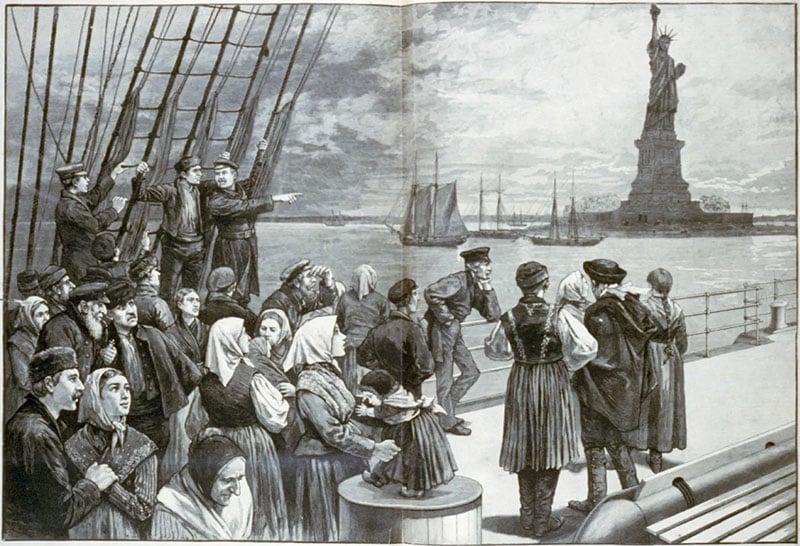
Image Credit: Wikimedia Commons / Library of Congress (https://commons.wikimedia.org/wiki/File:Welcome_to_the_land_of_freedom.png)
How Secure Do We Have to Feel Before the Unimaginable Becomes Possible?
How many more friends must I lose before the inevitable becomes reality?
I used to ask this during the AIDS crisis, when people were disappearing from our lives to a disease that sinister, that insidious.
Now I’m losing friends again — and so are most Jewish people I know — not to any illness, but to an ideology that doesn’t support my freedom to be a Zionist. Their views on my views are born of Qatar’s bankroll: huge sums thrown at American universities, Fashion Trust Arabia, and the film industry. People go where the money is. I get it, but I don’t respect it. Mostly, it makes me sad — because I’ve lost my closest, longest friendships over something they could never understand. The depth of my heritage sits right at my surface; they are generations removed from any persecution of their own.
Not all of them are antisemites. Some of them are even Jews, just radicalized beyond recognition.
And my life will never be the same.
Nobody threw me out of the “safe spaces” of the propagandized — no big scenes, no emotional pronouncements. I just stopped being welcome, and honestly? Relieved. It saves everyone the trouble of pretending. I used to be a fat kid; anything resembling the elephant in the room brings back sad memories.
Who needs a crystal ball when seeing is believing? You’d have to be blind not to see which way things are going. Jewish people tucking their stars of David inside their shirts. Arguments about Israel that don’t stay arguments for long. Friends unfollowing friends. Newspapers parsing language with surgical precision while the temperature rises outside the page — a reminder of how feckless legacy media is, and how it keeps proving itself no friend of the Jews.
So, here’s the question I can’t shake: How secure does a Jewish community have to feel before the unimaginable becomes possible?
Every Jewish community eventually believes it has reached permanence. Spain believed it — a thousand years on the peninsula, then four months to convert or leave. Germany believed it — iron crosses still on the wall when the knock came.
And the Soviet Union — the one that haunts me most — didn’t even run on old-fashioned Jew-hatred. It ran on hope. Communism promised the end of discrimination, a world where nobody would be judged by what they were born. Jews signed up, because everything they’d ever been born into came with a target on it. Then the new labels showed up: Zionist. Cosmopolitan. Rootless. Disloyal. The crackdown on “rootless cosmopolitans” never officially said the word Jew. It didn’t have to. Everyone knew. One August night in 1952, thirteen Jewish poets and writers were shot. The lesson isn’t that communism was uniquely evil. It’s that when a country needs somebody to blame, it doesn’t shop for a new address — it goes to the old one.
Which brings me to New York Times columnist Masha Gessen, who argues that antisemitism and anti-Zionism shouldn’t be lumped together — those careful distinctions matter, especially when politics runs hot. It’s a serious argument. It’s also spectacularly unhelpful for those of us who aren’t woke, far-left Democratic Socialists.
But then Gessen applied the theory to Boulder. A man firebombed a march for Israeli hostages — fifteen people burned, an 82-year-old woman dead — and Gessen suggested that violence that looks antisemitic might be “something else.” Something political. He was screaming about Zionists while he threw the Molotovs. This is where careful distinctions stop being a theory and start being a danger to every Jew in the diaspora.
But Moscow already ran this experiment. “Anti-Zionist” was the official vocabulary there too — precise, political, never technically about Jews — right up until Jewish poets were shot and Jewish doctors were arrested. Beware the language parsers. They are not to be trusted.
So, I’m not being a hysteric when I ask: is Manhattan’s future going to resemble Moscow’s past?
That’s the problem with the parsing. When Jews are targeted at anything connected to Israel, the outcome does not arrive with footnotes. We spend enormous energy debating what something is. The real question is what it does. And for the Jews on the receiving end, the distinction between antisemitism and anti-Zionism is a luxury enjoyed by people who are not the target — rather, people dissecting words from behind their desks and iPhones.
But history doesn’t only warn through repetition. It warns through the slow shift from “this is unimaginable” to “what are we even talking about.” Disbelief should be a warning sign to get your papers in order. And lately, the conversations in my many WhatsApp groups are getting four-alarm fiery.
My predictions have an annoying habit of coming true. This is the one time in my life I am begging to be wrong.
Every Jewish generation believes it has finally become the exception. Sometimes it’s right. Sometimes it’s not. The difference is rarely visible in advance. And at this point, the opera ain’t over — but we should all be taking singing lessons.
Happy July 4th – May the Fourth Be With You!
If you haven’t read or listened to my book, please do. Click here.

Related Topics
Related Posts