

From Naschmarkt to Shuk HaCarmel
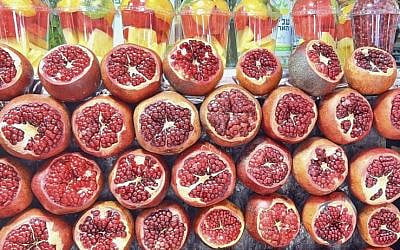
It was the display of the pomegranates that left me breathless. Row upon row of them was stacked with meticulous care, but the reason I stopped and stared was because every single one had been sliced in half. Hundreds of seeds, called arils, seemed to burst from their shells in three-dimensional splendor, as if they were calling to me:
“I am packed to the brim. Let me out of here!”
The arils were the color of deep rubies, reminding me of my mother’s precious gemstone that once fell from its setting onto the streets of Vienna when she was a young mother.
I gazed at those edible, glistening jewels for what must have been two or three minutes before I realized that my husband had disappeared.
On a Friday morning, the market is packed with shoppers, and I knew I would not spot Raphy so easily.
I reluctantly tore myself away from those sweet, holy fruits, the very ones we bless on Rosh Hashanah with the wish that our merits may be as numerous as their seeds, and continued squeezing my way through the throng of people.
Some of the merchants shouted the prices of their produce to passing customers, just as the vendors in Vienna’s Naschmarkt did when I was growing up in my hometown.
As a child, I often accompanied my late father to that ancient open-air market. Papa loved shopping there. It was a feast for his eyes, and he delighted in admiring Hashem’s colorful creations: every fruit, every vegetable, every fragrant herb displayed before him.
I believe he passed that love on to me.
Before I knew it, I found myself unable to move away from a stall displaying mountains of plump cherries. They were stacked nearly a meter high, glistening in the morning sun.
“Take one. Taste them,” the young merchant urged as he placed a handful into my palm.
I did as I was told, and the sweet juice burst into my mouth.
“They’re delicious,” I said truthfully, filling a bag with the beautiful fruit.
Every fruit has its own unique bracha, and somehow that fact becomes so much more meaningful while walking through an open market. The brilliant colors beneath a cloudless blue sky, the warmth of the sunshine, the fragrance of fresh herbs and ripe fruit, all of it makes one far more aware of Hashem’s magnificent creation than strolling through the aisles of a closed supermarket.
It is, in many ways, a small Gan Eden.
As I wandered through Shuk HaCarmel, I realized that although thousands of miles separate it from Vienna’s Naschmarkt, the two markets are forever intertwined in my heart. One belongs to my childhood, where I walked beside my father as he admired Hashem’s bounty. The other belongs to my life in Israel, where I continue to marvel at that same abundance in our ancestral homeland.
Perhaps that is how memories endure. They travel with us, waiting to be awakened by the ruby seeds of a pomegranate, the sweetness of a cherry, or the familiar voices of merchants calling out their wares. In that moment, the distance between Vienna and Israel disappears, and my father is once again walking beside me.