
Russian-American-Israeli Palestinian. Palestine is Israel.
From Neutrality to Bias: Wikipedia’s Quiet War on Israel
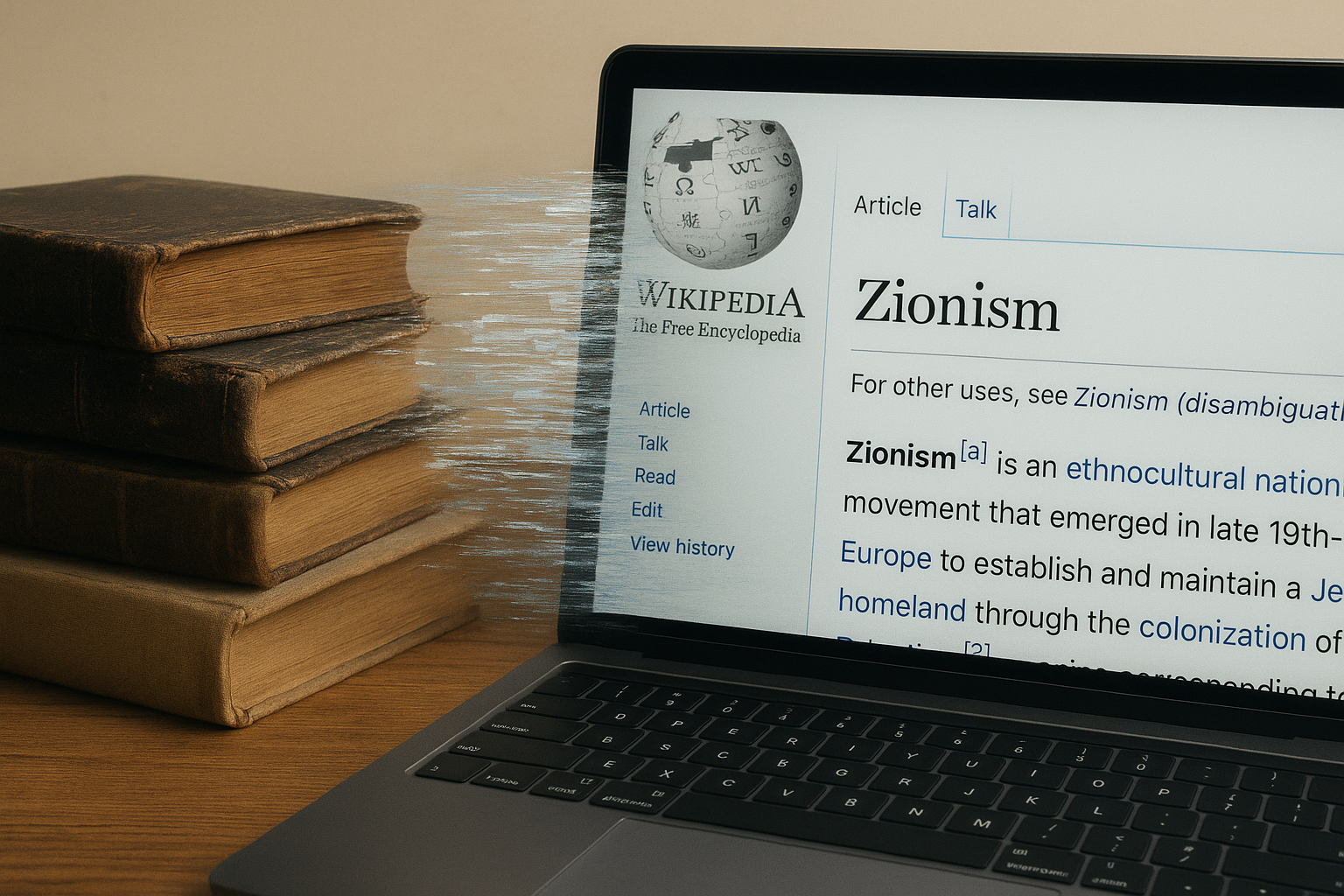
Books versus bytes: History preserved in records versus history falsified on Wikipedia—where edits don’t just distort the past, but fabricate reality. Image © Ivan Bassov, 2025. Licensed under CC BY 4.0.
How a Collaborative Encyclopedia Rewards Persistence Over Truth
Wikipedia was once hailed as humanity’s great neutral encyclopedia — a collaborative archive of knowledge, open to all, curated by many, corrected by all. But on battleground topics, “open to all” has quietly morphed into “dominated by the most organized and persistent.” And on Israel-related pages, that dominance has tilted toward an entrenched Ziophobic editorial bloc.
Observers have called it out: “Wikipedia is erasing the Jewish story,” warns Hadara Ishak; public figures like Hillel Fuld flagged the creep of antisemitism, noting it “feels like it’s getting very close to being institutionalized.” Jewish educators have tracked systematic efforts to recode pages on Zionism, Jewish presence in the Land of Israel, and contemporary conflicts. Many readers sense it without needing footnotes: the tone has shifted.
This isn’t necessarily conspiracy, but it functions as bureaucracy masquerading as consensus. Wikipedia’s rules reward those with more time, larger numbers, and the stamina to grind through endless “talk page” debates until their version becomes the “stable” one. It’s a war of endurance, not evidence — and zealotry outlasts balance.
The Slow Erosion of Balance
Search any sensitive Israel-related topic — “Gaza war,” “Palestinian identity,” “Zionism” — and you’ll often find narratives crafted less to reflect the complexity of facts and more to normalize a particular ideological framing.
Terms get shifted subtly over time: “terrorist” becomes “militant” becomes “fighter.” Historical context gets trimmed down in the name of “brevity,” while paragraphs of speculation or selective framing remain untouched because they’re “well-sourced” — even if the sources themselves are partisan opinion pieces.
It’s death by a thousand edits. Each change, viewed in isolation, seems trivial; together, they reframe the subject entirely. By the time most readers notice it, the baseline narrative has been replaced, and anyone trying to restore balance faces the procedural brick wall of consensus — which in practice means “the version preferred by the majority of active editors.”
Moreover, Wikipedia now hosts cynical inventions like “Gaza genocide” and “The Holocaust and the Nakba” — entries not built to inform but to launder propaganda into “history” and weaponize the encyclopedia itself.
Rewriting the Past: The “Palestinian” Problem
Another subtle but devastating distortion comes from how Wikipedia editors manipulate language retroactively. Today, every Arab in the region—no matter the era—is renamed “Palestinian.” Yet the term Palestinian was not adopted as an Arab national identity until the late 1960s. Before that, “Palestine” was primarily a geographic label—and one often applied to Jews of the region. In fact, Arabs themselves rejected the term, since it was strongly associated with Zionism.
Yet Wikipedia now rewrites history to impose the modern term onto earlier decades. Take the assassination of King Abdullah of Jordan in 1951. At the time, newspapers described the assassin simply as “an Arab.” As The Guardian reported:
King Abdullah of Jordan was assassinated by an Arab yesterday at the entrance to the El Aqsa Mosque, in the Old City of Jerusalem.
— The Guardian, July 21, 1951 (link)
But Wikipedia, in its current version, labels the assassin “Palestinian.” That is not only anachronistic—it is historical falsification. It imposes a political identity retroactively, cementing a narrative that simply did not exist at the time. This is not neutral editing. It is ideological engineering.
Why the Usual Fixes Fail
When people point out Wikipedia bias, the reflexive answer is: “If you don’t like it, edit it yourself.” That sounds fair until you realize the scale of the opposition. On Israel-related pages, a tight-knit group of Ziophobic editors watches every change like hawks, ready to revert, demand endless “reliable sources,” and tie opponents up in policy discussions until they burn out.
Some suggest fighting fire with fire — mobilizing pro-Israel editors to match the other side’s persistence. But here’s the sobering truth: this strategy already failed for Russia.
The Russia Parallel
Russia, with all its troll farms and coordinated information campaigns, also hated how Wikipedia described the Russia–Ukraine war. They poured resources into trying to rewrite it. They failed.
Why? Because Wikipedia is a global platform with a global editorial base. Even if you muster thousands of accounts, you’re up against tens of thousands of active editors worldwide who see your slant and push back. Russia’s solution was to launch parallel encyclopedias for domestic use — essentially Wikipedia clones but with state-approved narratives.
It “worked” only in the sense that it gave Russia an internal propaganda tool. But for Israel, this approach is pointless. Israel doesn’t need an internal Wikipedia; Israelis already have access to global information, and the battle here is for the global narrative, not a domestic echo chamber.
If Russia, with all its manpower and disinformation machinery, couldn’t win the Wikipedia edit war, Israel won’t either — at least not by brute-forcing edits.
The New Problem: Truth in the AI Age
Even if you manage to document facts with precision, there’s another grim reality: the other side can do it too — and with fabrication.
In the AI era, it’s trivially easy to generate “plausible” looking sources, doctored images, fake citations, and even entirely fabricated “archival” materials. A determined propagandist can flood the source pool with falsehoods that pass a cursory verification check, especially if sympathetic media outlets or blogs echo them. Once published in enough places, Wikipedia editors can cite them as “reliable secondary sources” under current rules.
This isn’t just a Wikipedia issue — it’s an epistemological crisis. We’re entering a time when proving truth becomes harder than producing lies.
So What Can Be Done?
If we can’t out-edit, then the battleground shifts to meta-awareness. That means:
- Exposing the process – Not just arguing over facts, but documenting how Wikipedia pages are shaped, which editors dominate them, and how “consensus” is manufactured.
- Educating the audience – Making readers aware that Wikipedia is not a neutral final word, but a snapshot of the most persistent editors’ worldview at any given moment.
- Building source credibility outside Wikipedia – Supporting robust, verifiable, and transparent archives of evidence hosted by trusted institutions so that when a fact is challenged, it has an independent anchor.
- Training digital literacy – Teaching people to evaluate sources, recognize framing, and spot narrative manipulation before they unconsciously absorb it.
The fight for truth in the AI age isn’t about creating one “perfect” encyclopedia. It’s about equipping readers to navigate imperfect ones without drowning in manufactured consensus.
Conclusion: The Real Battle
Wikipedia is no longer just a reflection of reality — it’s a contested territory where winning control of the narrative is itself a form of victory. For Israel, as for many causes, the temptation is to wage the fight inside Wikipedia’s walls. But the smarter battle may be outside: shifting public literacy so that no encyclopedia, however biased, can monopolize the truth.
The stakes are high. Once the historical record is rewritten — not by armies or governments, but by patient hands on a keyboard — recovering it becomes a race against time. And in the AI age, the clock is running faster than ever.
Related Posts