
Gratitude | Purpose | Renewal
From New Delhi to the Gulf: Israel and IMEC’s Defining Moment
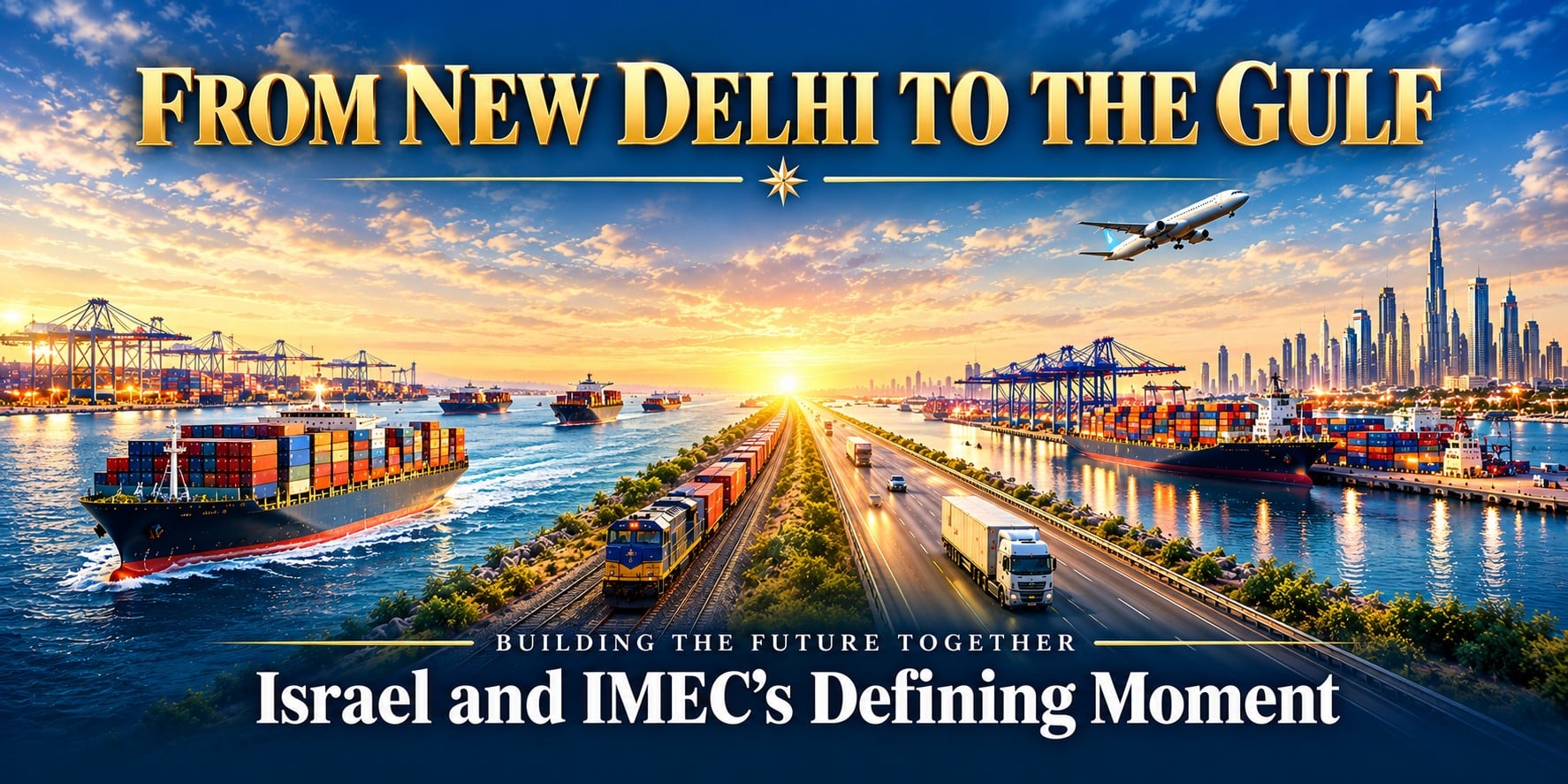
AI generated illustration
As IMEC moves from vision to execution, Israel must prove its value rather than assume its place.
The Vision Phase Is Ending
When the India-Middle East-Europe Economic Corridor (IMEC) was unveiled at the G20 summit in New Delhi in 2023, it was presented as a vision linking India, the Gulf, and Europe through maritime, rail, energy, and digital infrastructure. Like many large international initiatives, it generated headlines, declarations of support, and ambitious projections. Yet the significance of IMEC was never the announcement itself. The value of any trade route lies not in the maps drawn at summits, but in the infrastructure that is constructed, financed, and integrated into the movement of goods, energy, and data.
Events since then have reinforced the logic behind the project. Disruptions to shipping routes, concerns about supply-chain resilience, and competition for logistics and industrial investment have underscored the need for alternative pathways between Asia and Europe. More importantly, IMEC is entering the phase that determines whether major infrastructure initiatives succeed or fade into diplomatic history. The conversation is moving from vision to execution, from declarations to delivery. The question is no longer whether IMEC is a compelling idea, but which countries and infrastructure assets will become indispensable to its operation. Those that help build and shape the network will influence its future. Those that wait may discover that the most important decisions have already been made.
The Gulf Is Not Waiting
While much of the discussion surrounding IMEC remains focused on diplomatic announcements and strategic forecasts, the Gulf’s leading economies have focused on the practical foundations that make large trade networks possible. The United Arab Emirates has spent decades investing in ports and logistics infrastructure that support its role as a gateway between Asia, Africa, Europe, and the Middle East. Saudi Arabia is pursuing a similar objective through major industrial and transportation investments. Both countries understand that influence within emerging trade networks belongs not only to those who support them politically, but also to those that provide the assets required to make them function.
This distinction matters because IMEC is unlikely to emerge as a single corridor managed by a unified authority. It is more likely to develop as a network of interconnected nodes competing to become essential to the movement of goods, energy, capital, and information. In such a system, relevance is earned through execution rather than geography alone. Efficient ports, logistics hubs, and industrial zones become difficult to bypass. The Gulf states are already positioning themselves for that reality, building the capabilities that will make them indispensable regardless of how the network ultimately evolves.
The Race to Become Indispensable
Much of the discussion surrounding IMEC focuses on its sponsors and stakeholders, including India, the United Arab Emirates, Saudi Arabia, the European Union, and the United States. Their political backing and financial support remain important, but major infrastructure networks are rarely defined by declarations alone. History suggests that trade routes endure not because governments endorse them, but because businesses, ports, rail operators, logistics providers, investors, and industrial centers create value that others depend upon. Sponsorship may launch a project, but execution determines its trajectory. As IMEC evolves, the distinction between supporting the initiative and shaping it may become increasingly significant.
This is why IMEC should be viewed less as a corridor and more as a multi-node network. India represents a manufacturing and export node. The UAE has established itself as a logistics and transshipment node. Saudi Arabia is investing heavily to become an industrial and transportation node, while European ports will compete to serve as preferred gateways into continental markets. Each node seeks to attract investment, commerce, talent, and influence. In such a system, geography offers an advantage, but it does not guarantee relevance. The participants that matter most will be those that continuously expand their capabilities and make themselves difficult to bypass. The goal is no longer participation. It is becoming a node the network cannot afford to bypass.
Israel’s Place Is Not Guaranteed
Israel is often viewed as a natural Mediterranean anchor for IMEC, linking Gulf and Indian trade flows to European markets through its ports, technology ecosystem, and geographic position. Yet in a multi-node network, no role should be considered automatic. Trade routes reward participants that strengthen their value through investment, efficiency, reliability, and integration with other nodes. Geography may create opportunity, but it does not guarantee relevance. The countries shaping IMEC will prioritize the nodes that reduce costs, increase resilience, and facilitate the movement of goods, energy, and capital. Nodes are not inherited. They are built.
This reality should serve as a wake-up call for Israel. Despite its advantages, Israel remains outside the formal framework established by IMEC’s original signatories. The objective should not simply be securing a seat at the table but demonstrating why Israel should become essential to the network. That will require investments in Ashdod and Haifa to expand capacity and strengthen freight connections. Policymakers should also reassess the long-term potential of Eilat as a Red Sea gateway. The state can accelerate permitting, coordinate infrastructure planning, and modernize customs procedures, while private capital provides financing and operational expertise. Israel should also deepen cooperation with Cyprus and Greece as partners in an integrated Eastern Mediterranean node. Together, they could combine ports, energy assets, digital networks, and access to European markets into a platform that strengthens the broader IMEC system.
The race is no longer to join IMEC. It is to become indispensable before the network’s architecture is set.
Execution Creates Influence
The next phase of IMEC will be shaped less by diplomatic statements than by practical delivery. Infrastructure, transport, customs, energy, and logistics systems must function as an integrated whole. The countries that move most effectively from planning to implementation will gain disproportionate influence over the network’s development.
Influence derives from capability. The participants that matter most will be those that solve problems, reduce friction, and create efficiencies for others. As IMEC moves from aspiration to reality, influence will increasingly belong to those who build and improve the system. The future of the corridor will be shaped not by its loudest advocates, but by those who deliver results.
Shape the Network or Accept the Outcome
Recent disruptions to global shipping have reinforced the logic behind IMEC. In an era of supply-chain uncertainty, economic influence flows through the networks that move goods, energy, capital, and data across continents. IMEC is more than an alternative route between India and Europe. It is a contest over which countries and regions become the essential nodes of tomorrow’s commercial architecture.
For Israel, the opportunity extends beyond any single port or infrastructure project. Together with Cyprus and Greece, it can help establish the Eastern Mediterranean as a critical bridge between the Gulf and Europe. But opportunities of this scale do not wait. As investment accelerates and the architecture takes shape, the ability to influence it will diminish. The question is no longer whether IMEC matters. It is whether Israel intends to help build it. Those who create value will help shape the future. Those who delay will live with decisions made by others.
Related Topics
Related Posts