
From Observation to Insight: How Space-Based Data Reshapes Decisions on Earth
A view from above, and what it misses
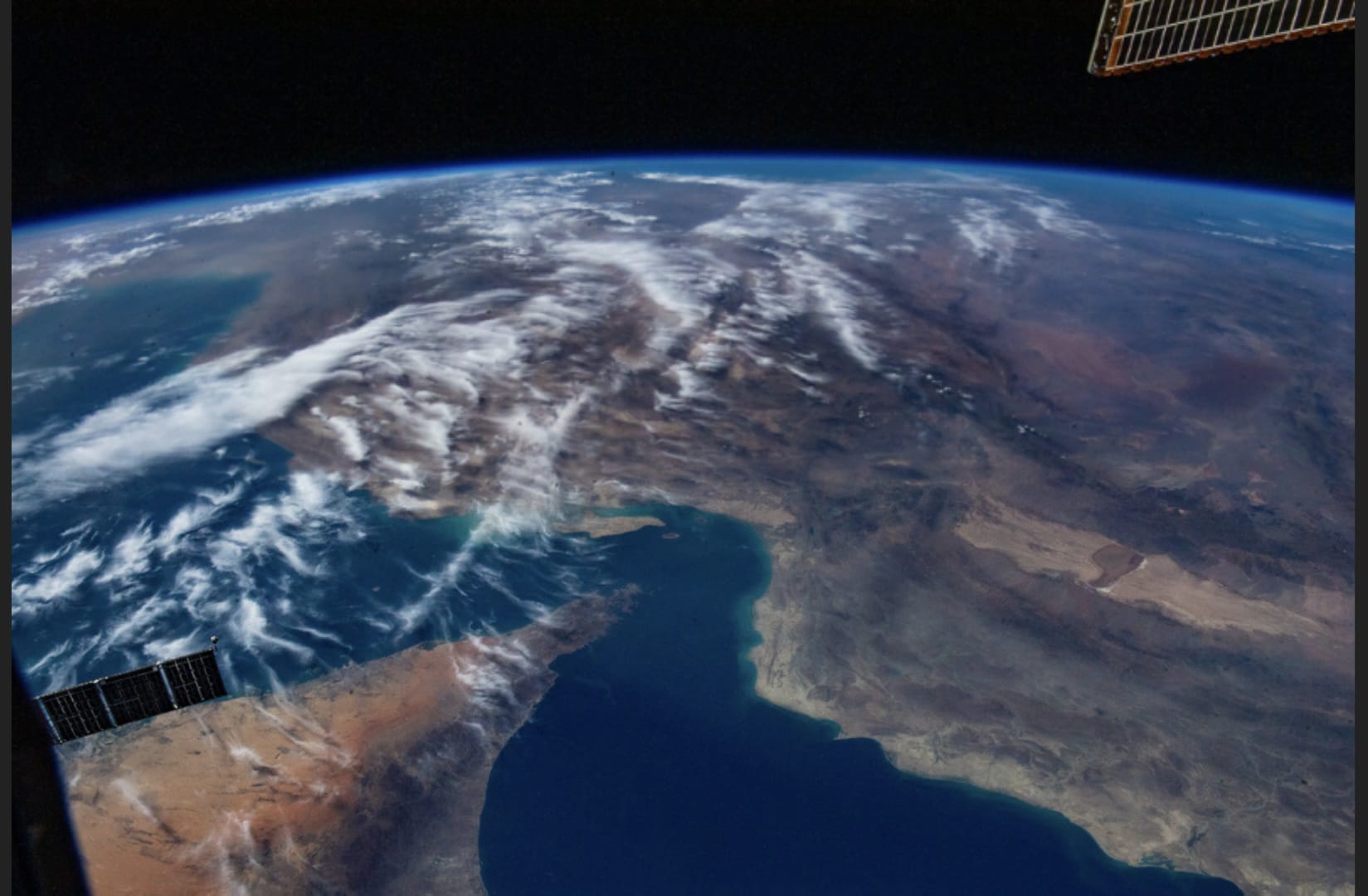
Looking down at Earth from space, the view can be deceptively serene. Take the Strait of Hormuz for example. From 400 kilometers up, it looks like a simple photographic map. We see a narrow stretch of water, a defined coastline, a quiet passage between land masses. But in reality, that narrow stretch of water is anything but simple. It is a pulse point for the global economy, a complex web of movement, risk, and interdependence. Having had the opportunity to observe Earth from space, one of the most striking realizations is not only how interconnected the world is, but how much of that complexity is not immediately visible. The view is clear, but the meaning behind it is layered. This understanding is at the heart of how space is reshaping our world today. We are moving beyond the era of merely seeing Earth from above to a new era of truly understanding it.
The Shift From Sight to Actionable Insight
For decades, satellites were primarily tools of observation. Their role was to capture images, to provide visibility into places that were otherwise inaccessible.
Today, that role has fundamentally changed.
Satellite data is now integrated with AI and analytics to generate real-time insights, enabling organizations to move from simply observing to actually understanding patterns and acting on them. This shift is what turns space into a decision-making layer.
Real-World Decisions, Powered by Space
This transformation is already visible across industries.
In maritime activity, satellites track thousands of vessels daily, providing insight into shipping flows, congestion, and potential disruptions.
In energy markets, space-based services support everything from identifying resources to monitoring distribution networks and infrastructure performance.
In environmental monitoring, satellites like MethaneSAT are designed to detect emissions from oil and gas operations, creating transparency and accountability at a global scale.
Even in agriculture, hyperspectral imaging satellites can assess crop health and resource use, enabling more efficient and sustainable food production.
These are not distant or theoretical capabilities. They directly influence how capital is allocated, how supply chains are managed, and how risk is evaluated.
Beyond Infrastructure: The Rise of Space-as-a-Service
One of the most significant shifts in the space economy is the move toward what is often described as “Space-as-a-Service.”
Instead of owning satellites, organizations increasingly access space-based data and capabilities on demand, much like cloud computing.
This model allows companies to leverage satellite imagery, geolocation data, and communication services without the need for heavy infrastructure investment.
The value is no longer in the satellite itself, but in the insights it generates.
The Israeli Perspective: From Engineering to Impact
This transition is also reflected in the evolution of Israel’s space ecosystem.
According to industry reports developed in collaboration with the Israel Innovation Authority and the Israel Space Agency, the sector is undergoing a clear shift from its traditional focus on defense-oriented satellite development toward a broader ecosystem increasingly centered on civilian applications, data, and global commercial services.
This shift aligns with the broader transition described earlier, where the value of space is moving beyond infrastructure toward data-driven insights and service-based models.
This is not a departure from Israel’s strengths, but a continuation of them. The same capabilities that enabled the development of advanced space technologies, precision engineering, and resilient systems are now being applied to generate value through data, software, and globally scalable applications.
For a country with deep expertise in artificial intelligence and data analytics, this evolution represents an opportunity not only to build space infrastructure, but to translate it into real-world impact.
From Data to Impact
From a business perspective, the most important question is not what we can see, but what we can do with that information to solve the challenges of our time.
Better data leads to better decisions, and in an era of climate volatility and resource scarcity, those decisions have never been more critical. Whether it’s monitoring methane leaks in real-time to meet carbon goals or using hyperspectral imaging to prevent crop failure in drought-prone regions, space-based data is the missing layer of the ESG (Environmental, Social, and Governance) framework. In regions where ground-level information is scarce or unreliable, satellites bridge the gap, turning “mission-critical” from a space-launch term into a standard for sustainable development on Earth.
Satellite data can support smarter planning, reduce inefficiencies, and enable more resilient systems. In that sense, space-based insights are not just about future innovation and discovery. It is about positively impacting our lives in the present.
Looking Forward
The image of the Strait of Hormuz serves as a reminder of how easily complexity can be reduced to a beautiful, static picture. But our world is dynamic and constantly evolving.
As we continue to push the boundaries of the space economy, our role is not limited to observing this complexity from the sidelines. Our responsibility is to use these tools to act more effectively, more responsibly, and more humanely.
Today, the real value of space is not just in the heights we reach or the images we capture, but in the clarity we bring back to the world below. It is a reminder that when we change our perspective, we gain the power to change our reality; because truly, there is no dream, or impact, beyond reach.
As a final note, I would like to extend my best wishes to Dr. Shimrit Maman and Ran Livne on their appointments as Chair and Director of the Israel Space Agency, as they step into a pivotal moment for the sector.