


Mathematics Teaching Professor, Author
From Pioneers to Present: The Story of Temple B’nai Israel in Aurora, Illinois
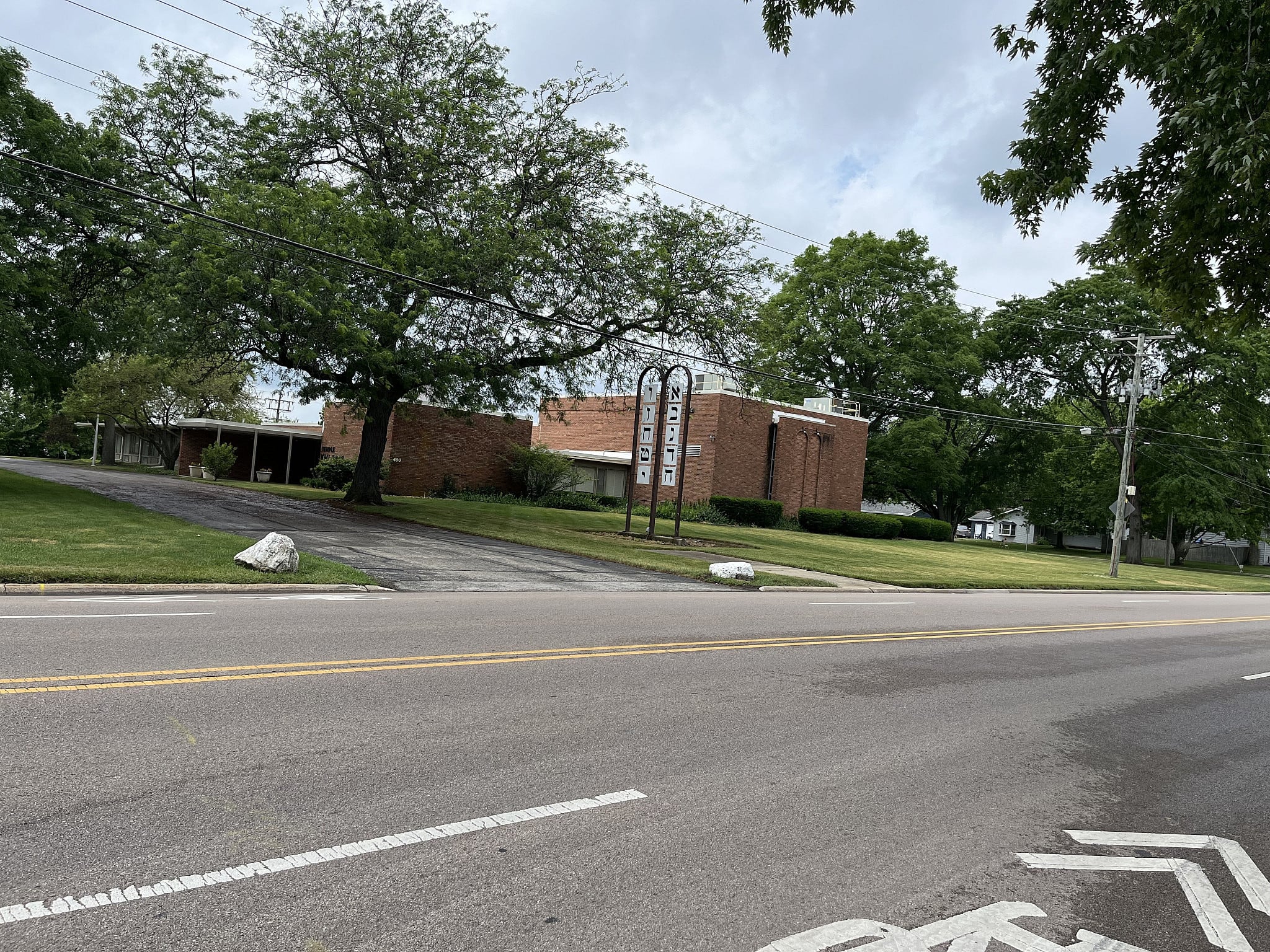
Temple B’nai Israel, Aurora, IL (Source: Temple B'nai Israel, Aurora IL)
Located in Aurora, approximately 37 miles west of Chicago, Temple B’nai Israel serves Illinois’s second-largest city. The congregation was officially established in 1904. While its current synagogue building on Aurora’s far west side has been its home since 1961, the congregation’s first permanent house of worship was constructed in downtown Aurora in 1927.
Temple B’nai Israel is a welcoming and diverse congregation of approximately 100 members, including individuals and families of all ages and backgrounds. Reflecting Reform, Conservative, and Traditional Jewish practices, the synagogue offers a variety of worship services, educational programs, and community activities throughout the year. For more than a century, Temple B’nai Israel has brought together people from Chicago’s western suburbs for prayer, learning, fellowship, social action, and celebration, while warmly welcoming non-Jewish partners, guests, and spiritual seekers to participate in congregational life.
I would like to thank the esteemed Micah Fogel, Religious Chair, Temple B’nai Israel, for his support of this article.
Synagogue
The sanctuary of Temple B’nai Israel is centered on its beautifully appointed bimah and Aron Hakodesh (Holy Ark), where the Torah scrolls are housed beneath the Eternal Light. Surrounding the Ark is a striking stained-glass composition depicting the Tree of Life growing around the sacred space, designed and executed by Conrad Schmitt Studio in the 1970s.
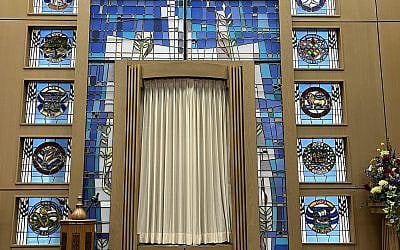
Encircling the arc are twelve stained-glass windows created by Chicago artist Todros Geller for the congregation’s 1927 synagogue. Representing the Twelve Tribes of Israel, the windows feature symbolic imagery associated with each tribe and are arranged clockwise beginning at the lower left: Dan, Naftali, Gad, Asher, Menaseh/Ephraim, Benjamin, Reuven, Simon, Levi, Judah, Issachar, and Zebulun.
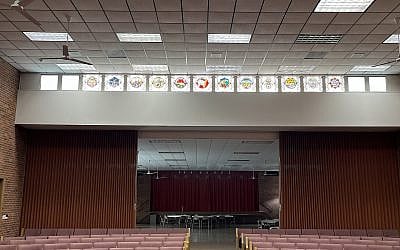
Looking from the bimah toward the congregation, visitors are drawn to the elegant clerestory windows that line the upper west wall of the sanctuary. Also designed by Geller, these stained-glass panels depict the Jewish holiday cycle in chronological order, from right to left: Rosh Hashanah, Yom Kippur, Sukkot, Simchat Torah, Hanukkah, Tu B’Shevat, Purim, Passover, Lag Ba’Omer, Shavuot, and Shabbat.
Together, the stained-glass artwork fills the sanctuary with color and light while reflecting the richness of Jewish tradition, history, and spiritual life.
Religious Events
Religious life at Temple B’nai Israel reflects the congregation’s diverse membership and commitment to welcoming a range of Jewish traditions. Serving approximately 100 members of all ages, the synagogue offers worship opportunities that draw from Reform, Conservative, and Traditional practices. A full-time rabbi guides congregants through life cycle events, teaches Torah, provides pastoral support, and leads worship services throughout the year.
The congregation celebrates all major Jewish holidays and holds Shabbat services every Friday evening and Saturday morning. A traditional service is conducted each Saturday morning, while the monthly Shabbat Chaverim service follows the Reform tradition. All services are egalitarian, with men and women participating equally and all Jewish adults counted toward the minyan. Worship is accessible to participants of varying backgrounds through prayer books that include English translations, transliterations, and explanatory notes. Guests, interfaith families, and visitors of all backgrounds are warmly welcomed to join services and the fellowship that follows.
Culture
Temple B’nai Israel places a strong emphasis on lifelong Jewish learning, offering educational opportunities for children, teens, and adults.
Its youth education program includes preparation for Bar and Bat Mitzvah and Confirmation, with instruction in Hebrew, prayer, Bible, Jewish values and ethics, customs and traditions, Israel, synagogue life, and Jewish holidays. Small class sizes and individualized attention help students build a strong foundation in Jewish knowledge while fostering a lifelong appreciation for Jewish heritage, practice, and community. In addition to classroom learning, the rabbi provides tutoring and guidance to support students in their studies and spiritual growth.
Adult education is a vibrant part of congregational life and is open to people of all religious backgrounds. Ongoing courses include advanced text-study classes exploring rabbinic literature, biblical interpretation, and classic Jewish writings, as well as introductory programs covering Jewish beliefs, traditions, holidays, prayer, kashrut, and synagogue practice.
Hebrew courses at beginner, intermediate, and advanced levels are available to both members and the broader community, welcoming participants of all faiths and ages.
Throughout the year, Temple B’nai Israel also offers a wide range of learning and enrichment opportunities, including holiday programs, family education events, speaker presentations, Friday night dinners, movie nights, Shabbat gatherings, community seders, and other social and cultural activities that strengthen Jewish identity and community engagement.
Beyond worship and education, Temple B’nai Israel offers a wide variety of ongoing activities that foster community, learning, and Jewish engagement throughout the year. Congregants can participate in multiple Shabbat services reflecting Conservative egalitarian and Reform traditions, as well as holiday celebrations marking the Jewish calendar. Adult educational programming includes lectures, Hebrew instruction, guest speakers, film discussions, and classes led by the rabbi, providing opportunities for continued learning and spiritual growth.
The congregation also supports a vibrant community life through its Friday night dinners, Sisterhood activities, and participation in Hadassah. Social action projects and community service initiatives reflect the synagogue’s commitment to tikkun olam, repairing the world, while social gatherings and special events strengthen connections among members. Together, these programs create a welcoming environment where individuals and families can celebrate Jewish life, build lasting friendships, and engage meaningfully with their community.
Historical Background
In 1654, the region that would later become the United States was a mosaic of Indigenous homelands and emerging European colonies. Indigenous nations remained the dominant presence across the continent, maintaining sophisticated societies, trade networks, and systems of governance that had existed for centuries.
Along the Atlantic coast, the English were firmly established in the Virginia colony around Jamestown and in New England’s Massachusetts Bay Colony, while the Dutch colony of New Netherland prospered in the area that now includes New York, New Jersey, and Delaware. To the south, the Spanish controlled Florida, centered on St. Augustine—the oldest continuously occupied European settlement in what is now the United States—as well as extensive territories across the Southwest.
It was in the year 1654 that the first Jews arrived in America when twenty-three Jewish refugees landed on the shores of Dutch Colonial New Amsterdam. In September of that year, a group of 23 Sephardic Jews arrived after fleeing Brazil and the Inquisition; en route, their French ship was attacked by pirates, leaving them robbed of their possessions and arriving in the New World destitute.
Despite initial resistance from Governor Peter Stuyvesant, whose anti-Jewish stance was ultimately overridden by legal and commercial pressures from the Dutch West India Company, the settlers were permitted to remain. This moment marked the beginning of the first organized Jewish community in North America.
By the 1850s, the United States was a rapidly expanding nation moving toward civil war, driven by intense national debates over the expansion of slavery. Three presidents led the country during this transformative decade: Millard Fillmore Franklin Pierce and James Buchanan.
It was in the 1850s that Aurora evolved from a small frontier milling settlement into a rapidly growing railroad and manufacturing hub. Located about 40 miles west of Chicago, the decade brought significant population growth, industrial expansion, and civic development, transforming Aurora into an important emerging community in the Fox Valley region.
And it was in this decade that Jewish pioneers first arrived in Aurora during the 1850s and early 1860s, as part of the broader wave of German-Jewish immigration to the United States. These early settlers came primarily from Germany, leaving European homes in search of new economic opportunity and freedom in America. These early immigrants reflected a largely Reform-minded German Jewish tradition and were only loosely organized at first, forming the foundations of what would later become a more structured and enduring Jewish community in Aurora.
By the time the next wave of immigration from Eastern Europe began at the turn of the 20th century, few of the earlier German Jewish families remained in Aurora. Those who did stay had generally become well established in their professions and were often less religiously observant, while maintaining a supportive role in the broader Jewish community. It was this newer wave of Eastern European Jewish immigrants, many arriving from Russia and neighboring regions and often more traditionally observant, that began organizing communal prayer and social life in a more formal way, drawing on assistance from the earlier German Jewish residents when needed.
It was in 1904 that this growing community established an organized congregation that would eventually become Temple B’nai Israel, marking the foundation of Aurora’s first synagogue. From its earliest years, the congregation drew members from Aurora and surrounding communities, and over time it developed into a lasting center of Jewish religious, cultural, and social life in the region.
For its first few years after 1904, the organization that would become Temple B’nai Israel had no formal structure and kept limited records, though it did bring in a rabbi to lead services and serve as a shochet, ritual butcher.
By 1923, the congregation incorporated as the Young Men’s Hebrew Association, and in 1927 it acquired its first permanent synagogue building in downtown Aurora. That historic structure, later sold, still stands today, while the congregation moved to its current west-side home in 1961. The present synagogue building itself was constructed in 1959.
Throughout much of its history, the congregation has identified as “traditional,” while remaining sensitive to members who preferred different styles of worship. In the 1990s and 2000s, it sometimes described itself as “Reconservadox,” reflecting its blend of Conservative and traditional practice. Worship has included a traditional Shabbat minyan alongside services using Conservative liturgy and, at times, Reform prayer books such as Mishkan T’filah. In recent years, the traditional minyan has become fully egalitarian, reflecting evolving congregational values.
In more recent decades, however, the Jewish population of Aurora has declined, as many younger generations have moved away or chosen to affiliate with other communities. Despite these demographic changes, Temple B’nai Israel continues to serve as a historic and active center of Jewish life in the region, maintaining its traditions while adapting to the needs of its members.
The vibrant history of Temple B’nai Israel reflects the broader story of Jewish life in Aurora, from its earliest German Jewish settlers in the mid-19th century, through the arrival of Eastern European immigrants who organized communal worship in 1904, to the establishment of a lasting synagogue presence in the 20th century. Over time, the congregation grew, built and relocated its synagogue homes, and developed a distinctive blend of traditional, Conservative, and Reform practices that continues to shape its identity.
Today, Temple B’nai Israel stands as both a historic institution and an evolving community, preserving more than a century of Jewish life, learning, and worship. While demographic changes have affected the size of the Jewish population in Aurora, the congregation remains committed to sustaining Jewish tradition, fostering community, and adapting to the needs of future generations.
Contact Information:
Temple B’nai Israel, 400 N. Edgelawn Drive, Aurora, IL 60506
Phone: (630) 892-2450
Email: office@temple-bnai-israel.org
Website: temple-bnai-israel.org/