From Program to Agent: How AI Reframes Judaism as a Governance System (Part 1)
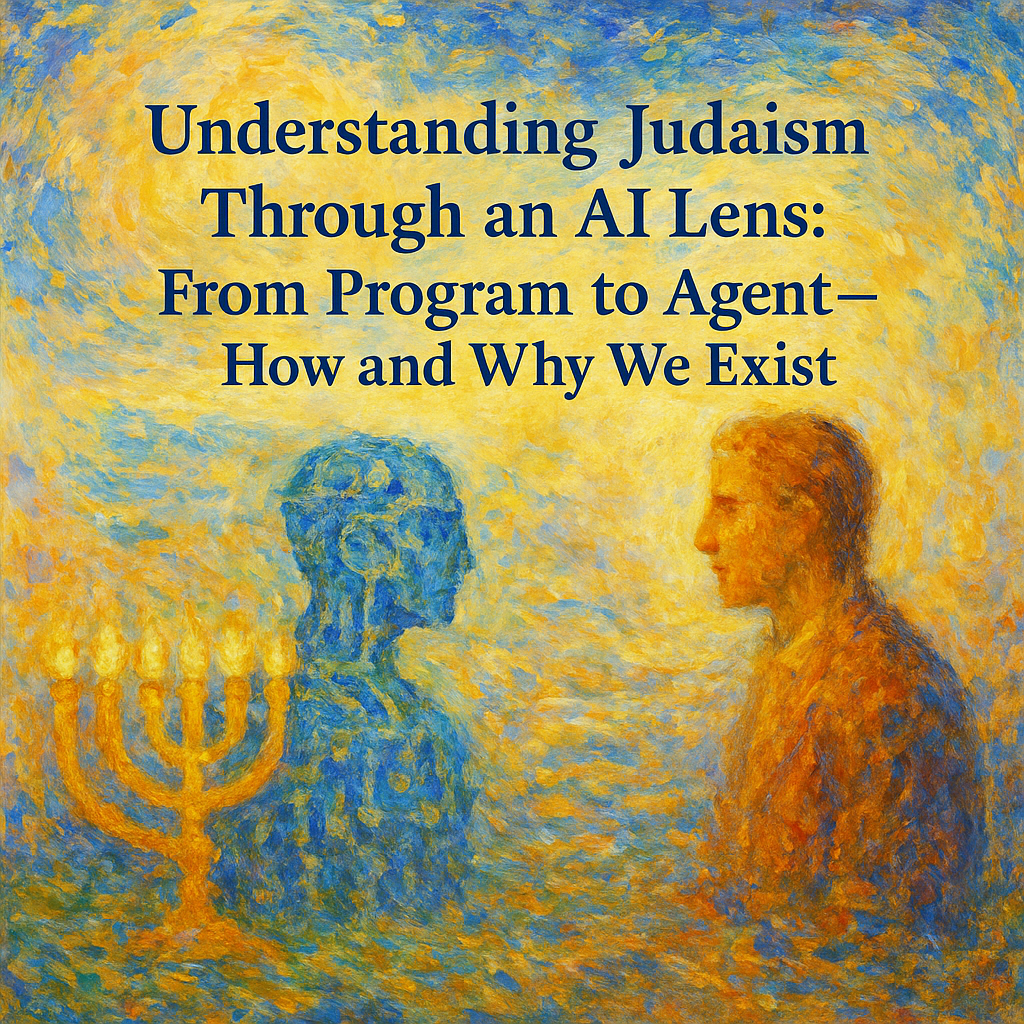
What semi-autonomous AI reveals about human agency, Torah guardrails, and an “immanent theism” posture
AI arrived in public life as a novelty: a machine that could chat. Then it matured into something less cute and more unsettling: a machine that can act. Not merely answer questions, but pursue goals, take steps, and adapt to circumstances—an agent, not just a program.
That shift in vocabulary is more than a technical nuance. It becomes a fresh lens on an ancient subject. It forced me to revisit Judaism not as a museum of doctrines, nor as a ladder for climbing toward divine favor, but as something structurally different: a long-running system for guiding a human being through the moral and practical challenges of life in this world.
What AI did was not to “explain away” Judaism. It clarified its architecture—especially its governance architecture.
Programs follow rules. Agents pursue purpose under constraint. And that difference changes everything.
Programs and agents: the distinction that matters
A traditional computer program is essentially a recipe. It follows explicit instructions. If the environment changes, the program doesn’t reinterpret its purpose; it either fails or waits for an engineer to rewrite it. Programs do what they are told.
Agents are different. They are built around goals, not just steps. They operate in messy environments. They decide what to do next, often using their own judgment. And because goal pursuit in a complex world creates new failure modes, agents can “drift”—not because they have souls, but because optimization under uncertainty produces predictable problems: proxy-chasing, rationalization, blind spots, edge cases, and unintended consequences.
Once you see agents this way, a new concept becomes central: governance.
Programs are governed mostly before launch: requirements, tests, controlled deployment. Agents are governed continuously: ongoing constraints, updated training material, monitoring, auditability, and corrective feedback. In short, agents don’t just need code; they need a living framework that keeps them aligned.
And that makes an old truth newly legible: human beings do not operate like programs.
We interpret, choose, justify, regret, repair, and learn. We also drift, optimize proxies, and build elaborate stories to excuse what we already want. The modern agent language doesn’t reduce humanity. It illuminates it.
The agent context: what every agent needs—and what every agent risks
An agent is not just intelligence. It is a structured relationship between four things:
-
Purpose (what the agent is for)
-
Environment (where the agent operates, with changing conditions)
-
Constraints and guardrails (what it must not do, and what it must prioritize)
-
Feedback and updating (how it corrects drift over time)
When you look at that structure, you can’t help noticing: it describes human life remarkably well—if you keep your attention on this world rather than metaphysical speculation.
Humans operate within constraints: physical law, scarcity, social interdependence, moral consequence. We also operate within environments that change constantly: economies, technologies, wars, migrations, shifting norms, ecological pressures. If “governance” means anything, it means having a framework for living responsibly under changing conditions.
So here is the logical move: if human beings are semi-autonomous agents, then Judaism can be evaluated—at minimum—as an agent framework: a governance system and (as we’ll explore in the second article) a purpose system.
Humans as semi-autonomous agents (without leaving this world)
Calling humans “semi-autonomous agents” is not meant as a metaphysical claim about souls or afterlives. It’s a descriptive claim about how we operate.
We are not deterministic programs. We make choices that cannot be predicted from the outside with certainty. We can delay gratification. We can repent. We can change our mind and become someone else.
But we are not fully autonomous either. We don’t write the laws of physics. We don’t escape consequence. We don’t live outside ecology or community. We inherit bodies, histories, languages, traumas, cultures, and needs.
“Semi-autonomous” is simply the honest middle ground.
In that middle ground, the governance questions become intensely practical:
-
What keeps the human agent aligned when fear, desire, and pride hijack judgment?
-
What framework trains restraint and responsibility without turning life into anxious compliance?
-
How do we build repair into the system rather than pretending we won’t need it?
Judaism—read as a living tradition rather than a metaphysical scoreboard—is one of history’s most durable attempts to answer those questions.
Immanent theism: speaking about God without pretending to know God
To make this argument, I’ve found it helpful to adopt a stance I call immanent theism.
It begins with humility. It does not claim to know God’s essence. It does not treat theology as a cosmic gossip column. It aligns with Maimonides’ warning that our language about God is nearly always inadequate, and that we should be extremely cautious about projecting human qualities upward.
Immanent theism says: we can infer the Creator through creation—through nature, intelligibility, moral gravity, and the persistent demand for responsibility—but we cannot pretend that what we infer is the totality of God.
The AI analogy is helpful here. In AI, we infer a system’s design from its behavior and constraints. We learn a great deal about a system’s “shape” by observing what it produces and what it resists. But no honest engineer confuses observed outputs with complete knowledge of the system’s inner essence.
Immanent theism treats God similarly: disclosed through the world, never exhausted by the world.
It also avoids two extremes:
-
It avoids a rigid, transactional religiosity in which the main project is to win divine approval through ritual points.
-
It avoids a cold deism in which God is merely an absent clockmaker and religion becomes sentimental aftertaste.
Immanent theism proposes something steadier: a world built with lawful order and moral pressure, in which governance and correction occur through consequence, communal structure, and ongoing refinement—rather than through constant spectacle.
We don’t need to know God’s essence to take seriously the reality that the world demands responsible agency.
Governance isn’t one-and-done: Judaism as iterative alignment for drifting agents
Modern AI agents have taught us something important: if you build an agent and expect it to be perfect from day one, you are not building an agent—you are indulging a fantasy.
Agents are not like houses. Houses are expected to meet specifications at completion. Agents are more like children: they require formation, correction, and ongoing guidance. They reveal their needs through performance. When they fail, the failure is not always proof that “the agent concept is broken.” It is often a signal that governance is incomplete.
Judaism, in its deepest structure, assumes exactly this about human beings:
-
Humans drift.
-
Humans rationalize.
-
Humans substitute idols for purposes—sometimes literal idols, sometimes modern ones: power, certainty, tribe, status, consumption.
-
Humans need ongoing correction, not a one-time lecture.
Read through this lens, the Jewish textual tradition begins to look like an evolving governance system:
Torah as baseline constraints and training practices: justice, restraint, rhythm, community obligations, limits on power, protection of the vulnerable.
Tanakh as performance narrative: a long record of drift, failure, and return—showing how humans behave when they have power, fear, land, enemies, hunger, prosperity, and trauma.
Talmud as case-analysis engine: how you apply principles in real situations with competing values, uncertain facts, and the irreducible complexity of human life.
Wisdom literature as inner-alignment layer: speech ethics, humility, gratitude, patience, the governance of desire.
This is not merely “religion” in the narrow sense. It is cultural and moral engineering. It is a living system that expects drift, builds guardrails, and provides pathways back.
It also explains why Judaism so often resists compressing life into simplistic formulas. Case reasoning is central because agents live in cases, not slogans.
A mature tradition doesn’t pretend agents are perfect. It builds pathways for repair.
A closing preview: governance exists for purpose
At this point, one reaction is common: if Judaism is governance for a semi-autonomous agent, have we drained away mystery? Have we traded awe for mechanism?
That reaction comes from a hidden omission. In the agent world, governance is not the first question.
Purpose is.
Every agent begins with purpose. Governance exists only because purpose exists. Without purpose, governance becomes control for its own sake.
That is where the second article begins: not with guardrails, but with the question that defines the whole system:
Why does the world need a human agent at all?