A New York City Cantor
From Protest to Propaganda: Jesse Welles and the Theft of Jewish Folk Legacy
Why a viral “anti-war” singer is really singing Hamas’ talking points—and erasing the Zionist roots of American protest music.
Folk music has long been a battleground of conscience—a genre where the poet’s guitar strums truths too uncomfortable for political platforms. But in 2024, a new folk voice suddenly emerged whose protest songs curiously protest everything except the real forces threatening liberal democracies and Jewish lives around the globe. His name is Jesse Welles.
Lauded by progressives as the next Dylan, Welles has quickly become a social media sensation with songs that “sing the news,” though his editorial choices raise more questions than answers. One online critic-fan named him a “Troubadour of the Misinformed Left.” That’s pretty accurate. His most popular track, War Isn’t Murder, takes direct aim at Israeli Prime Minister Benjamin Netanyahu and former White House adviser Jared Kushner, blaming them for the Israel-Gaza conflict and promoting an age old libel, direct from The Protocols of the Elders of Zion, painting Jews as a money-grubbing genocidal people as their motivation for this war against Hamas, while conspicuously failing to make any mention of Hamas, Islamic Jihad, or the rise of a coordinated global intifada. “War isn’t murder, there’s money at stake/Girl, even Kushner agrees it’s good real estate/War isn’t murder, ask Netanyahu/He’s got a song for that and a bomb for you/War isn’t murder, it’s an old desert faith/It’s a nation-state sanctioned, righteous hate.” The lyrics drip with moral clarity for his many antizionist “liberal” fans—until you notice who’s absent from blame. There is no mention of the butchery of October 7th. No names for the hostage takers and no mention of Israeli hostages still being held in terror tunnels. No terrorists, only “states.”
When pushback followed, Welles released a damage-control track for TikTok commenters who he believed were the ones who were “CON-fused,” titled Don’t Hate the Jews—a non-apology cloaked in melody that is conspicuously missing from his 61 track album of TikTok audio. Jesse here makes it seem he’s saying it is okay to hate Zionists, but not okay to hate Jews – his fans online echo his language, insisting that there’s a difference between a Zionist and a Jew, none of which matter to those who target us because of his propaganda. His only other song about a contemporary war, How Many, mourns “a curious death toll” and paints Russians as tragic victims—without naming Putin, without acknowledging the true suffering of Ukraine. He instead accuses Ukraine of war crimes: “How many Russians have died?/They don’t come from Moscow or Saint Pete/They come from Dagestan, Buryatia, Tuva, Kuban/And thеy all get ground into meat.” Like his Gaza commentary, it’s a study in deliberate omission: count the dead, erase the killers, then accuse the defenders of genocide.
Most appalling, perhaps, is his song Springtime in America, where Welles parrots one of the most dangerous and debunked blood libels to come out of the Israel-Hamas war: the claim that Israel is intentionally starving Gaza and luring starving Palestinians into aid distribution points with the intent of running them over with aid trucks. “Way down yonder in Gaza/It’s hard to come by luck/If and it gets delivered/They hit you with the truck.” This narrative, like most everything, was fabricated and disseminated by Hamas, then echoed by gullible media outlets before being disproven by video and forensic evidence. And yet here is Jesse Welles—who brands himself as the “singer of the news”—elevating Hamas’ propaganda with a grinning face and a strumming guitar. Either he doesn’t know the news, or he’s choosing deliberately to sing only one side of it: the terrorist side.
This is not folk music in the tradition of truth-telling troubadours. This is not Dylan.
Bob Dylan Knew the Real Enemies
Welles has modeled himself, at least superficially, on Bob Dylan—mumbling melodies, a Travis pick, a scratchy drawl and an edge. But the resemblance is skin-deep. Bob Dylan never mistook the oppressors for the oppressed, and he didn’t outsource his conscience to trending hashtags.
Dylan was raised in Hibbing, Minnesota, in a household steeped in Jewish and Zionist pride. His father was president of the local B’nai Brith chapter. His mother led Hadassah. His childhood summers were spent at Herzl Camp in Wisconsin, named after the founder of the political Zionist movement, Theodore Herzl, where when they weren’t causing mischief or chasing after girlfriends, Bob and his friends sang Israeli folk songs by the fire and studied Zionist history and Hebrew songbooks. That camp songster that I have—a mix of Israeli anthems and Jewish Zionist pioneer folk melodies—was just as formative to Dylan’s lyrical worldview as Woody Guthrie’s guitar, emblazoned with “This Machine Kills Fascists.” Jesse should take note that Woody was talkin’ about America fighting the Nazis when he added those words. He married Marjorie Greenblatt, the daughter of a prominent Zionist family that is buried in Israel. Woody was even more proudly Jewish and Zionist as a non-Jew than Dylan in some ways; unlike Dylan, Woody wrote a number of fun Chanukah songs for his kids and gave his son Arlo a Bar Mitzvah with their very controversial family rabbi, the notorious Rabbi Meir Kahane.
It’s no coincidence that Dylan quietly escaped the crazed anti-war hippie crowd that mobbed his apartment in the Village on his 30th birthday, and was instead discovered by a journalist on the Mediterranean beach in Herziliyah with his wife, nor that he made quiet, repeated visits to Israel following his father’s death in 1968. He even attempted to make aliyah to Kibbutz Neve Eitan on the bank of the Jordan River in the mid-70s. It was around this same time he wrote Watching the River Flow—a song likely not about abandoning protest, but about leaving behind the empty posturing of a movement that no longer knew what it was fighting for.
And now, in the ultimate historical irony, it is the kibbutzim on Israel’s borders—those same peace-loving, leftist, idealistic communities—that were among the first targets of Hamas’ October 7 massacre. The kind of communities that American folk icons like Pete Seeger once visited, celebrated, and even helped popularize through songs like Tzena, Tzena—a joyful anthem about the IDF defending the Jewish homeland.
What would Dylan say today? Perhaps he already did, in Neighborhood Bully in 1983 on the very appropriately named album, Infidels:
The neighborhood bully he just lives to surviveHe’s criticized and condemned for being aliveHe’s not supposed to fight back, he’s supposed to have thick skinHe’s supposed to lay down and die when his door is kicked inHe’s the neighborhood bully.
Jesse Welles would do well to study those lyrics and get an accurate historical education of the conflict and the prevalent Western media bias against Israel before trying to conquer a topic that he really doesn’t understand, and in the process, preaching an “anti-war” message that is in the service of terror.
Bringing It All Back Home
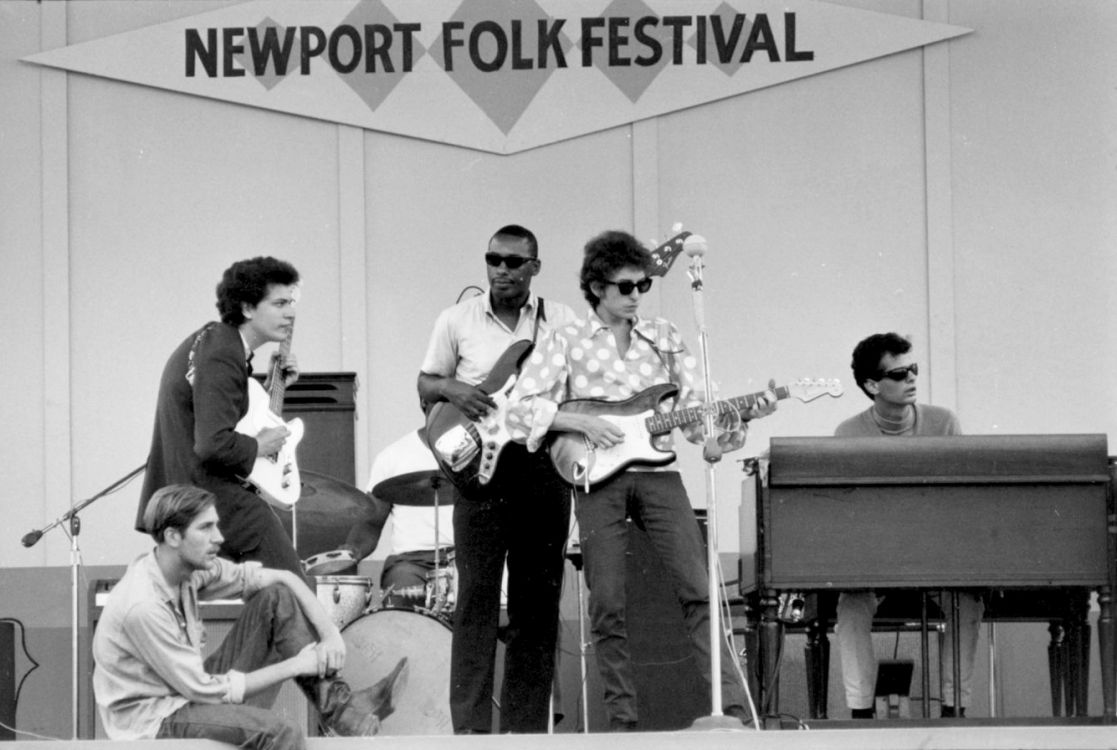
When Bob Dylan stood on the Newport stage in 1965 and asked, “How does it feel to be on your own, with no direction home, like a complete unknown, like a rolling Stone?”—he wasn’t just talking about personal alienation. He was speaking from the inherited memory of a people who had been cast out of every homeland they’d ever known. Dylan knew what it meant to have no direction home because his ancestors had fled pogroms in Lithuania and Ukraine. His great-aunt, Ida Solemovitz’s murder at the hands of a love crazed non-Jew in 1906 in my hometown, Superior, Wisconsin, prompted the family’s relocation to Hibbing and the anglicization of their name to “Stone”—a change made to survive in a country that didn’t always welcome Jews.
So when Dylan sang at the Newport stage of being “a complete unknown,” it wasn’t just rebellion. It was legacy. It was the grief of a people who had to hide who they were to stay alive. It is those few seconds in his biopic, “A Complete Unknown,” when the camera quickly pans over the contents of a package from his real family, “The Gang Up North.” It is addressed to Robert Zimmerman and contains a photo of Bob in his tallit studying Torah together with his father and his white bearded Orthodox rabbi, a Holocaust survivor from a long dynasty of Torah scholars named Rabbi Reuben Maier, a photo of him with his Herzl camp friends, an invitation to his Bar Mitzvah, and even his tzitzit with p’til t’cheilet, the blue woven fringes from the end of his tallit that are intended to remind him of the covenant he made with God as a Jew committed to ethical values. Besides the legendary crossroads of Robert Johnson, this may well have been Bob’s “bargain” he spoke of years ago on 60 Minutes, “with the chief commander of this earth and the world we can’t see.”
Jesse Welles doesn’t know how it feels.
He equates our God with the God of Hamas in War is a God: “They both have the same damned God/They just don’t know how to read.” It seems here Jesse doesn’t know that Israel is a secular state unlike the Islamic countries surrounding it, it welcomes millions of Palestinian Arabs, Muslims, Christians, Druze, people of all faiths to enjoy equal rights. He doesn’t know that Hamas for the past twenty years has educated the entire Gazan population to become martyrs for a holy war. In Genocide Cake, he puts the IDF in his crosshairs: “And they′re aimin’ to do ya some harm/And if ya straddle the fence with the both of your legs/Bury your head in the sand/Well there′s plenty of folks at the IDF, and they specialize in that/Somethin’ is wrong and you don′t know what.” He never mentions a word about Hamas or Islamic terror – in this or any song. The only one trying to “straddle the fence” and have his cake and eat it too is Jesse.
Since he almost stole a line directly from Dylan’s Ballad of a Thin Man and used it against the IDF, I’ll launch it back at Jesse: “You know something is happening, but you don’t know what it is, do you, Mr. Welles?”
He sings as if all wars are the same, it’s all black and white, oppressor vs. oppressed, a war of death counts, all power is evil, and all history is myth. But Dylan knew better. Dylan named names. Dylan stood with the oppressed while also defending the right of Jews to live safely in their ancestral home. He did it with subtlety and nuance, with a timelessness and sophistication that made many other stars want to cover his songs. He didn’t exempt or romanticize terrorists. He didn’t erase context or promote propaganda in pursuit of likes and follows.
And yet here we are, in 2025, with a new generation of folk singers performing under Palestinian flags at the Newport Folk Festival, chanting slogans that erase Jews and rewrite history. One attendee this year observed the emcee, the comedian John C. Reilly, unfurl a Palestinian flag shouting to a cheering crowd, “We love our Jewish friends here, but I mean, come on!” The same Newport founded by George Wein and Pete Seeger, co-founded by Theodore Bikel, also a fervent Zionist. The same Newport where Bob Dylan once dared to plug in and speak truth to both left and right. The same Newport where the children of Holocaust survivors and kibbutz founders once raised their voices for peace rooted in truth. The same Newport where unlike the Nova Music Festival, isn’t being swarmed by genocidal Hamas terrorists, but instead by their unwitting allies, some even garbed in keffiyehs. Allies who are prolonging the war by aiding in spreading the messages of Hamas in a deliberate attempt to divide the United States from its longtime ally, Israel.
It’s not antisemitic to criticize Israel, but it is antisemitic to focus solely on Jewish leaders like Netanyahu and Kushner. Criticizing our own Jewish leadership is a tradition that stretches back to Moses and the Exodus. Jesse could take lessons from millions of Israelis who have perfected the art of criticism and do it far better than him. They can do so because unlike in Gaza and other Islamic regimes, they have freedom of speech. But if you’ve built your entire online presence based upon suddenly becoming “anti-war,” only in the wake of the atrocities of October 7th and cannot find a single word to say about it and the spread of Islamic terror, it is indeed antisemitic, yes, even if you, in a gleeful waltz, absurdly, almost tongue-in-cheek, ask your fans, “but for God’s sake, don’t hate the Jews.”
Jesse Welles may carry a guitar as a former grunge singer who has gone acoustic on TikTok as “anti-war” in the aftermath of October 7, but he does not carry that tradition. He isn’t reviving folk protest. He’s replacing it. What we’re witnessing is not a renaissance. It’s an erasure.
If there is any “Great Replacement” theory that is actually true, it is that virtually all of the industries that began predominantly by Jews and proud Zionists – television, film, theater, superhero comic book franchises, music – are dominated today by anti-Zionists.
Folk music, at its best, isn’t propaganda. It’s prophecy. It tells hard truths. It names the tyrants. It sings in memory, and in warning.
Bob Dylan knew. Jesse Welles doesn’t.
And we, the heirs of that true folk tradition, must not remain silent.
Related Topics
Related Posts