


From Rice University to the Bondi Beach Massacre
On 14 December 2025, a terrorist mass shooting occurred at Bondi Beach in Sydney, Australia, in the early evening during a Hannukah celebration attended by approximately one thousand people. Two gunmen killed 15 people, including a 10-year-old child. Australian Federal Police declared it an Islamic–linked terrorist attack. N umerous world leaders, news outlets and Australian authorities declared that the shooting was motivated by antisemitism. Australian prime minister Anthony Albanese On On 14 December 2025, a terrorist mass shooting occurred at Bondi Beach in Sydney, Australia, in the early evening during a Hannukah celebration attended by approximately one thousand people. Two gunmen killed 15 people, including a 10-year-old child. Australian Federal Police declared it an Islamic–linked terrorist attack. Numerous world leaders, news outlets and Australian authorities declared that the shooting was motivated by antisemitism. Australian prime minister Anthony Albanese said it was a deliberate attack on Jewish people during the first day of Hanukkah. (See Wikipedia article.)
What is the connection between the Bondi Beach massacre and Rice University, which is over 8500 miles away? To answer that question we must go back to the events of February 15, 2024, which is when the “campus Intifada” broke out at on the Rice University campus. The protest movement at Rice started with a group of pro-Palestinian protesters disrupting a presentation by by Antonio Neri, Chief Executive Officer of Hewlett Packard Enterprises, organized by the Rice Center for Engineering Leadership and attended by approximately 200 guests. The response by Rice to this clear violation of the university’s Code of Student Conduct, as well as Policy 820, was a thundering silence. In fact, the only public response to the disruption was an op-ed article at Rice’s student newspaper, The Thresher. The article ended with “This is an institutional matter, and I wait for an institutional reply from the Rice president, provost and other authorities.” No institutional reply ever came. When explicitly asked, the response from Provost Amy Dittmar was “We cannot comment due to students’ privacy”, even though they could have commented without mentioning students’ names. Opacity is an instrument to evade accountability.
After the disruptors were expelled from the auditorium by the Rice University Police Department (RUPD), they regrouped outside the Brochstein Pavilion at the center of the campus, where they mounted a loud demonstration. As on other campuses, the demonstrators did not call for a ceasefire or for an independent Palestinian state. Rather, their loud chants included “From the river to the sea, Palestinian shall be free”, “Intifada Revolution is the only solution”, and “Globalize the Intifada”. There has been an extensive debate whether such chants are or not antisemitic. But I am an Israeli Jew (Israeli, for short). We hear people say these days, “I am not antisemitic; I am anti-Zionist.” I doubt that these people can define “Zionist”; “Zionist” for them has just become a code word for “Israeli” or “Jew”. I challenge anyone to argue that such chants are not anti-Israeli. As Judith Shulevitz wrote, “A close look at the words being shouted at protests on campuses across the country reveals why some see the pro-Palestinian cause as so threatening.”
Israelis (there are about 15 Israelis on the Rice campus) view chants about the Intifada as threatening, rather than merely offensive. The Second Intifada was a 2000–2005 terror campaign aimed at Israeli civilians — which included suicide bombings, shootings, and stabbings — resulting in over 1,000 people murdered. I lost a very good friend in the Passover Massacre, a suicide bombing carried out by Hamas at the Park Hotel in Netanya, Israel in March 2002, during a Passover festive meal, in which 30 civilians were killed and 140 were injured. To me “Globalize the Intifada” means that not only Israelis in Israel are legitimate targets, but that Israelis everywhere are legitimate targets. The Intifada chants are simply calls for violence. As Jonathan Chait wrote about the US campus-protest movement: “The movement’s ideological character invites rage and violence.”
My response to these threats was to launch a formal complaint with RUPD. On February 16, 2024, I informed RUPD, as well as Rice’s leadership, that threats of violence have been issued against me and against other Israelis on the Rice campus. The only response I received was that I should download an alert app to my phone. (Other Israelis received similar advice.) Inquiries as to what happened with my RUPD complaints have been answered with “We cannot comment due to students’ privacy.”
I and others also filed complaints with Rice’s Office of Equal Opportunity Services, arguing that the threatening chants violate Rice’s Policy 830 on Discrimination and Harassment. EOS investigated if the chants that we found threatening are truly threatening. Perhaps “From the river to the sea” is just about freedom, never mind that the origin of the phrase, as coined by the Palestinian Liberation Organization in the 1960s, was “from the water to the water, Palestine will be Arab”, which is what protesters at the Rice “liberated zone” (see below) have been chanting in Arabic. Perhaps, “Intifada” just means ““shaking off injustice”, and “resistance is justified” is just about “self-defense”, never mind the 1,000 Israelis that were murdered in the Second Intifada, and the 1200 Israelis that were murdered on Oct. 7.
After a six-months long investigation, EOS dismissed the complaint, arguing that the Intifada chants do not meet the Texas Penal Code standard of “threats of violence”, which requires the threat to imply imminent harm. But the complaint was not based on the Texas Penal Code, but on Rice’s Policy 830, which refers to conduct that is “severe or pervasive enough to create a work or educational environment that a reasonable person would consider intimidating, hostile, or abusive.” In mid-April 2024, a group of about ten Israelis — faculty members, staff members, and students — held a meeting with the leadership of the university, including President DesRoches and EOS Director, Dr. Richard A. Baker. We made it clear that we do not feel safe on the Rice campus. Two people pulled out pocket knives that they carry with them for self defense while on the Rice campus. The leadership listened with interest, but no promise of concrete steps to address these issues was made. Apparently, they have decided that all ten Israelis that came to the meeting are not reasonable persons.
A couple of weeks later, at the end of April 2024, Rice SJP declared a “liberated zone” on campus. Rice said that this “encampment” had their approval, and called it a “student-led teach-in event”, but the approval — acquiescence may be a better description — came after the fact and was not obtained 48 hours in advance, as required.
The image below is of a poster distributed at the Rice encampment. It clarifies what the chant “Free Palestine” mean; it means “Zionists get out”, i.e., ethnic cleansing. Another chant glorifies violence against Israelis, “with blood we redeem you Palestine”. The chant “We don’t want Zionist here”, turn the “liberated zone” into a Israeli-exclusion zone. Yet, in an end-of-semester email sent to campus April 28, 2024, President DesRoches described the encampment activities as “responsible, personal expression”. So Rice students are calling on the Rice campus for ethnic cleansing, and President DesRoches refers to that as “responsible expression”.

In early September 2024, in preparation the first anniversary of Oct. 7, 2023, RiceSJP posted the following image on their Instagram page.
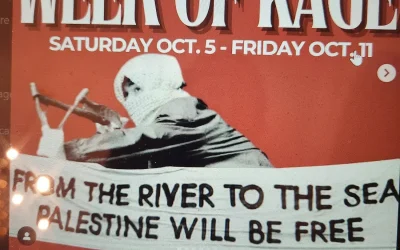
In response, I filed another complaint with EOS, arguing that the image implies violence and therefore amounts to intimidation, according to Policy 830. A ten-months long investigation ensued. At this point Rice was quite aware that it is a fairly bad idea to get in the crosshairs of the Trump Administration (which came into power in January 2025), so the investigation did conclude that the Instagram image did amount to intimidation. So what did Rice do about this? The only answer I got was “the appropriate measures were taken”. There was no public response. The usual excuse for such silence is “students’ privacy”. But while students are entitled by law to privacy, students clubs have no such privilege, so the excuse is just that, an excuse.
What happened on the Rice campus happened also on numerous other campuses in the US and internationally. Incitement for violence was normalized under the cover of “freedom of expression” and “support for Gaza”. While the vast majority of those who engage in such conduct have no intention to proceed from words to actions, incitement does have an significant impact on the small number of individuals who are inciteful, if I may coin a word. By now we know what “Globalize the Intifada” chants do lead to violence. On May 21, 2025, Yaron Lischinsky and Sarah Lynn Milgrim, two Israeli Embassy staffers, were murdered in Washington, DC. The murder suspect, Elias Rodriguez, told police on the scene, “I did it for Palestine, I did it for Gaza,” according to the charging documents. Witnesses recounted hearing him chant, “Free Palestine” after he was taken into custody. A week and half later, on June 1, 2025, a group gathered in Boulder, Colorado, to raise awareness for hostages held in Gaza was attacked, leaving 12 people injured. The suspect, Mohammed Sabry Soliman, accused of throwing incendiary devices at them, allegedly planned the attack for a year, and told police he wanted to “kill all Zionist people,” according to court documents. On October 2, 2025, during the Jewish holiday of Yom Kippur, man drove a car into pedestrians before stabbing worshippers at the Heaton Park Hebrew Congregation, a synagogue in a suburb of Manchester, UK. As we see from this list of incidents, the fine distinction between Zionists and Jews is lost on the inciteful.
The “Globalize the Intifada” chant is finally recognized as an incitement for violence. The Australian state of New South Wales is planning to ban such chants, according to recent news, amid a crackdown on “hateful” rhetoric and slogans. Other countries are taking similar measures. But, at Rice University, such a chant is apparently still accepted as a legitimate expression of opinion. ‘From the river to the sea’ chant is antisemitic, said France’s human rights envoy after the Bondi Beach massacre. But at Rice University, it is another legitimate expression of opinion.
There is no direct causal chain from the events on the campus of Rice University to the atrocity at Bondi Beach. But Rice does have a few drops of blood on its hand, I believe.