
Welcome to the Ongoing Situation
From “Save the Planet” to “Yalla Intifada”
Greta Thunberg's latest slogan isn't the story — it's the symptom
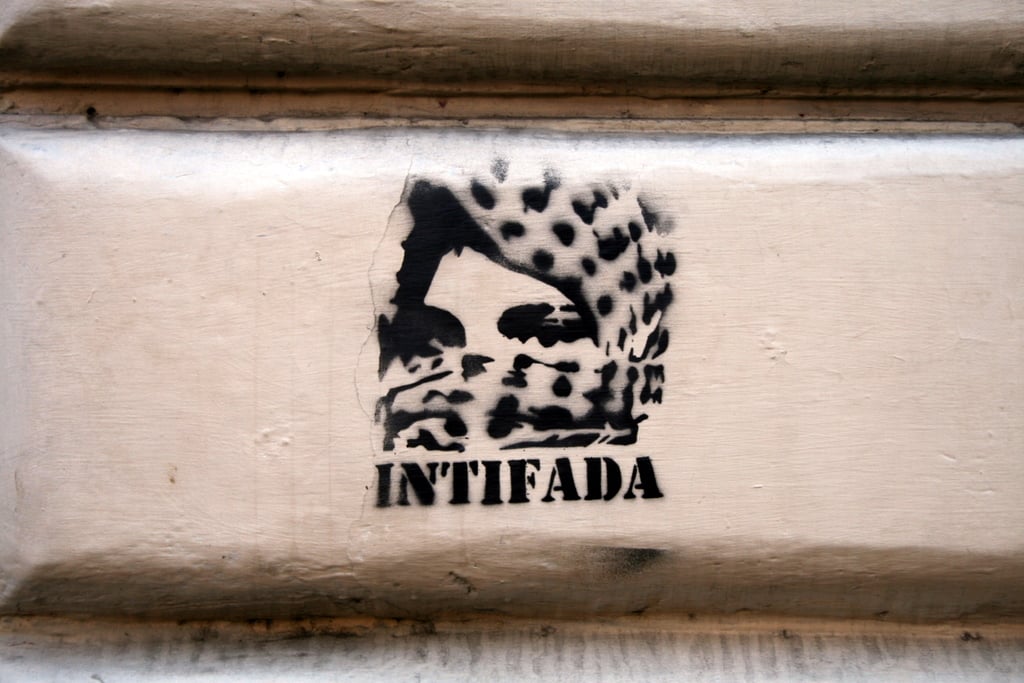
Intifada stencil pictured in Rome, Italy,15 August 2009, by Jim Fitzgerald. (Wikimedia Commons)
Greta Thunberg built one of the most well-known activist movements of the 21st century around a quite simple proposition: listen to the scientists.
Whether you admired her conviction or found her sanctimony exhausting, her message was refreshingly uncomplicated. The planet was warming. The evidence was overwhelming. Political leaders weren’t doing enough. The solution was to pay attention to expertise rather than ideology.
There was something almost quaint about that version of activism. It asked us to believe that objective facts could still persuade people.
This week, Greta was photographed wearing a shirt bearing the slogan “Yalla Intifada.”
Whatever one thinks of the slogan itself, the journey between those two messages tells us something interesting—not only about Greta, but about activism itself.
Somewhere along the way, saving the planet stopped being enough.
Today’s activist isn’t just expected to care about every issue. Every issue is expected to fit the same ideological framework. Climate change must be linked to capitalism. Capitalism to colonialism. Colonialism to Gaza. Gaza to policing. Policing to race. Race to gender. Gender to immigration. Every cause becomes evidence for every other cause until politics begins to resemble a single, sprawling belief system rather than a collection of distinct problems requiring distinct solutions.
The single-issue activist has become an endangered species.
Imagine telling a marine biologist that credibility now requires an opinion on Kashmir, or informing an astrophysicist that she can’t discuss black holes until she’s issued a statement on Sudan. We would find that nonsensical. Yet that is what we have come to expect from public activists. Expertise has given way to ideological membership.
Social media deserves much of the credit. Algorithms reward consistency more than curiosity. Once someone becomes a public moral authority, their audience doesn’t only want them to remain within their area of expertise—they want them to validate an entire worldview. Followers arrive for climate change but stay for geopolitical commentary. Before long, activists become authorities on subjects they have never seriously studied. They become brands, and brands can’t leave a trending topic untouched.
The pressure is subtle but relentless. Every breaking news story demands a response. Every silence becomes a statement. Every movement gradually absorbs the language, priorities, and enemies of every other movement until they begin to resemble one another.
The casualty is complexity.
The Israeli-Palestinian conflict, one of the world’s oldest and most emotionally charged disputes, becomes another square on an activist bingo card. Its history, contradictions and competing narratives disappear beneath a vocabulary that arrives prepackaged, complete with approved slogans and predetermined heroes and villains. The same framework that explains climate policy is now expected to explain one of the world’s most enduring geopolitical conflicts.
Which brings us back to Greta’s shirt.
Language has a peculiar way of disguising violence. Yalla Intifada sounds unfamiliar enough that many Western ears hear little more than a vaguely revolutionary slogan. But translate the sentiment instead of the words and it starts to resemble shirts reading “Long Live the Troubles” or “Red Terror Forever.” Distance doesn’t just make the heart grow fonder; it makes other people’s tragedies sound poetic.
For many outside the Middle East, intifada has become an abstract symbol of resistance—a word detached from the history that gave it weight and repurposed for protest signs, Instagram stories and now clothing. For most Israelis, however, the word doesn’t live in political theory. It lives in memory: buses people hesitated to board, cafés where ordinary afternoons became crime scenes, parents waiting anxiously for children to answer their phones, security guards outside shopping malls, and the uneasy calculation that went into a decision as straightforward as whether today felt like a day to linger in crowded places.
Dictionaries may tell us what words mean. But societies remember the weight words carry.
None of this requires agreement about the Israeli-Palestinian conflict. People can disagree passionately about the occupation, the war in Gaza, the Israeli government or Palestinian aspirations. Those are legitimate political disagreements.
There is, however, a meaningful distinction between advocating for Palestinians and turning the language of political violence into lifestyle branding. The easiest violence to romanticize has always been violence that happened somewhere else.
History has a funny way of becoming fashionable when your family never had to live through its terror.
Greta’s shirt will eventually disappear into the endless churn of the news cycle. Another slogan will replace it. Another activist will become the internet’s newest moral authority.
What won’t disappear is the broader transformation it represents.
Activism once aspired to persuade people by expanding their understanding of a particular issue. Today, it often asks them to adopt an entire worldview in which every issue arrives with its conclusions already attached.
Ironically, a movement that began by urging the world to respect scientific complexity now approaches geopolitical complexity with alarmingly little curiosity.
The journey from “Save the Planet” to “Yalla Intifada” isn’t just the evolution of one activist.
It’s the evolution of activism itself. And that’s the real story.
Related Topics
Related Posts