

Historian, Librarian, Educator, and Artist
From Shadow to Spirit: Raquel Sanchez’s Light From Darkness at the Marie Gallery
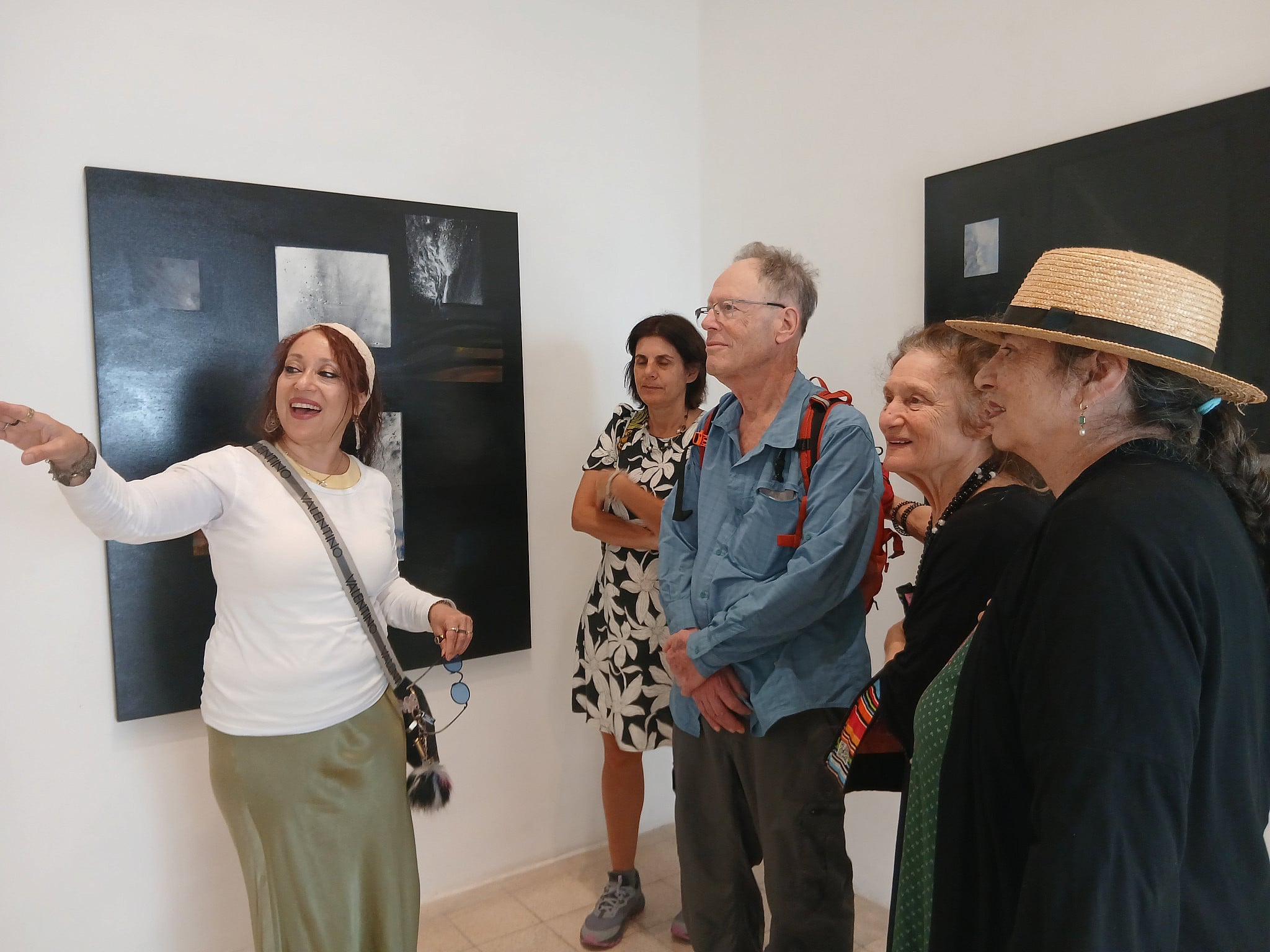
Raquel Sanchez introducing her works to visitors—pieces where words and pale lines emerge from darkness like whispered prayers. (Photo: Bonnie K. Goodman)
Exhibition: Raquel Sanchez: Light from Darkness
Curator: Vera Pilpoul
Venue: Marie Gallery, Jerusalem
Dates: October 31 — November 30, 2025
Artist Talk — November 27, 6:00 p.m.
Marie Gallery, Jerusalem
Featuring Raquel Sanchez, in conversation with artist Shai Azoulay and curator Vera Pilpoul, discussing her solo exhibition Light from Darkness.
In Light from Darkness, Paris-born artist Raquel Sanchez, raised across the U.S., Europe, and Latin America, Sanchez turns ordinary materials into vessels of meaning: torn lace, sandpaper, feathers, onion skin, ink, and eucalyptus leaves. Layer by layer, her paintings suggest repair, patience, and a deeply Jewish practice of making light present even when the world feels torn.
The Opening Light
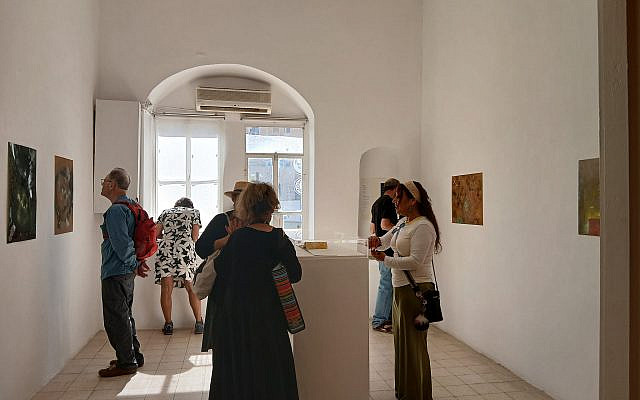
On a warm autumn morning in Jerusalem, the Marie Gallery glowed. Visitors drifted slowly between Sanchez’s canvases and mixed-media works, taking in surfaces that seemed to breathe: pale veils of pigment, stenciled lace, graphite marks, feathered forms, and fields of near-black where thin lines gleamed like threads. The exhibition’s title, Light from Darkness, felt less like a theme and more like an ethic — how to find clarity without denying fracture.
Curator Vera Pilpoul shaped the show as a gentle passage: bright canvases that open into rougher, intimate works on sandpaper and cardboard, concluding with black works where light is drawn rather than painted. Her aim, she told me, was to let viewers “move from brightness to difficulty to a distilled quiet,” so the installation itself teaches the eye to look, then to listen.
An Artist’s Journey
Sanchez’s path to this room began far from Jerusalem. She grew up moving between Paris, New York, Ibiza, Essaouira, and Caracas, always surrounded by artists, writers, and musicians. Creativity was the language of her childhood. As she put it in our conversation: “My father was the poet laureate of Venezuela and my mom, Ellen Lapidus Stern, is a painter and we grew up around writers and artists all the time… my stepdad was filmmaker.” That immersion formed a reflex toward making — words, color, images — in the midst of everyday life.
Yet her first professional devotion was to other people’s lives. Sanchez trained in social work, moved to Jerusalem, and poured years into founding and building what became Crossroads, a haven for at-risk youth. “Kids who think differently and don’t do well in school generally do great in the Arts,” she told me. She helped design a program that made the arts central — poetry, cooking, whatever could open a door. Creation was not extracurricular; it was lifeline.
Only later did she give herself full permission to return to artmaking. In New York, a gallery mentor pushed her toward risk. “He basically came to my house. He said, okay, now draw with your eyes closed. Now, imagine something — anything. Enjoy it with your eyes closed.” The exercise broke open a new way of working. “I found myself… in my own quiet… space. And it helped me.” When she chose to step forward as an artist without hedging, she said, “I decided to take myself seriously. And when I did, things changed.” A second change arrived with professional trust: “And then the second level was when… [the gallerist] took me seriously. And my work started to really sell. And that also changed things.”
From Canvas to Sandpaper
The gallery presents two bodies of work. The canvases — meditative fields with airy color — read like songs under the breath. But the works on paper, sandpaper, and treated cardboard supply the exhibition’s pulse. They began with a disappointment: “I had originally applied to the… biennale on shedding skin. I didn’t get in… I developed this idea.”
What emerged on these rough supports is a vocabulary of transformation. Sanchez threads actual lace through pigment, lets watercolor pencil and ink bleed and pool, beds down feathers and onion skins, and presses eucalyptus leaves so their veins become drawing. “Feathers… onion skin… ink, eucalyptus leaves which are like healing,” she listed while we spoke. “And… the lace, which is already torn… sandpaper — kind of coarse, like what it takes to shed skin… and cardboard… I had to treat it so that it would be permanent.”
Those choices aren’t decorative; they’re declarative. Lace arrives pre-broken — already torn — like a truth we carry. Sandpaper is honest about abrasion; change, she reminds us, is rarely polite. And cardboard, a humble packaging material, must be strengthened and sealed to last: repair as technique.
Pilpoul’s curation rests on Sanchez’s own year of constraint and adaptation. “It was a year that was hard for me to get to my studio,” the artist said. “And so, there were fewer paintings this past year on canvas and way more on paper… And… it’s cool though because… the results… were good… it was received well and people wanted to buy.” Pilpoul responded to that intimate scale, selecting paper works that show how meaning emerges from limitation. She places the sandpaper series centrally, then guides us into the black works where line becomes lantern.
Rather than imposing a thesis, Pilpoul’s wall text and installation choices let Sanchez’s own ideas carry the weight: shedding the skin of old habits, shalom bayit as practice, and the insistence that peace is made, not found.
Themes: Shedding, Listening, Repair
Sanchez’s language for this show is direct. “Shedding our skin — like it hurts to do it,” she said, “but it’s worth it.” That pain is etched into the surfaces: abraded, rubbed, re-layered. Inside the household register of shalom bayit, she finds a wider horizon: “What it takes to change so that you will have peace in yourself. Peace in… your home. And peace… in the country. And later in the outside world.”
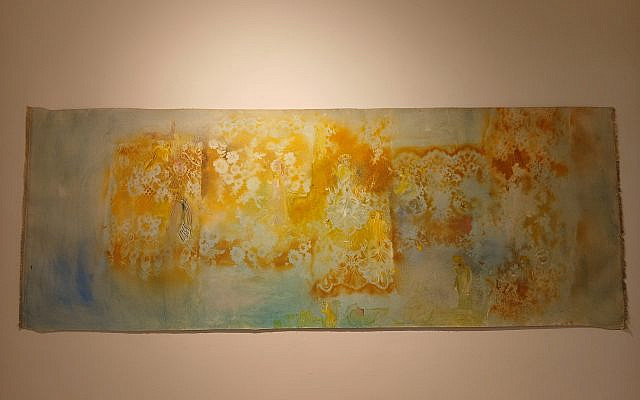
The works refuse easy symbols. A ballerina loses her head; a Mexican family appears; traces of the Nova Festival hover — glimpses that form a people’s mosaic, not a manifesto. “There’s all these different… aspects to who we are as a people,” she said. The point is not a single image but layered looking: “To show our intricacies and to show how much we need to change.”
The Black Works
Toward the end of the installation, the lighting softens. Here these black works hold the room like a held breath. White and pale lines float on darkness; words sometimes appear and recede. Sanchez described their clarity simply: “It’s very much more obvious with the black on the black paper and the light that’s drawn on there with the light colors.” The syntax mirrors the images — spare, exact, steady.
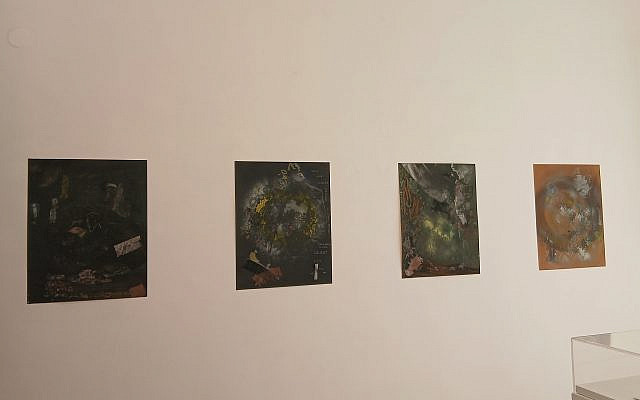
One piece reads as shelter — miklat — without insisting on the word. The surfaces feel prayed-over, not proclaimed. After October 7 and the long year that followed, Sanchez found a register that can acknowledge rupture without spectacle. As she put it when describing the year’s feeling: “Everything, the whole world felt torn.” If the canvases hum, these works listen.
An Afternoon with the Artist
A few days after the opening, we spoke again — this time in the car, late afternoon, as she navigated Jerusalem’s arteries going to attend an evening women’s havruta. The conversation moved easily between biography, materials, and the persistence it takes to keep making art in a complicated year.
We returned to how the show took shape. “She [the curator] connected this to the Light from Darkness… She fell in love with these works, and they weren’t originally accepted in the gallery because they were on paper… it was a year that was hard for me to get to my studio… way more on paper.” Sanchez was grateful for the trust. “I gave her her voice with my work,” she said of letting Pilpoul choose and place.
Her description of process was matter-of-fact, almost instructional: “I put these ideas together, cut out stuff, put stuff in and just made layer upon layer… anything that wasn’t average… sandpaper… cardboard… I had to treat it so that it would be permanent.” The goal isn’t polish; it’s truth. The surfaces remember every decision — abrasion, addition, restraint.
Traffic thickened; the sky went gold. We spoke about what the pieces seek: connection that begins close to home and opens outward. “Let’s do the most basic thing and have a connection between you and me,” she said. That line could stand as the show’s thesis. The rest is discipline: sanding, layering, listening for when to stop.
Seeing with Care
Part of the exhibition’s force is compositional. Sanchez balances sparse passages with intricacy: empty space beside a thicket of marks; a single fragment of lace beside a fugue of graphite. The eye has to move slowly to register what’s really there. She wanted that: “There’s so many things going on in each image… you have to look at them really good to see everything that’s there.”
What begins as mixed media resolves into moral method. Torn lace is not analogy; it’s evidence. A feather is not symbol; it’s weightless weight. Onion skin is another ordinary material Raquel transforms — fragile, ephemeral, yet essential to the layered surface.
Curator in Brief: Vera Pilpoul
Tel Aviv-based Vera Pilpoul is an art writer and curator known for exhibitions that explore spirituality, identity, and women’s creative labor in Israeli contemporary art. Here, she distilled Sanchez’s practice into a clear arc — canvases to sandpaper to black — and let the materials speak. Rather than press captions onto the works, she gave viewers room to slow down, to accept that revelation arrives gradually, like light adjusting in a dark room.
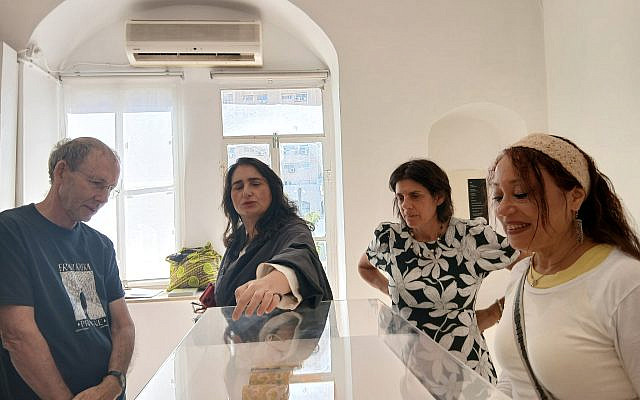
What struck me most, standing in the gallery after speaking with Sanchez, was how precisely Pilpoul’s curatorial framing mirrored the artist’s lived process. Pilpoul approaches the exhibition not as a mere arrangement of works, but as a profoundly theological structure, a way of returning the viewer to the origin point of creation itself. In her words:
“The title Light from Darkness situates Raquel Sanchez’s work within a broad conceptual and theological framework, the pre-cosmic moment evoked in the opening verses of Genesis: ‘…and the earth was without form and void, and darkness was upon the face of the deep… And God said: let there be light; and there was light.’ These verses do not merely serve as a point of reference but propose an ongoing practice: light is not an external essence that appears on the canvas but an inner unfolding, a sustained dialogue with matter and time, a cautious beam crystallizing from concealment.”
Pilpoul’s reading gives voice to what Sanchez herself articulates in a different register. In the car, she had described art as something she felt “pulled into,” a place where “light and quiet come together” and where she could “deal with everything that happened — the intifadas, 9/11, the kids at Crossroads, the storms inside myself.” What Pilpoul names as pre-cosmic darkness, Sanchez experiences as the lived space of uncertainty, vulnerability, and transformation.
That parallel — between theology and biography — becomes the exhibition’s secret engine
Shalom Bayit, Lace, and the Tactile Theology of the Everyday
Pilpoul writes:
“Sanchez’s paintings and monotypes contemplate processes of becoming. They dwell in a frayed, open space, before boundaries solidify, before the hierarchy between figure and ground is set. Light is shaped through darkness, emerging and seeping through dense material masses. In her work, darkness is not void but fertile ground, laden with symbolic, emotional, and material potential.”
In our conversation, Sanchez expanded on the materials: “I used sandpaper because shedding skin hurts. It’s rough. It’s effort. And I used lace because lace is already torn. Like us. We’re torn, but we’re still beautiful.”
In the Shalom Bayit monotypes, that torn lace becomes a contemplative device. Pilpoul again:
“In this latter series, conceived and created over the past two years, each pigment layer and each lace imprint perform an act of discernment, marking the primary separation between being and absence, body and space. Lace transcends its nostalgic, corporeal dimension to become a visual-conceptual device: a membrane through which revelation is filtered.”
The pairing of curator and artist becomes almost contrapuntal: Pilpoul names, Sanchez gestures; Pilpoul explicates, Sanchez intuits. Between them, the works acquire a dual coherence — philosophical and personal.
Sanchez summarized it simply: “Everything felt torn after October 7. Everything. The lace was my way of saying — here is what’s broken, and here is where the light gets in.”
Paper, Sandpaper, and the Ethics of Touch
The gallery walls alternate between canvases and the now-signature works on sandpaper. At first glance, the sandpaper pieces appear to belong to an entirely different artistic lineage — scratchy, granular, resistant. Yet Pilpoul identifies them as an extension of Sanchez’s ongoing inquiry:
“Sanchez employs material not only as a visual surface but as an investigative field: each pigment layer, each mark, is a mode of attentiveness, a slow and deliberate touch with the world.”
This attentive slowness is something Sanchez talks about often. “When I draw on sandpaper, it forces me to slow down. You can’t rush it. The paper will punish you. It’s like learning to listen again — to yourself, to the world, to God.”
The sandpaper pieces carry an intimacy the canvases do not. They are smaller, closer to the body, almost like diary pages written during wartime — layered with watercolor pencils, ink, acrylic washes, charcoal, and lace impressions: each piece a meditation in grit and tenderness.
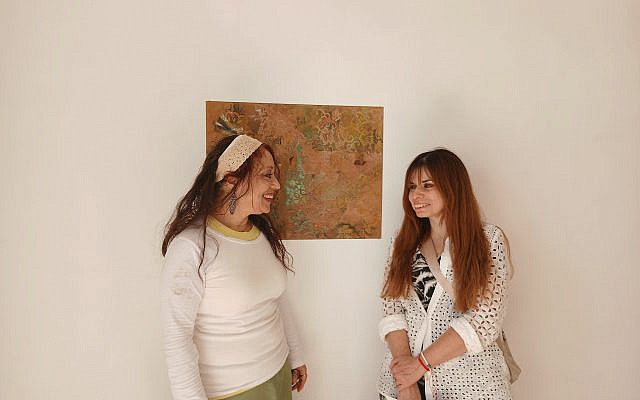
The Hidden Light and the Ethics of Looking
Pilpoul situates Sanchez’s work within a Jewish symbolic lineage:
“Many of her works resonate with Jewish traditions, particularly the Midrash of the Hidden Light, a remnant of the primordial light that, according to tradition, was preserved from the time of creation. This is not a symbol of absolute hope, but a quiet testimony, a subtle trace.”
In a world saturated with spectacle, Sanchez’s light refuses to dazzle. Pilpoul continues:
“In Jerusalem, a city layered with theological and historical intensities, the light in Sanchez’s work refuses to erupt. It is built gradually, through attention… Her work invites the gaze to slow down, to treat revelation as an ethical rather than merely aesthetic act.”
This echoes something Sanchez told me when I asked how she hopes viewers approach the works: “Slowly. With patience. With compassion. We’re not meant to understand everything right away. Not in life, not in art.”
Layers of Biography, Layers of Paint
Sanchez’s life, as recounted in our recorded conversation, is itself a study in layered becoming: daughter of a poet laureate, stepdaughter of a filmmaker, longtime social worker and founder of the Crossroads program for youth at risk, New York transplant, Jerusalem returnee, wife, sister, artist, student of Torah.
“When I took myself seriously, everything changed,” she told me. “Then the second change was when Uri Rosenbach took me seriously.”
That dual recognition — self and other — forms the backbone of her artistic evolution. “I worked with kids at risk for years. I loved them. Some still call me mom. But now I can breathe. Now I can be happy in a deep way.”
The paintings hold trauma, war, displacement, political tension, and religious searching. They contain feathers, onion skins, eucalyptus leaves — modest materials elevated into metaphors of healing and impermanence.
Listening Across Difference
Sanchez also spoke about the ethical work that begins at home and extends into how we live with disagreement: “We want to get along… Even if we don’t want to get along, we should get along… and we should start respecting one another.” She frames the listening she hopes for in simple, sturdy terms: “It’s not only about being heard… it’s listening to the other voices.”
The paintings practice the same posture. The black works do not shout; they attend. The paper pieces don’t perform; they invite. It’s a visual language that asks for reciprocity — what she called “the background and the foreground” learning to speak without drowning each other out.
After a Torn Year
Sanchez compared parts of this period to earlier seasons of constraint: “Another thing like Corona… deciding, okay, what am I going to do with all this energy… expressing myself when I feel trapped.” The works don’t dramatize that feeling; they metabolize it. The result is less a diary of events than a record of practice: show up, sand a little, add a little, stop a little sooner than you want to.
In that sense, Light from Darkness participates in a wider Israeli conversation about how to live honestly after rupture. Sanchez’s contribution is plainspoken and enduring: keep attending to the small things — the torn lace, the thin line, the steadying ground of shalom bayit — until a path for light appears.
Vera’s Vision: Curating as Revealing
Pilpoul concludes:
“Revelation, in art as in life, occurs on the threshold: a continuous act of separation, of distinguishing presence at the edge of disappearance. ‘Light from Darkness’ in Sanchez’s hands is not a final word, but a method. Powder, lace, chalk: in each work, light emerges in silence, as if for the very first time.”
Her reading of Sanchez is not ornamental; it is foundational. She articulates what the artist herself senses but often leaves unnamed — that the work is not meant to offer answers but to frame a set of practices: looking, listening, attending, discerning.
Sanchez calls this “finding quiet in the chaos.” Pilpoul calls it “a cautious beam crystallizing from concealment.” Both illuminate the same truth.
Conclusion: Quiet Radiance
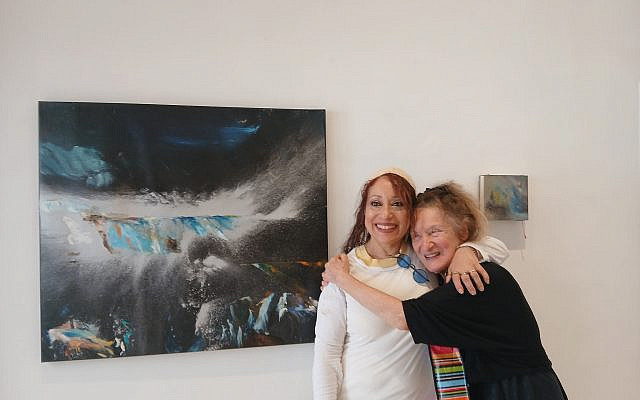
“I gave her her voice with my work,” Sanchez said about trusting her curator. It’s also what the art does for us. These pieces give viewers back a voice that is slower, gentler, more exacting — a way of looking that refuses both denial and despair.
Light from Darkness isn’t a spectacle; it’s a practice of attention. And in that practice, Sanchez makes a simple, durable claim: even when everything feels torn, there is work we can do with our hands — layering, sanding, mending — until light shows through.
© 2025 Bonnie K. Goodman. All rights reserved.