From Soviet Agitprop to Potemkin Scholarship: The Long Life of a Genocide Smear
The pageantry has changed, but the IAGS is restaging a decades-old script. And while the “genocide” charge remains baseless, the cynicism behind it deserves full exposure.
The charge of “genocide” against Israel has a long history. Two weeks ago, it took a dramatic turn, when the International Association of Genocide Scholars (IAGS) voted to adopt a resolution endorsing that charge.
At first, it looked like a textbook case of institutional capture. Like the Middle East Studies Association and the American Studies Association, which endorsed the academic boycott of Israel, or the American Association of University Professors (AAUP), which abandoned principle when it reversed its position that such boycotts violate academic freedom, many expected the IAGS to be another case in point.
Yet there was no capture to speak of. To call the IAGS an institution was generous: membership requires little more than paying dues. As commentator Salo Aizenberg quipped on X, he paid $30 and was admitted the same day. Still, the New York Times described the IAGS as “a leading group of academic experts on the topic.”
The resolution’s real purpose was not scholarly judgment but political theater—reinforcing a narrative among campus activists and projecting the appearance of expert consensus to the broader public. And the IAGS is hardly alone. While the AAUP has not officially endorsed the genocide allegation, its leadership has eagerly lobbed around charges of both genocide and “scholasticide.” The IAGS resolution will only serve to bolster that stance. At this rate, one half-expects the launch of an International Association of Scholasticide Scholars.
The Origins and Evolution of the Charge
For all the theatrics, the script is not new. The charge itself originated with Soviet propagandists after the defeat of Moscow’s Arab clients in 1967, in a conflict Egyptian President Gamal Nasser had vowed would be a “war of annihilation” against Israel.
The charge did not disappear. It resurfaced in the NGO Forum at the World Conference Against Racism in Durban in 2001. Ostensibly convened to combat racism, the real purpose of the conference was to brand Israel a racist state.
The genocide charge was picked up by Norman Finkelstein, the notorious scholar-activist who accused Israel of carrying out a “slow-motion genocide” after Israel’s 2005 withdrawal from Gaza. This was at a time when activists were casting about for a rationale for Hamas’s continued attacks from Gaza, and Finkelstein’s framing provided one. That framing kept the accusation alive on the margins of academia and activism until it was revived on a larger scale during Israel’s 2014 war with Hamas.
Roughly 2,100 Gazans were killed in that war—about half of them combatants—yet activists and celebrities seized on the moment to brand the war as genocide. The accusation was then codified in the 2016 Movement for Black Lives platform.
It was revived again soon after Hamas’s October 7, 2023, massacres across southern Israel, as Israeli ground forces prepared to enter Gaza. A few weeks into Israel’s ground campaign, New York Times columnist Nicholas Kristof sensationally compared “the pace of killing civilians” in Gaza to that of the 1994 Rwandan Genocide, when over 800,000 were slaughtered in 100 days. Yet nearly two years later, even according to Hamas’s (inflated) figures, the Gaza death toll stands at 63,000—an order of magnitude below Kristof’s implied comparison.
That kind of hyperbole gave South Africa—backed by Iran and Qatar—cover to bring a genocide case against Israel at the International Court of Justice in December 2023. When the case stalled, Ireland urged the court to broaden its interpretation of genocide, admitting that Israel’s actions did not meet the existing standard.
Meanwhile, Piers Morgan Uncensored helped mainstream the genocide charge. Among his first guests was Finkelstein, who had written on October 7—as Hamas livestreamed its massacre—that “It warms every fiber of my soul.”
In Congress, the Squad had made the genocide charge their latest anti-Israel refrain. On July 30, 2025, Bernie Sanders gave it new force from the Senate floor, declaring that Israel had waged an “all-out, illegal, immoral and horrific war of annihilation against the Palestinian people.” Days earlier, he had accused the Netanyahu government of “extermination.” Obama aides Ben Rhodes and Tommy Vietor, alongside a network of human rights organizations backed by the Open Society Foundations (OSF), amplified the claim.
Potemkin Scholarship and Media Stagecraft
We learned what all of this was building toward two weeks ago, when the IAGS conferred its scholarly imprimatur. The resolution declared that Israel’s actions in Gaza met the UN’s definition of genocide. Headlines proclaimed: “Israel Committing Genocide in Gaza, World’s Leading Experts Say” (BBC), “Israel’s Actions in Gaza Are Genocide, Says Association” (Time), “International Association of Genocide Scholars: Israel Is Committing Genocide” (The Guardian), and “Israel’s Gaza Campaign Amounts to Genocide, Say Scholars” (Financial Times).
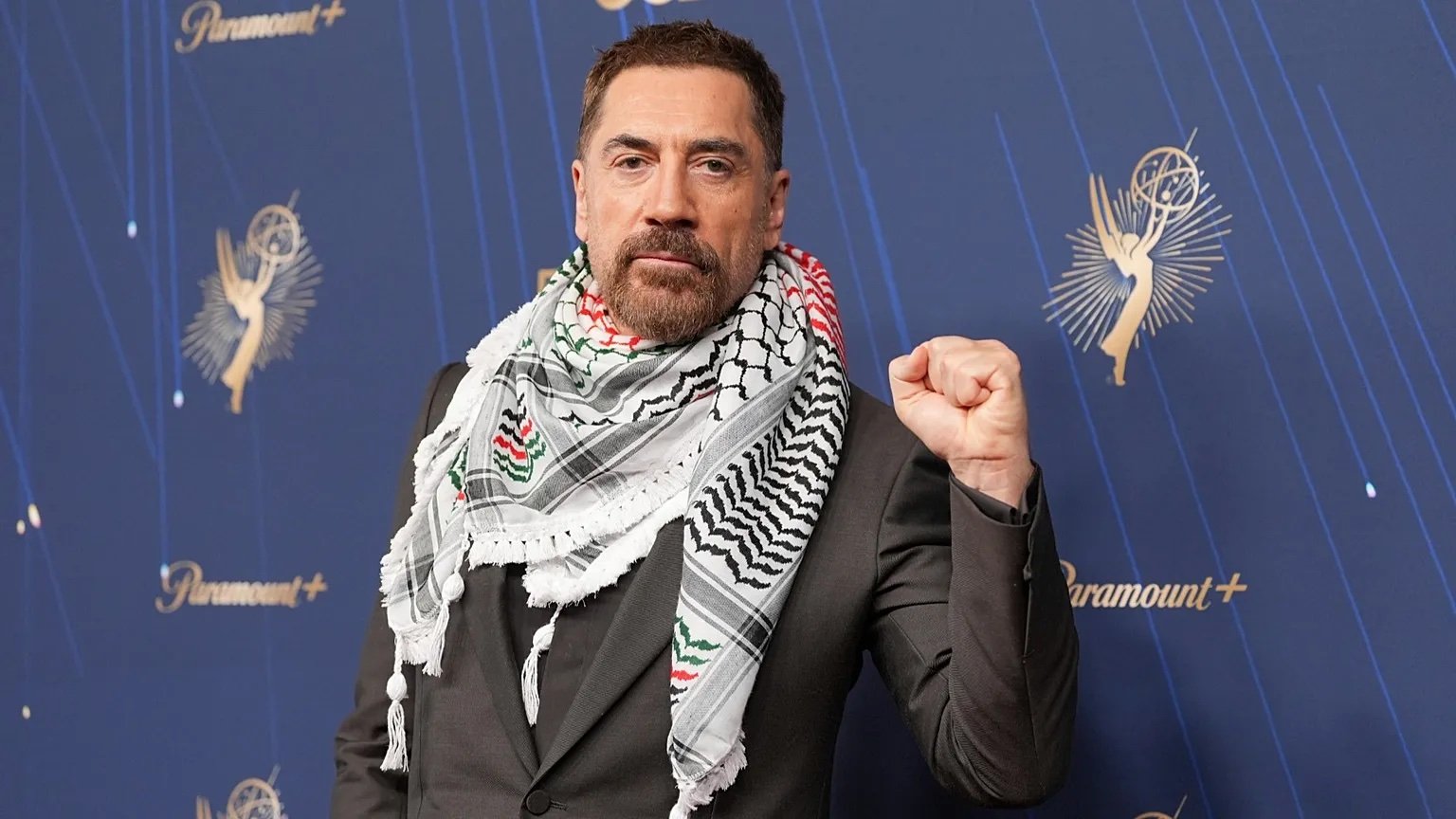
When Javier Bardem—a figure not known for his erudition—name-checked the IAGS at the Emmy Awards, the resolution reached full pop-culture sanctification, riding the same wave of unreality as Greta Thuberg’s selfie flotillas.
Headline readers would not have known that only 129 of some 500 members voted—never mind that anyone with $30 can join. In the IAGS, these outlets had found their Potemkin village: a shell institution paraded as the somber consensus of experts.
The timing was hardly coincidental: on September 1, the anniversary of Germany’s invasion of Poland, the IAGS resolution placed Israel in the legal category devised in response to Hitler’s crimes.
Yet the text was riddled with distortions. Chief among them was the claim that the ICJ had already found it “plausible that Israel is committing genocide” in Gaza. In reality, the Court affirmed only that Palestinians have “plausible rights” to protection from genocide, and that continuing the conflict “risked” violating those rights—grounds for provisional measures, not a judgment on the merits. So how did these supposed experts make such a glaring error—the same “error” Finkelstein made when he accused a former ICJ head of “shamelessly lying” about what the Court had actually said?
The IAGS’s sources are telling. In addition to the UN, it cited six NGOs: Amnesty International, Human Rights Watch, B’Tselem, Forensic Architecture, Democracy for the Arab World Now (DAWN), and Physicians for Human Rights. Every one of them has received major funding from OSF. DAWN’s executive director, Sarah Leah Whitson, once fundraised for HRW in Saudi Arabia’s Shura Council, touting the organization’s record of anti-Israel advocacy—a reminder of how tightly these networks are intertwined.
The genocide charge is part of an information war designed to shape Western opinion. Images of children with preexisting medical conditions have been presented as proof of mass starvation—while independently verified photographs of famine-level emaciation were notably absent. In June 2024, Bernie Sanders set the precedent by displaying such images in the Senate without documentation. The BBC aired, then pulled, a Gaza documentary narrated by a 13-year-old later revealed to be the son of a senior Hamas official. Soon after, German reporters alleged staged photo-ops in viral images.
Meanwhile, the same outlets that amplify these claims have downplayed images of 24-year-old hostage Evyatar David—reduced to a living skeleton and forced to dig his own grave in a tunnel. In this way, the information war against Israel doubles as a psychological operation against the American public, designed to erode support for Israel and to render the line between reality and make-believe illegible.
One day after the IAGS resolution, the Begin–Sadat Center for Strategic Studies released Debunking the Genocide Allegations, a 311-page, data-driven audit of the Gaza war that tests casualty claims, targeting, and food-truck deliveries against primary sources. It is arguably the most comprehensive to date. Yet none of the aforementioned outlets even acknowledged it.
Repudiating the Smear
With reality under assault from our sense-making institutions themselves, it’s essential to set out why the genocide charge is so deeply cynical. By my count, there are nine reasons.
First, Israel has gone to unprecedented lengths to minimize civilian casualties in a war it did not seek—dropping leaflets, making phone calls, evacuating civilians, and putting its soldiers at increased risk.
Second, Israel has facilitated the entry of two million tons of aid into Gaza—feeding the enemy on an unprecedented scale—even as Egypt has kept its own border largely shut.
Third, Hamas faced a moment of great vulnerability in November 2023. It was saved by U.S. pressure on Israel—and an emergency financial lifeline from USAID.
Fourth, Hamas has pursued an avowed strategy of human sacrifice, counting on civilian deaths to win the information war. The media made that strategy viable, giving Hamas an incentive to keep fighting—and prolonging the very conflict it branded as genocide.
Fifth, even Hamas’s casualty figures belie the allegation. As British Army Major (ret.) and defense analyst Andrew Fox observed, “More bombs have been dropped in Gaza than people have been killed.”
Sixth, the IAGS resolution cheapens the very concept it invokes. By wielding the word reserved for the most serious of crimes as a political weapon, it empties “genocide” of meaning—robbing it of the moral force that word was meant to carry.
Seventh, the October 7 massacres were genocidal in both intent and execution—planned as the opening act of a multi-front war to eradicate Israel’s Jews. Accusing Israel of this crime grotesquely inverted this reality.
Eighth, the moral inversion serves to mobilize genocidal hostility toward Jews. This hostility was primed to ignite on American campuses on October 8 and has only intensified since, culminating in assaults, firebombings, and deadly violence. As the collaboration of media, NGOs, and academic associations shows, the mobilization is anything but spontaneous.
Ninth, Hamas immediately vowed to repeat October 7. Given the chance to do so, it will enjoy the backing of the same networks that choreographed the illusion of genocide.
For those who saw through this illusion, our truth-seeking institutions had become unrecognizable. For those swept up in it, the illusion supplied moral inversion, manufactured consensus, and a scapegoat—the core elements of a totalizing ideology.