
Foreign Policy Analyst | India, Israel & Middle East
From Tehran to Kashmir: The New Terror Challenge
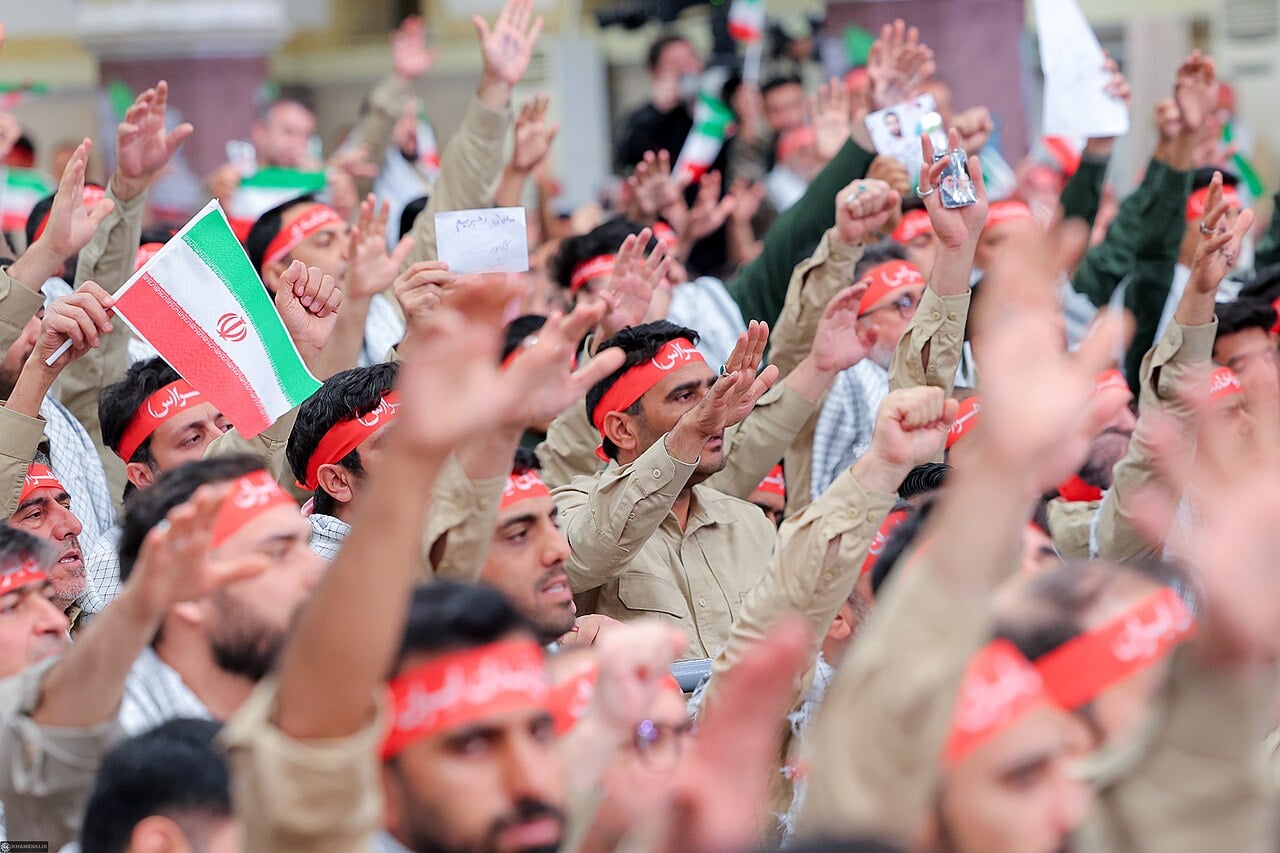
Photo: Khamenei.ir, via Wikimedia Commons, CC BY 4.0
Terrorism and security are evolving as the outcome of the growing use of networks as tools of control, monitoring, and violence. The same strategic change is playing out in diverse ways, from Iran’s increasing intelligence networks inside society to Pakistan’s cross-border terror ecosystem based out of Pakistan Occupied Kashmir (PoK).
One such major development unfolded in Iran, and it deserves the focus of anyone keeping tabs on worldwide security risks. Hossein Taeb was named commander of the Basij paramilitary organization on August 10, 2026, by Mojtaba Khamenei, the new supreme leader of Iran. Taeb is no average bureaucrat. In 2009, amid Iran’s brutal suppression of the Green Movement rallies, he oversaw the Basij. He eventually headed the IRGC’s intelligence service for thirteen years. Both the United States and the European Union imposed sanctions on him in 2011 and 2010, respectively. At the same time, Pakistan’s growing terror networks are using overseas experience and tactical learning, especially from Hamas, to expand their influence throughout Kashmir. These advances provide a new challenge for intelligence and counter terrorist organizations in India, since they illustrate how networks may serve quite diverse purposes, such as domestic surveillance in Iran and cross-border terrorism from Pakistan.
Iran’s Shift Towards Networked Internal Surveillance
In the appointment order, Khamenei directed Taeb to “strengthen the popular intelligence network” and deploy more innovative technology for a “people-based” reaction. Across Iran, the Basij has already spread to neighborhoods, schools, businesses, and mosques. Now, obtaining intelligence is at the top of Taeb’s priority list.
Just weeks before, in July 2026, India’s Ministry of Home Affairs labeled 23 Pakistani nationals as terrorists using the Unlawful Activities (Prevention) Act. Seventeen of them are Pakistani and six are Indian. Nevertheless, they are described as operating from Pakistan-occupied Kashmir (PoK). They are linked to Jaish-e-Mohammed, Lashkar-e-Taiba, and other militant organizations, with their activities including recruiting members, facilitating infiltration, supplying weapons, providing financial support, and organizing terrorist attacks. At the surface level these two developments, Iran taking surveillance deeper into ordinary life and Pakistan developing a cross-border terror ecosystem, may not seem to be connected. In fact, they are diverse representations of the same strategic reality. Both want to make networks the tools of power, but in very different ways. For the Indian intelligence specialist, this is not just an academic exercise, but one of urgent operational consequence.
When Khamenei told Taeb to “strengthen the popular intelligence network,” and that he should use more advanced technologies for a “people-based” reaction, he was speaking more than politics. The order is basically a strategic roadmap for the expansion of society monitoring via a permanent intelligence network integrated in mosques, schools, colleges, workplaces, neighborhoods and streets. The goal is to discover indicators of public dissatisfaction early, so authorities can see and react to any disturbance before it escalates into organized demonstrations. This strategy has been backed by the IRGC-affiliated Fars News Agency, which has called on mosques and Basij sites to create local networks to “identify vulnerable individuals and suspicious actors” and crush any public demonstrations. This is more than just countering external dangers. It is an aggressive approach designed to discover and pre-empt internal opposition before it escalates into organized disorder. Consequently, Iran sees its own frontiers as the principal arena of conflict.
Pakistan’s Cross-Border Terror Ecosystem
Pakistan’s viewpoint contrasts sharply. Its approach is to project influence and violence outside, via a complex cross-border ecosystem of terrorist networks, rather than to concentrate on internal resilience and repressing dissent at home. The July 2026 UAPA designations therefore offer more than a list of names; they provide a clearer picture of the operational architecture India confronts. The 23 individuals designated, including 17 Pakistani nationals and 6 Indian nationals, operate from Pakistan and Pakistan occupied Jammu and Kashmir and are involved across different stages of the terrorist ecosystem, from recruitment and training to infiltration, logistics, financing, arms supply, drone based weapons delivery and attack planning. Particularly noteworthy is the presence of Mohammed Shaheed Faisal, an engineer based in Bengaluru. His alleged recruitment of young people via social media and their training in data encryption and the use of false identities shows how these networks have moved beyond traditional paramilitary operations and are increasingly using digital devices and technological skills.
What makes this ecosystem more dangerous is its ability to innovate at the tactical level. In August 2026, intelligence sources discovered a strategic partnership between Hamas and Pakistani militant groups, including Lashkar-e-taiba and Jaish-e-Mohammed, and they reported that the ISI and Pakistan’s military establishment were actively supporting it. The goal is to train these organizations “up to Hamas operational standards,” allowing them to withstand a lengthy conflict with Indian armed forces while learning from Hamas’ use of tunnel warfare in Gaza. Pakistani terror organizations might use Hamas’s skills in guerilla warfare and tunnel infrastructure to create comparable capabilities in Pakistan held Kashmir. If such networks were to emerge, Indian troops may have to contend with a more sophisticated type of asymmetric warfare, with subterranean tunnels providing terrorists with hidden routes of transportation, storage, infiltration and assaults, posing issues comparable those encountered by Israel in Gaza.
Iran and Pakistan: One Strategic Insight, Two Opposite Models
A strategic convergence point is crucial to this issue. Both Iran and Pakistan acknowledge that the future of security is dependent on networks rather than organizations, but they come to quite different conclusions about how to put that insight into action. Iran is building an intelligence network to identify, infiltrate and eliminate threats from inside, in a defensive, inward-looking stance that focuses on regime survival. Meanwhile, Pakistan is building networks to project threats beyond its boundaries. It has an offensive paradigm that offers strategic reach but with plausible deniability. However, below the difference lies a common intelligence lesson. The distinctions between terrorist groups, rebel movements, proxy armies and political players are becoming more blurred. The danger is no longer just the organization itself, but the network that unites its people, capabilities, finance, technology and operating channels.
PRAHAAR and India’s Response to Networked Terrorism
India’s PRAHAAR (National Counter Terrorism Policy and Strategy) strategy, issued in February 2026, acknowledges the evolving nature of terrorism primarily by identifying that terrorist organizations are increasingly exploiting organized criminal networks for logistics and recruiting to enable strikes in India. It sheds light on the increasing abuse of new technology for disinformation, communication, funding, and attack planning, including crypto wallets, the dark web, social media, and encryption. The strategy also points out the possible use of CBRNED materials and the exploitation of drones and robotics by state and non state actors for deadly purposes as important problems for India’s anti-terror authorities.
Operational Implications for Indian Intelligence
This comparative analysis has significant operational implications for the Indian intelligence agencies. First, the adversary’s adaptability is rising. The Hamas, LeT and JeM axis is a conscious endeavor to absorb and reproduce tactical ideas established in other theaters of battle. Therefore, India’s counter terrorism apparatus must go beyond Pakistan and watch global terrorist networks, conflict zones and burgeoning centers of terrorist innovation where new tactics, technology and operational procedures are being created. Second, the role of the financial ecosystem is just as important as the role of the operational environment. The UAPA designations provide ways to seize assets and disrupt finances, but these instruments need to be utilized proactively, especially since terrorist networks are increasingly using crypto wallets and the dark web to hide their operations. Consequently, tracing the funds is just as crucial as capturing the assailant. Third, field intelligence is still important. PRAHAAR’s focus on an intelligence driven preventative strategy based on real time information sharing is valid, but its performance is contingent upon robust community level intelligence networks. India should consequently develop its own domestic intelligence capability in a legal and intelligence-driven manner, rather than following Iran’s coercive model.
Fourth, technology is a double-edged sword. The instruments that terrorist networks rely on, from encryption to drones to cryptocurrencies, may be used to monitor, disrupt and destroy them. This awareness is shown in PRAHAAR’s focus on monitoring bitcoin wallets and thwarting dark web funding. Fifth, it is imperative to enhance cross-border intelligence collaboration. The link between Hamas, LeT and JeM suggests that terrorist networks are becoming more international, so persistent information sharing across borders are crucial to confront them. PRAHAAR acknowledges that to tackle transnational terrorism effectively, international and regional cooperation are necessary complements to national efforts.
Conclusion
Both Iran and Pakistan have come to the strategic realization that networks are becoming more important than organizations, but they are taking different approaches based on this realization. Iran is creating networks for monitoring and controlling its populace while Pakistan is creating networks for the projection of terrorism outside its boundaries. India’s goal is to identify, map and destroy both kinds of networked danger without copying either paradigm. The next generation of counter terrorism will thus not only depend on the ability to attack terrorist organizations, but on the ability to identify, monitor and destroy the networks of people, funding, technology and logistics that maintain them. This technique has its theological basis in PRAHAAR, which India has. The key strategic challenge today is to translate that framework into sustainable operational capabilities.
Related Posts