From the Cemetery to the Maternity Ward
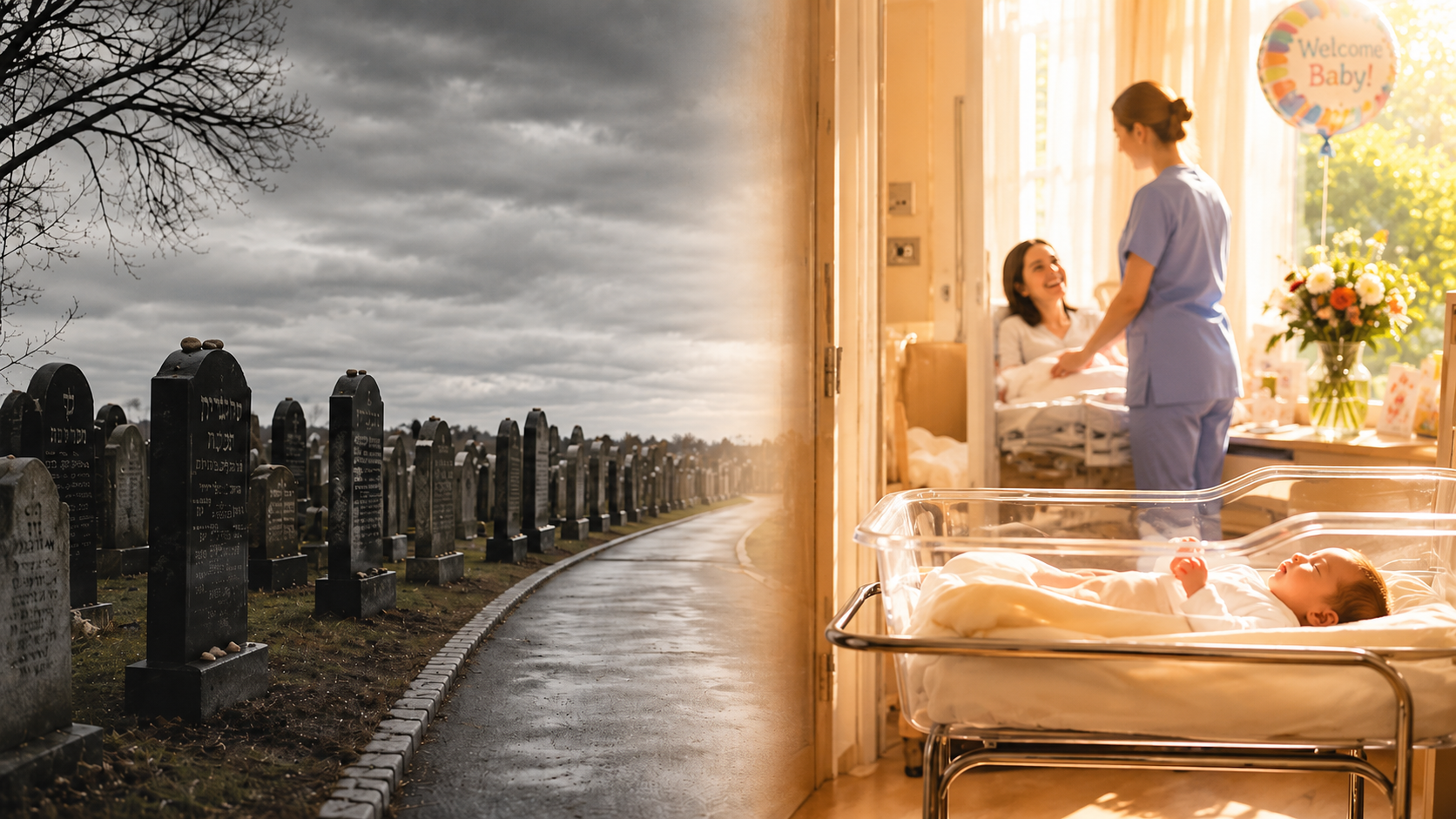
This Monday, I drove from one end of the universe to the other.
Not literally, of course. I was only driving a few short miles from the cemetery, where I had just completed a funeral, and heading straight back to the maternity ward of the hospital, where Chana and our brand-new baby son were waiting for me.
But emotionally and spiritually, it felt like I was traveling from one world to another.
From a place of tears to a place of joy. From a place of loss to a place of birth.
From a place that overwhelms you with death to a place so full of new life.
As I was driving, I could not stop thinking about the contrast. The cemetery is so respectful and still. The maternity ward is so full of hustle and noise. A cemetery makes you think about the end. A maternity ward is all about new beginnings.
But then I thought about it a little more.
Is a cemetery really only a place of death?
I was just there, and I’m alive. The family was alive. The friends who came to honor and remember were alive, standing there with love, memories, and loyalty.
And is a hospital really only a place of life?
Sadly, I have been in hospitals many times for very different reasons. I have stood at many bedsides where life was slipping away. I have been there with families at those most painful moments of loss and death.
So what defines a place? Is it just who is there? Is it what most people are doing there?
And somewhere on that drive between the cemetery and the hospital, I realized that the difference between these two places is not only what happens there, but WHY people go there.
A hospital is a place of life because that is its purpose. People go there to fight for life, to be healed, and to bring new life into the world. Even when there is pain, and even when there is death, the mission of the hospital remains a place for preserving life.
A cemetery is different. Even though living people are there, even though holy and beautiful things happen there, its purpose is to bury, to mourn, and to remember those who have passed on from this world.
A place is defined by its purpose. Not only by what is there, but by what it is there for.
And then I thought about my tiny son, just twenty-four hours old.
His life is just beginning. Like every child, he will hopefully have many years, many blessings, and many moments of joy.
But like all of us, he will also have moments of weakness, laziness, frustration, and temptation.
That is part of being human. The ups and downs.
We all have moments that are alive with meaning. A prayer said with sincerity. A mitzvah done with joy. A kind word when someone needed it. A few minutes of Torah learning. A dollar given to charity. A choice to forgive.
Those moments live forever.
But then there are other moments. Moments of selfishness. Moments of laziness. Moments when we live only for comfort, pleasure, ego, or convenience.
Those moments may feel very alive at the time. They may be exciting and enjoyable. But they do not last.
The Talmud says that the righteous are called alive even after they pass, while the wicked are called dead even during their lifetime. At first, that sounds strange. If someone is breathing, he is alive. If someone has passed away, he is no longer alive. What does the Talmud mean?
Chassidus explains that when something is connected to G-d, it is connected to eternity. A mitzvah is not just a good deed that happened once and disappeared. It creates an infinite light that changes the world. It becomes part of the eternal purpose for which we were created.
These holy moments are alive because they carry eternity within them.
And other moments are spiritually empty, because they begin and end with the self.
This does not mean that we must live perfect lives. Nobody does. Just like a hospital still has pain, and a maternity ward still has exhaustion, a place of life does not mean there is never darkness there.
But the question to ask is: What is the purpose of this place? Is this a place dedicated to life, or a place defined by death?
I know that not every moment of my son’s life will be perfect. There is nothing I can do about this reality of life.
But as his parent, I can try to teach him how to define himself when he grows up, and how to understand the purpose of his life’s journey.
This is one of the powerful messages in this week’s Torah portion.
The Jewish people spent 40 years traveling through the desert. Sometimes they camped for a day, sometimes for many days. Sometimes the journey felt clear, sometimes it felt confusing. But the Torah tells us, “By the word of G-d they camped, and by the word of G-d they traveled.”
The main point was not how long they stayed in each place, or whether each stop felt easy or hard. The key was knowing that the journey had direction. That they were being led by G-d.
That is what gives life its identity.
A person can have hard stops and still be on a holy journey. A person can have confusing chapters and still be moving toward his divine destination. A hospital is still a place of life, even when painful things happen along the way.
In the bassinet next to our baby, there was a dollar bill.
It was not just any dollar bill. It was a dollar that the Rebbe had given Chana when she was a small girl, for her to give to charity.
One of the nurses noticed it and said, “Look, his first dollar bill. Someone is teaching him to become a millionaire.”
She smiled and said it in a cute way, but I imagine she may have been thinking about those stereotypical money-hungry Jews who are teaching their children to worship money from the day they are born.
She could not have been more wrong about how we view money.
For us, putting that dollar bill in the bassinet meant the exact opposite of teaching a child to chase money.
It meant that from the first moments of his life, we want him to know that money has a purpose. Money can feed a hungry person. Money can help a child learn Torah. Money can bring Shabbos candles into a home. Money can build a shul, support a family, comfort someone in pain, and create more goodness in the world.
The true value of money depends on the purpose we give it. Just like everything else in life.
This week, I drove from a cemetery to a maternity ward. But really, all of us make that journey every day.
Every morning, we choose what kind of place our life will be. A place where holiness occasionally visits, or a place whose purpose is life. A place where G-d makes an occasional visit, or a place where the whole journey is lived “by the mouth of G-d.”
If a person defines life as self-gratification, personal success, comfort, and pleasure, then even the holy moments of our life become like occasional visitors in a cemetery. Respectful and meaningful, but temporary. They do not define the place.
But if I define the purpose of my life to serve G-d, to bring kindness into the world, to raise a family with values, to help another person, to build something meaningful, then my life is like a maternity ward. It’s a place dedicated to giving birth and creating life.
Even if I sometimes fall. Even if I sometimes waste time. Even if I sometimes give in to comfort or ego. Those are spiritually dead moments, but they do not define the whole place.
My new son, and all of us, will have mixed moments. We will all have hospital moments and cemetery moments. We will all have moments of joy and sadness, strength and struggle.
But we can choose the purpose.
We can choose to make our homes places of life. We can choose to make our money a tool for life and our words a source of life. We can choose to make our journey one led by G-d.
And when that becomes the purpose, then even the ordinary moments begin to live forever.
May we be blessed to raise our children to live lives that are not only full of days, but days full of life.
Good Shabbos,
Rabbi Yankie & Chana Denburg