
Liberal Zionist
Featured Post
From the Kotel to Iran: Protest matters
At 17, I was detained by the police for wearing a tallit at the Western Wall. Then I was released and I did it again. And again. Iranians should have the same right
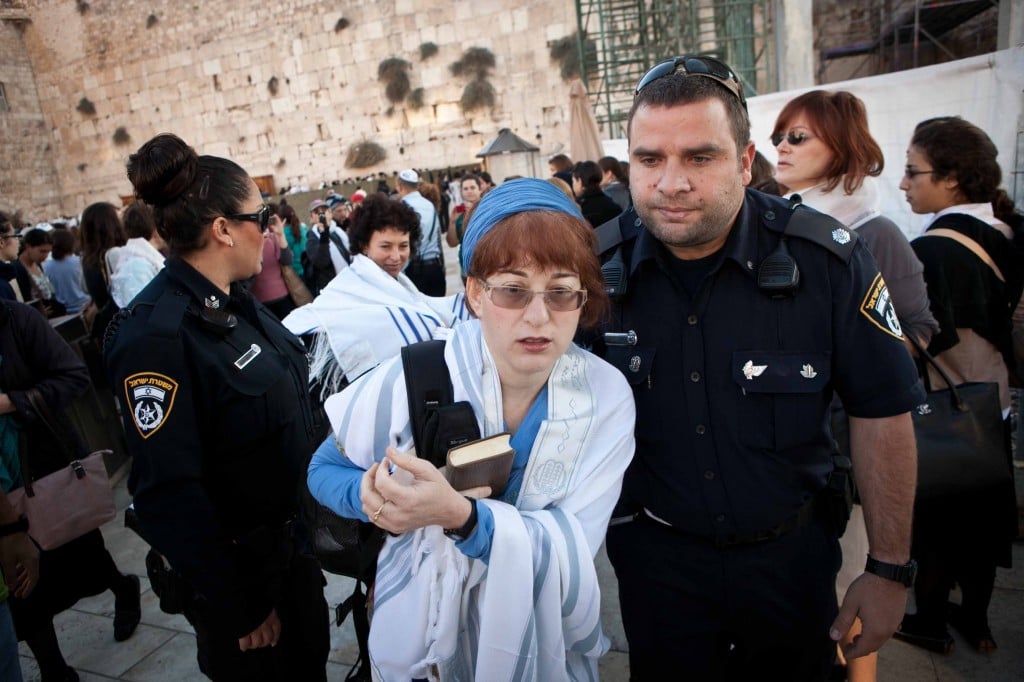
Illustrative. A woman is arrested for wearing a prayer shawl at the Western Wall in November 2012. (courtesy, Woman of the Wall)
Arrested in a Democracy
Thirteen years ago today, I was arrested at the Western Wall. I was 17 years old, standing next to my mom and the women of Women of the Wall. Our “crime”? Wearing a tallit, a Jewish prayer shawl, as women in the women’s section of one of Judaism’s holiest sites.
I was detained. Questioned. Taken in by police. And then I was released.
When I think about that day now, I cannot separate it from what has been happening in our region, especially over the past few weeks.
In Iran, protesters continue to be killed for dissent. Young people are executed after sham trials. Women are imprisoned for demanding basic autonomy. Families bury their children for speaking out. In authoritarian regimes, civil disobedience can cost you your life.
And here I was, a Jewish teenage girl arrested for praying.
Released the same day.
Given due process.
Able to speak publicly.
Able to continue organizing.
That contrast is not abstract.
Israel is deeply imperfect. Religious freedom here remains contested terrain. Pluralistic Judaism is not fully recognized. The Orthodox monopoly over marriage and conversion continues to shape millions of lives. Women still do not have full equality in religious spaces. There is still so much to fight for.
But I was arrested in the only democracy in the Middle East.
I did not fear execution.
I did not fear disappearance.
I did not fear that my activism would cost me my life.
And that matters.
When Democracy Moves
At the time of my arrest, women wearing tallitot at the Kotel could be detained under policies enforcing “local custom.” Our prayer was treated as a disruption. Our presence was framed as provocation.
We kept showing up. Month after month, Women of the Wall returned. Lawyers fought. The country debated whether women’s prayer was a threat or a right.
And two months later, the legal basis that allowed women to be detained for wearing a tallit was overturned. The arrests stopped. The policy shifted.
Two months.
Not because change is usually that fast. It is not. Women of the Wall had been fighting for decades before my arrest. But in that moment, the public pressure, legal advocacy, media attention, and civil disobedience all converged. The system responded.
That is the power of organized resistance inside a democracy.
We showed up.
We were arrested.
We went to court.
We told the story.
And the law changed.
It did not fix everything. Religious equality in Israel is still unfinished work. But that moment proved something to me at 17 that I have carried ever since. Civil disobedience is not just symbolic. Social action is not just noise. Visibility can force institutions to move.
Holding Perspective
Watching what is happening in Iran over the past weeks makes that perspective sharper. There, dissent can cost you your life. Here, dissent can change the law.
That does not mean we stop pushing. Rather, it means we do not ignore the ways Israel falls short. It means we understand the responsibility that comes with democratic space.
I am proud of that arrest, proud that, at 17, I stood for the kind of Judaism I believe in: expansive, pluralistic, rooted in equality. And I am profoundly aware of the privilege embedded in that pride.
To fight the state and remain free.
To challenge policy and see it evolve.
To keep organizing openly.
Especially in this region.
Thirteen years ago, I was arrested for wearing a tallit.
Today, women pray at the Western Wall wearing tallitot without being detained.
The work is not finished. Religious equality in Israel is still incomplete. But I remain grateful and deeply aware of the responsibility that I get to keep pushing for change in a place where protest can lead to policy reform, not a funeral.
—
A Call to Action
We know what it means to show up. We know what it means to demand change. We know that public pressure matters. Join me this Saturday evening at 19:30, February 14, 2025, outside the US consulate in Tel Aviv at a rally standing in support of the brave Iranian people.
Solidarity does not stop at borders.
Related Topics
Related Posts