
99.6% Ashkenazi + .4% Viking = 100% Zionist
From the River to the Sea, and Somewhere in Between
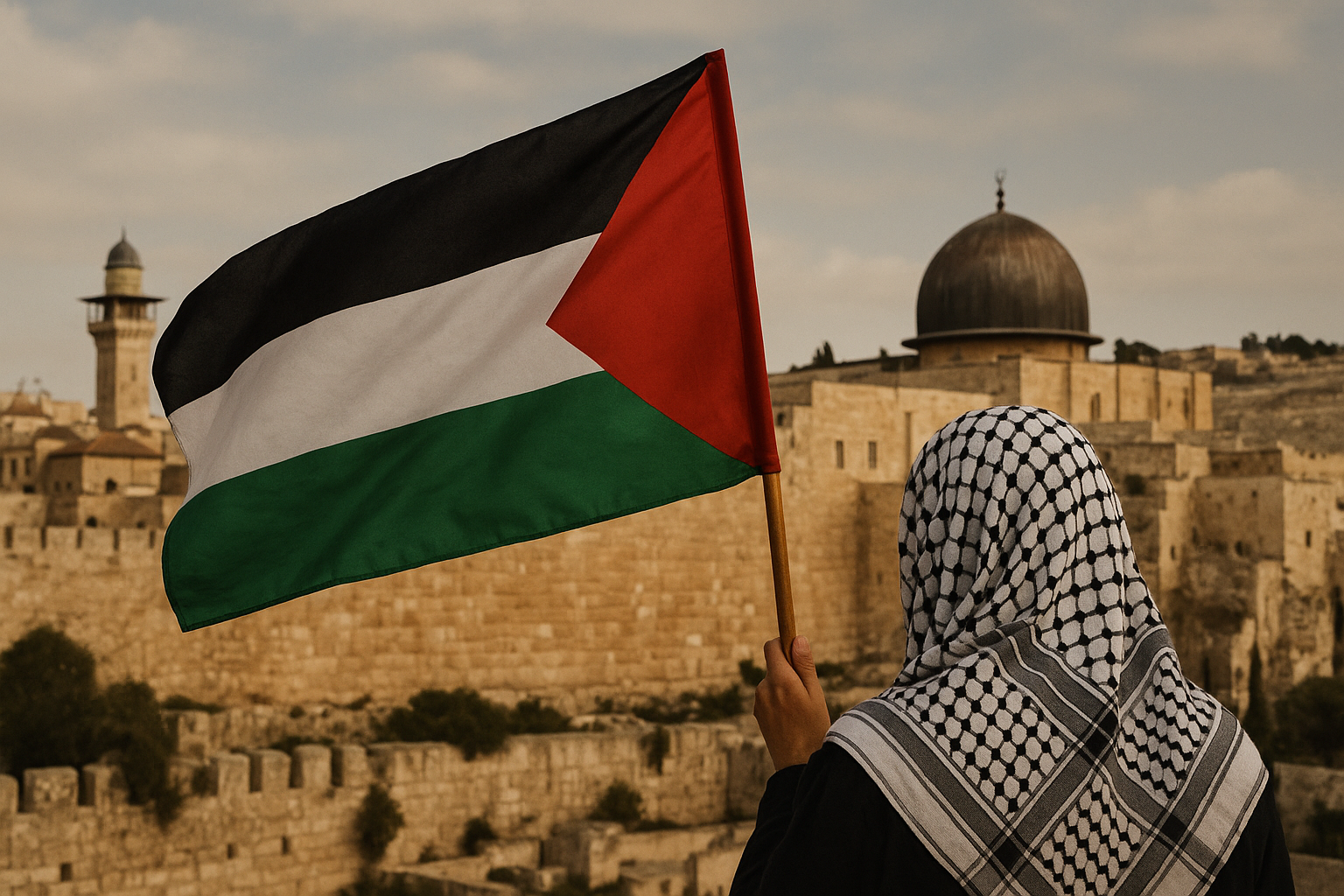
From the River. (AI-generated image)
If I moved to Florida, I’d be a Floridian. If I moved again to Texas, I’d be a Texan. But I was born in California, and for better or worse, that’s still how I see myself. Our identity is often tied to geography—but geography doesn’t always equal nationhood. That distinction has been gnawing at me lately, especially when I consider the people who now call themselves Palestinian.
Recently, someone responded to one of my op-eds by accusing me of historical inaccuracy. The piece explored Palestinian identity, and I was taken aback by the claim. I reread the article—twice—and even ran it through an AI tool to check for factual errors. The verdict? No historical inaccuracies. But the feedback was still enlightening: while my assertions were technically true, they could be perceived as biased or overly blunt, and perhaps too dismissive of nuance.
Fair enough. I’ll own that. I have strong opinions. But I also care deeply about truth—especially the kind that can’t be neatly distilled into slogans or hashtags. And if we’re going to discuss identity and history, let’s do it honestly, even if it means sitting with uncomfortable contradictions.
Here’s where I’m coming from: I don’t deny the existence of people who identify today as Palestinian. Nor do I deny that they’ve lived in the region for generations—many for centuries. But the notion of a sovereign Palestinian people with deep-rooted national identity stretching back through the ages—that’s where I draw a firm line. Because that version of history simply isn’t supported by facts.
The Levant has always been home to a mosaic of peoples—Christians, Muslims, Jews, Druze, Bedouins. They lived in cities and villages across what we now call Israel, Gaza, Jordan, Lebanon, Syria, and Judea and Samaria—the area the modern world typically refers to as the West Bank. But they were not citizens of a Palestinian state. They were subjects of empires—first the Ottomans (if we go back to the 1500s), then the British. The land was governed, not by Palestinians, but by foreign rulers. And during those centuries, the idea of a Palestinian national identity, distinct from other Arabs, was virtually nonexistent.
The term “Palestinian” itself had a different meaning under the British Mandate. It referred broadly to anyone living in the geographic region of Palestine—Jews and Arabs alike. Golda Meir had a Palestinian passport. The Jerusalem Post was once called the Palestine Post. The Jewish community in the land had institutions like the Palestine Symphony Orchestra and the Palestine Electric Company. It was not a term of ethnic or national distinction—it was administrative.
Then came the reshaping of the region. After the fall of the Ottoman Empire, borders were drawn—some arbitrarily—by European powers. In the 1940s, the inhabitants of Greater Syria were divided up: some became Lebanese, others Syrians. Then came the creation of Transjordan (later Jordan) and, eventually, the birth of the State of Israel in 1948.
Throughout this process, Arab identity remained fluid and pan-national. The idea of being “Jordanian” or “Iraqi” was still settling into place. And in that context, “Palestinian” wasn’t yet a fixed national identity—it was a label of location.
From 1948 to 1967, Judea and Samaria (the West Bank) and East Jerusalem were under Jordanian control, an illegal annexation not recognized by the U.N. or most of the world, and Gaza was administered by Egypt. The Arabs living there were considered Jordanian citizens or, in the case of Gaza, administered without formal annexation. There were no calls during those decades for a sovereign Palestinian state in those territories. No protests against Jordanian “occupation.” No movement to create a homeland independent of Jordan. The PLO, founded in 1964, didn’t even mention the West Bank or Gaza in its original charter—it focused instead on dismantling Israel.
Then came the Six-Day War in 1967. Israel, in a war of survival, took control of Gaza, and liberated East Jerusalem and Judea and Samaria. And suddenly, those same individuals who had lived as Jordanians began identifying not by their religion or tribe or city—but as Palestinians. An identity, forged in resistance, hardened in conflict.
Let me be clear: I’m not denying that Palestinians exist. I’m not denying their humanity, history, or pain. What I’m questioning is how national identity gets constructed—and why this particular one is so often framed as ancient, immutable, and undeniable, while the Jewish historical presence is cast as recent or foreign, when, in fact, the land of Israel – with Jews as its citizens, Hebrew and Aramaic as its languages, and Judaism as its religion, existed – thrived even – long before Islam, Christianity, and the Roman Empire even existed!
And this brings me to the West’s favorite political alliteration: the “two-state solution.” It rolls off the tongue like a magical fix—simple, symmetrical, fair. Western diplomats repeat it like a mantra, convinced it’s the panacea to peace in the Middle East. But the slogan hides a fatal flaw: many Palestinians don’t actually want it. Polls consistently show broad rejection of a permanent two-state solution unless it is viewed as a steppingstone to a single Palestinian state “from the river to the sea”—in other words, one in which Israel ceases to exist.
Yet the West continues to treat “two states” as a moral litmus test. And in doing so, they demand that Israel give up vast portions of its ancestral homeland—Judea and Samaria—not to mention ancient cities like Hebron, where the Jewish patriarchs and matriarchs are buried. Bethlehem and Nazareth—central to the life of Jesus, himself a Jew from Judea—are treated as bargaining chips. Somehow, it is the Jews who are asked to forfeit their birthright in the name of progress, while others are asked for nothing.
Consider Jordan. Roughly 60–70% of its population self-identifies as Palestinian. Yet Jordan refuses to cede even one inch of its land to form part of a Palestinian state. Worse, it refuses to allow many Palestinians—former citizens, mind you—back into its territory. Refugees remain locked in squalid camps that have now become permanent cities. The Arab world’s unwillingness to absorb or naturalize Palestinians has done more to perpetuate this conflict than any Israeli policy. And yet, somehow, Israel is expected to bend further—give more, concede more, and risk more.
When people chant “from the river to the sea, Palestine will be free,” they are not calling for peaceful coexistence. They are calling for the erasure of Israel. That’s not a nationalist aspiration. That’s a supremacist one.
This doesn’t mean there isn’t room for a Palestinian state. I believe there could be—under the right circumstances. But let’s be honest about what that would entail: compromise, recognition, and coexistence. Not the replacement of Israel. Not the erasure of Jewish history. Not another attempt to reverse what has become irreversible.
Some might say, “Well, identities evolve.” And they do. I don’t deny that Palestinian identity today is real to those who hold it. Just like I may be called a Floridian if I move to Florida, even if I was born and raised in California. But being a Floridian doesn’t mean I get to rewrite Florida’s history—or deny the rights of others who live there.
So no, I don’t deny that there are people who now identify as Palestinian. But I do challenge the notion that this identity comes with a pre-existing claim to sovereign nationhood that predates Israel. That narrative is not just misleading—it’s false and dangerous. Because it turns a political dispute into an existential one. And when one side sees your existence as illegitimate, compromise becomes impossible.
I don’t expect everyone to agree with me. In fact, I’m certain many won’t. But if we’re going to have honest conversations about this conflict, we have to stop treating historical myth as moral authority. Because between the river and the sea, there’s a complicated, painful, and very real history. And somewhere in between, there might still be room for truth—if we’re willing to see it.
Related Topics
Related Posts