From the White Coat to the Digital Stage
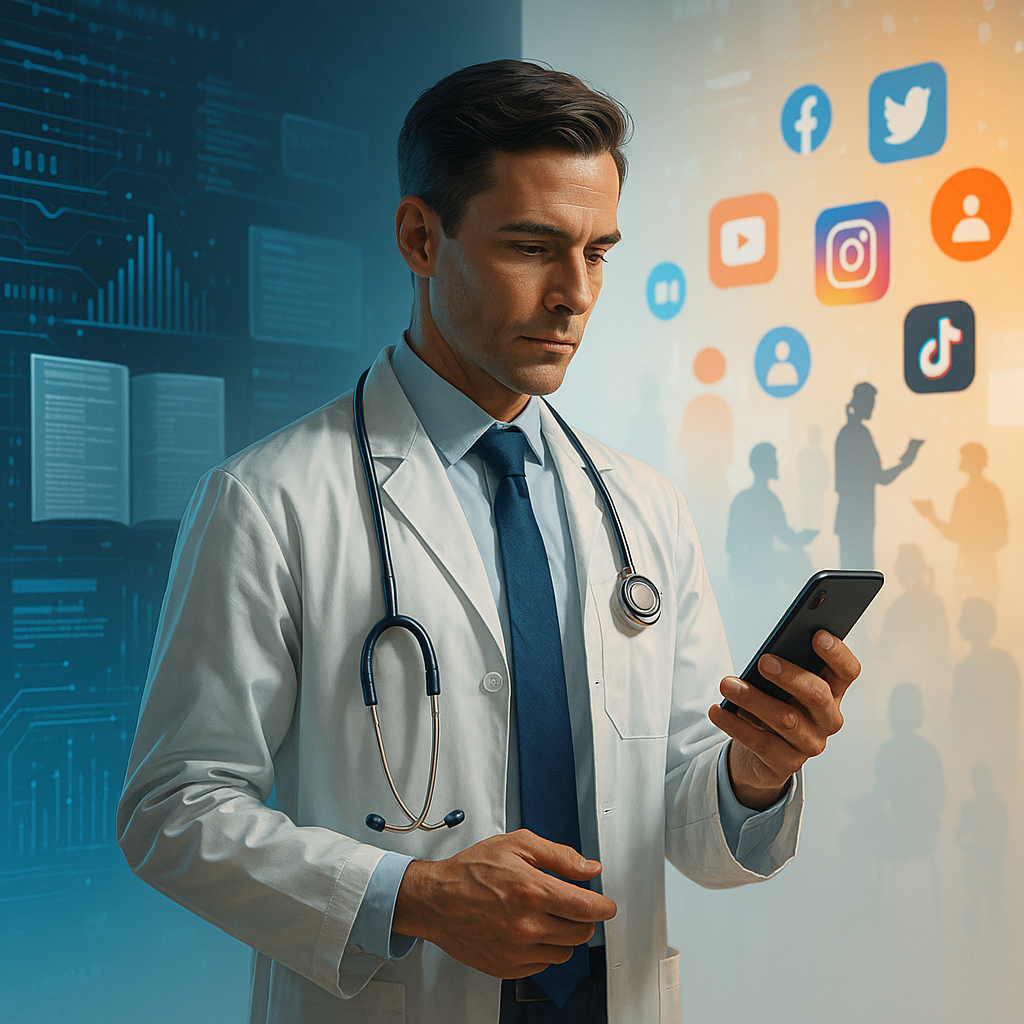
Being a physician in 2025 means much more than keeping up with artificial intelligence or precision medicine. It means breaking out of the outdated notion that social media engagement is an act of populism or self-promotion. In reality, it has become a vital skill for physicians, researchers, and academics – as essential as statistics or physiology.
If You Don’t Tell Your Story, It Won’t Be Heard
You can publish in The New England Journal of Medicine, The Lancet, or Nature Medicine – but if you don’t know how to advocate for your work, it may never reach the people who need to hear it. It will remain confined to academic journals, invisible to patients, policymakers, and even many clinicians.
In a world saturated with misinformation, visibility is responsibility. Being silent on digital platforms allows others – often with no medical background – to control the narrative about health and science.
What the Research Shows: Doctors Are Online, but Mostly Silent
A 2021 study by Hameed and colleagues compared physician social media (SM) presence and activity across different specialties. It found that 70% of physicians had a social media presence, yet 90% posted nothing at all per month. Interestingly, female and younger physicians were more likely to have a presence, while surgeons and older physicians showed higher activity and more followers (Hameed I, Oakley CT, Ahmed A, et al. JAMA Netw Open. 2021;4(7):e2118213. doi:10.1001/jamanetworkopen.2021.18213).
Another study published in Frontiers in Public Health (2024) found that when physicians post professional knowledge, it correlates with better patient adherence and treatment outcomes. In contrast, when they post mostly personal content, it correlates with lower adherence and worse outcomes.
(Front Public Health. 2024;10.3389/fpubh.2024.1459536).
Meanwhile, up to 80% of Internet users seek health information online, and social media now plays a central role in how they access and share it
(Forgie EME et al., J Med Internet Res. 2021;23(12):e25230. doi:10.2196/25230).
These findings highlight a troubling paradox: while the public is looking for health information on digital platforms, physicians – the most credible voices – are largely absent or passive there.
We Need to Be Both: Credible and Present
Today, we see two extremes.
On one end, many established physicians remain disengaged from social media, dismissing it as unserious or ego-driven. On the other, a growing number of medical students and early-career professionals are entering social platforms seeking fast impact – before they have the experience or academic grounding to ensure credibility.
The result: well-intentioned enthusiasm that sometimes borders on superficial influence, with “medfluencers” who may not yet have the depth to educate responsibly.
The truth lies somewhere in the middle.
The right path is to build credibility through science, research, and clinical experience — then translate that knowledge into accessible, engaging content that can inform, inspire, and shift paradigms.
Social media isn’t about abandoning academia; it’s about amplifying it.
Communication Is Now a Core Clinical Skill
We teach physicians how to interpret p-values but not how to communicate discoveries in a 90-second video. We train them to present at conferences but not to craft an engaging Instagram post or a precise X (Twitter) thread.
That must change. Social media fluency should be part of every medical curriculum — a skill taught and practiced, not improvised.
Just as physicians take courses in biostatistics or epidemiology, they should take one in Digital Communication and Social Media for Health Professionals.
Fighting Misinformation with Expertise and Empathy
Misinformation spreads faster than evidence. But rather than avoiding social platforms, physicians should reclaim them – bringing science to where people actually are.
Einstein said: “If you can’t explain it simply, you don’t understand it well enough.”
Social media, in that sense, is the modern test of our ability to communicate knowledge simply, accurately, and compassionately.
Why It Matters: Impact and Mission
Most of us went into medicine to impact lives – to heal individuals or improve public health. Yet today, most patients acquire their health information from social media, ChatGPT, and Google. If physicians are absent from these arenas, we risk losing our connection to the very people we set out to serve.
Being on social media is not about self-promotion. It’s about presence, advocacy, and public trust. It’s about ensuring that credible science is not drowned out by louder, less qualified voices.
The Future of Medicine Is Connection-Driven
Artificial intelligence will help us analyze; social media will help us humanize.
The next evolution in medicine is not only precision treatment – it’s precision communication.
Physicians who understand this dual role – scientist and storyteller – will be the ones who shape healthcare’s future, not just in journals but in the real world.