
An Aging Jewish Feminist
From Vows to the Steppes of Moav: Parashat Matot-Masai
As we conclude the book of Bamidbar (Numbers), we’re left with both victories in war and reminders of just how conditional progress can be—especially for women. At the end of last week’s parshat Pinchas we met the five daughters of Tzelophad—who asked for the right to inherit after their father died without a son. Instead of turning them down, Moses consulted God, who replied, “The daughters of Tzelophad speak rightly.” This was a triumph for women’s rights.
But in this week’s double portion Parashat Mattot-Masei, the tribal leaders from Manasseh are concerned: What if these women marry outside the tribe? The land might be given to another tribe, disrupting the balance of tribal nahalot—the land allotments. And so, a new rule is added: they may inherit land—but only if they marry within their tribe. What began as a revolutionary granting of women’s rights, is now circumscribed. What we have is compromise. They are praised, named, and heard—but ultimately reabsorbed into the system they challenged. They change the law; but the law quickly adapts to maintain control. Does this sound familiar?
Unfortunately, this fits in with the earlier parts of our parsha, when women’s agency is systematically undermined. A woman may make a vow to God—but only if her father or husband doesn’t object. If they do, the vow is nullified, and God forgives her. Only widows and divorcées are free to act independently.
Then comes the battle against Midian. God commands Moses to gather troops from the Israelite tribes and take revenge on the Midianites. A thousand soldiers from each of the twelve tribes are sent:
They took the field against Midian, as יהוה had commanded Moses, and slew every male. The Israelites took the women and other noncombatants of the Midianites captive, and seized as booty all their beasts, all their herds, and all their wealth. And they destroyed by fire all the towns in which they were settled, and their encampments. They gathered all the spoil and all the booty, human and beast, and they brought the captives, the booty, and the spoil to Moses, Eleazar the priest, and the Israelite community leadership, at the camp in the steppes of Moab, at the Jordan near Jericho. Moses, Eleazar the priest, and all the chieftains of the community came out to meet them outside the camp. Moses became angry with the commanders of the army, the officers of thousands and the officers of hundreds, who had come back from the military campaign. Moses said to them, “You have spared every female! Yet they are the very ones who, at the bidding of Balaam, induced the Israelites to trespass against יהוה in the matter of Peor, so that יהוה’s community was struck by the plague. Now, therefore, slay every male among the noncombatants, and slay also every woman who has known a man carnally; but spare every female noncombatant who has not had carnal relations with a man (Numbers 31:7–18).
Thus Israelite soldiers are commanded to kill all male captives and all Midianite women who had sexual relations with men—only virgins are spared. The spoils of war include human beings, explicitly listed as part of the bounty. The story is horrifying, especially now, in a post–October 7th Israel, when images of raped and murdered women are fresh and searing. We should not close our eyes to the way violence against enemy women is not only permitted but commanded. One can even argue that the over-kill we are seeing today has roots in our sacred texts. There is a midrash (here) which teaches this:
Rabbi Shimon ben Lakish says: Anyone who becomes compassionate when he should be cruel will ultimately become cruel when he should be compassionate, as it is stated: “And Nov, the city of priests, he smote by sword” (I Samuel 22:19). Should Nov not be like descendants of Amalek? The Rabbis say: Anyone who becomes compassionate when he should be cruel, ultimately, the attribute of justice will harm him, as it is stated: “Saul and his three sons died” (I Samuel 31:6). [Ecclesiastes Rabbah 7:16]
Building a just and moral society is no simple feat. Striving for an ideal world often demands difficult, even painful, choices. This would seem to be the excuse used today to continue a war which seems to have no end. Yet most commentators prefer to focus on the compassionate and moral nature of God and his army.
JEWISH APOLOGETICS
This episode was and is problematic for Jewish commentators, as it raises profound ethical and moral questions. And why not start with Moses who, as so many point out, constantly criticizes the Israelites. He tells them, “It is not because of your righteousness or the integrity of your heart that you are coming to possess their land” (Deuteronomy 9:5). This stance echoes throughout the prophets, all the way to Malachi, the last of them: “For from the rising of the sun to its setting, My name is great among the nations… but you are profaning it!” (Malachi 1:11–12). This approach suggests that possession of the land must be accompanied by moderation and righteousness. If we do not behave properly, we do not have a right to the land.
Rambam illustrates this in the Mishna Torah. He cites a verse from Deuteronomy וְקָרָאתָ אֵלֶיהָ לְשָׁלוֹם—You shall call out to her [the enemy city] in peace, He claims that the Israelite army has to call out to its enemies in peace. Even the seven native Canaanite nations, whom God commanded to annihilate–man, woman, child, and cattle, must first be given the opportunity to surrender and accept Jewish dominion. If they refuse, only then, may they be attacked (Hilchot Melachim, 6:1,4).
Some commentators note that the text never explicitly states that the Israelites actually carried out every aspect of Moses’s command. This ambiguity has been used in apologetic literature to suggest the possibility that not all instructions were followed in practice, thus toning down the episode’s severity.
Several commentaries emphasize that the Midianite women were considered complicit in earlier seduction and idolatry that led Israelites to sin at Peor (Numbers 25). These explanations frame the killing as a continuation of divine justice rather than wanton violence. Some midrashic texts struggle with the paradox that Moses, himself married to Tzipporah, a Midianite woman, daughter of Yitro, the high priest, commands the killing of Midianite women but allows virgin girls to be spared. Others point to this inconsistency to suggest the act was not a blanket ethnically-motivated slaughter; rather it targeted specific participants in the earlier wrongdoing.
Then there are those modern voices who openly discuss the narrative’s ethical difficulty and suggest that the ancient Israelites, like all ancient peoples, were products of their time, with Torah laws evolving from and responding to that context. This, they argue, allows contemporary readers to confront and wrestle with such passages without justifying their literal enactment today. Some go even further to explicitly deny that the Torah ever condoned genocide, contextualizing the event within unique historical circumstances, or interpreting the text non-literally.
Apologetics misses the point. A command attributed to Moses and God should disturb us. We continue to wrestle with the legacy of such texts—especially when right-wing voices in our own society invoke them to justify immoral cruelty in the name of justice.
SETTLING OUTSIDE THE LAND
Finally, there is another kind of unsettling situation: the request by the tribes of Reuven and Gad and half of Menasseh to settle outside the land. At first, Moses is furious—to him they are reminiscent of the spies who sowed fear. But the two and a half tribes agree to fight alongside their brothers before settling on the eastern side of the Jordan.
We ourselves will cross over as shock-troops, at the instance of יהוה, into the land of Canaan; and we shall keep our hereditary holding across the Jordan.”So Moses assigned to them—to the Gadites, the Reubenites, and the half-tribe of Manasseh son of Joseph—the kingdom of Sihon king of the Amorites and the kingdom of King Og of Bashan, the land with its various cities and the territories of their surrounding towns (Numbers 32: 32-33).
Thus it is possible to be at one with the people in the land of Israel, while residing outside its boundaries. Their choice feels personal. We came to Israel in 1967. My three children were born in the land and so were my seven grandchildren. However, even before this last war broke out, my son had already taken on a pulpit position in Los Angeles. And immediately after the war broke out, my youngest daughter, left first to Greece, then settled in India. Both have remain engaged with Israel’s—teaching, editing, advocating—but from afar. They remind me of Reuven, Gad and the half tribe of Menasseh: present, committed, but not physically here. And I wonder—are they outsiders now? Or simply part of a new diaspora, helping Israel survive in an interconnected world?
I’ve spent my life believing in the centrality of Israel. But I also once argued with Ben-Gurion that it was possible to live a full Jewish life abroad. And now, decades later, I tell my children and grandchildren the same. Jews live everywhere, not only here. And we must stop using the word galut to describe life outside this land. It is not exile—it is extension. Especially when those abroad are just as committed to Jewish continuity and justice as those who live in the land. And we should listen to their voices.
The five daughters of Zelophehad inspired us in their desire for land, the nachalah. But their story also warns us: progress that comes from above can be revoked just as easily. Real change comes from persistent questioning—from speaking up, again and again.
As we end Bamidbar, we are told: “These are the commandments and judgments which the Lord commanded.” Authority reasserts itself. And yet, just before that, we heard women’s voices—daring to question, daring to imagine a different future.
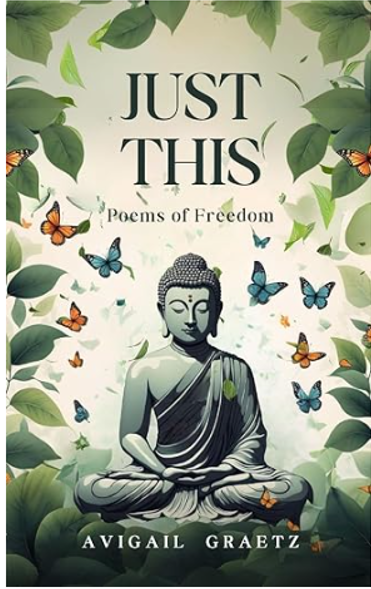
My daughter’s poetry reminds me that our lives—Jewish lives—are no longer defined by one border, one identity, or one sacrifice. Here are her words in her book, Just This: Poems of Freedom (2024).
My life
A woman who fled from war to Greece, to India, to Thailand
an external rotation that will probably never stop
just like planet Earth I am grateful to visit,
just like my Jewish heritage traveling the world.
I do not want to carry the burden of
one single home,
one single identity,
one single God,
that needs constant sacrificing, constant struggle with humans,
with oneself.
Shabbat shalom to us all—wherever we may be.
Related Posts