

Fruitfulness and faith: A lens for Jewish unity
As we near the implementation of the first phase of Trump’s ceasefire plan, the big question we will soon be asking is “In what way has Israel changed?”
No doubt our people will first have to process the sacrifice of so many in these past two years. Ultimately however we will need to turn our attention to forging a new and united path forward. It is perhaps for this reason, that I have been most troubled by recent headlines that (as during the protests over judicial reform) speak again about the divide between the “State of Tel Aviv” and the “State of Israel.”
The implication here is that Tel Aviv represents the modern, secular, economic, and defense powerhouse of the country. While Israel refers to the traditional, religious, and historical foundations of the Jewish people. It is worth remembering however that this tension is not new.
To illustrate this point I want to draw your attention to Ephraim, the son of Yosef. The liturgy of the month of Tishrei is riddled with references to this enigmatic and complex figure. A character that is both beloved and wayward, fruitful yet rebellious. To understand his role with greater clarity, I want set him against two of his brothers in particular: Yehudah and Menashe. I accept that Yehudah is not strictly Ephraim’s brother but I use the term loosely to emphasise the ‘sense family’ that is Am Yisrael. The term ‘tribes’ sometimes has the inadvertent connotation of distance and competition.
- Yehudah is acknowledged to represent spiritual kingship, Torah, and ultimately Mashiach (ben David).
- Menashe which literally means “forgetting” is an allusion to the past, albeit a difficult one. A focus on the exile but also the power of heritage, tradition and continuity.
- Ephraim literally means “to flourish”. In contrast to these two ‘siblings’ he embodies practical forward-driving energy. Ephraim focuses on dominating the ‘here and now’.
In essence, it strikes me that these three figures embody the ongoing dynamic within the Jewish people. A tension between religious and secular, tradition and innovation, memory and progress. Let us explore further.
Ephraim and Yehudah: Kingship vs Power
The rivalry between Ephraim and Yehudah is deeply woven into the Tanakh. After Shlomo HaMelech’s reign, the kingdom divided: Yehudah in the south, with Jerusalem and the Beit HaMikdash, and Ephraim leading the northern tribes. Whereas in Yehudah the Davidic line of kingship was maintained – “לֹא־יָסוּר שֵׁבֶט מִיהוּדָה” (“The scepter shall not depart from Yehudah”) – the kings of Ephraim repeatedly turned to idolatry and rebellion. Jeroboam, the first king from Ephraim, even established rival altars in the northern kingdom to prevent his people from making the pilgrimage to Hashem’s chosen place, Jerusalem, because it was in the territory of Yehudah (I Melakhim 12:28–30).
Yet despite this rebellion, we continually encounter that Ephraim retains a unique status. The prophet Jeremiah records Hashem’s own words: “הֲבֵן יַקִּיר לִי אֶפְרַיִם… עַל־כֵּן הָמוּ מֵעַי לוֹ, רַחֵם אֲרַחֲמֶנּוּ נְאֻם־ה’” (“Is Ephraim My dear son? Is he a delightful child? For whenever I speak of him, I remember him still. Therefore My inner being yearns for him; I will surely have mercy on him, says Hashem”) (Yirmiyahu 31:19). Rashi comments that although Ephraim strays, Hashem’s compassion remains constant, likening him to a firstborn who, even if wayward, still holds his father’s deepest love.
Our tradition of two messiahs, Mashiach ben Yosef (from Ephraim, being Yosef’s son) and Mashiach ben David (from Yehudah), further illustrates their intertwined destiny. Midrash describes Mashiach ben Yosef as the one who fights Israel’s physical battles and prepares the way for Mashiach ben David, who brings spiritual completion. In modern terms, this might be reflected by secular Israel’s achievements in security and innovation, paving the way for a fuller spiritual redemption led by Torah and tradition. A transformation we are now able to subtly perceive as happening.
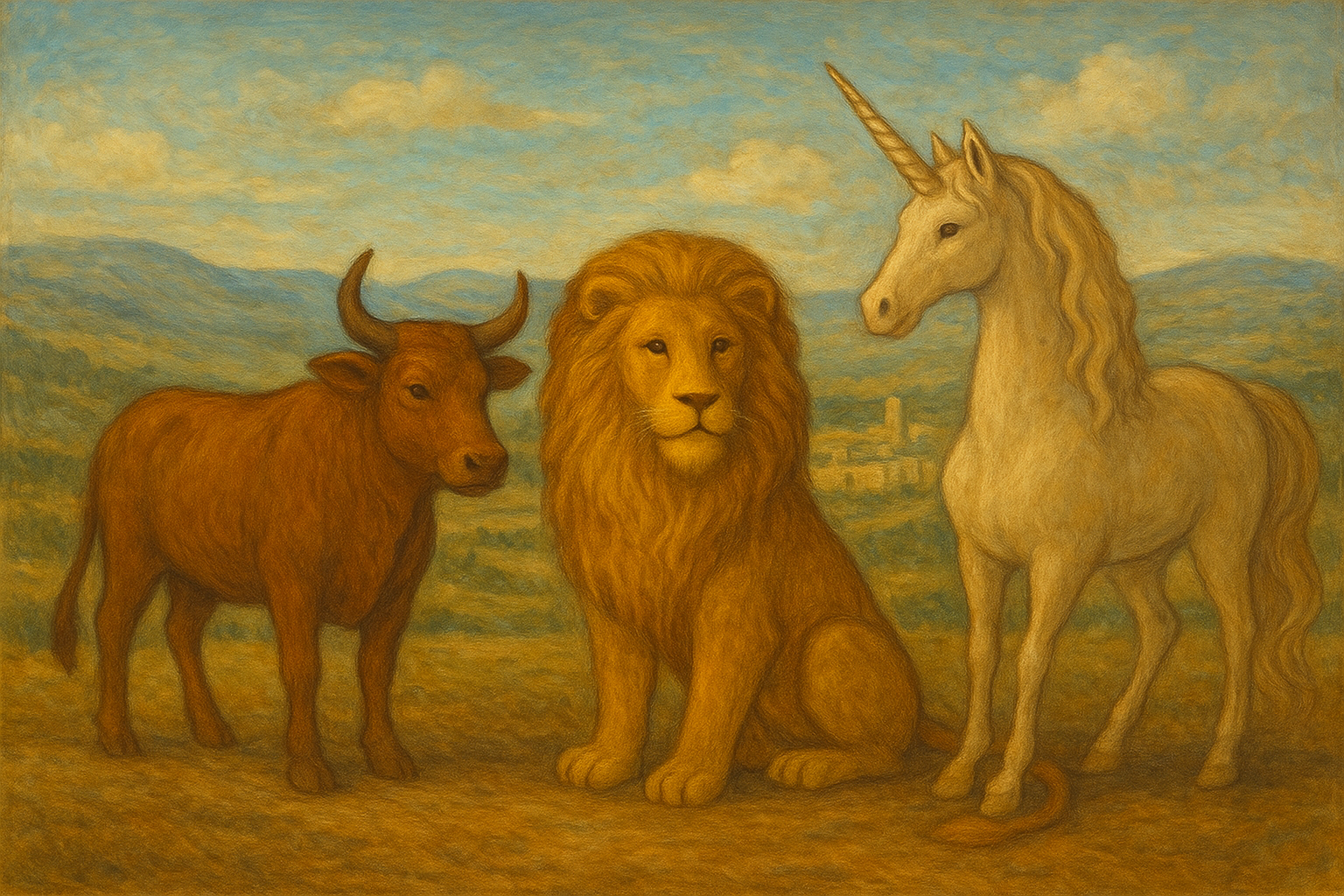
The tribal symbols of Yehudah and Ephraim further illustrate the unique and contrasting features of the essential character of each ‘brother’. Yehudah is the lion, the king of beasts, symbolizing spiritual leadership and sovereignty. Ephraim is the ox. A powerful and industrious creature, suited for the labors of ploughing and building. Secular Israel today, like the Ephraim of old, has become the ox: the might of the Israel Defense Forces, the recent daring strikes of the Air Force in Iran, the strength of the economy, and the relentless energy of the high-tech sector.
Ephraim and Menashe: Memory vs Fruitfulness
The second emblematic and complementary pairing is with Ephraim and Menashe, who is Ephraim’s older brother. Both were born in Egypt, the heart of exile to parents Yosef and Osnat. Their very birth outside the Land of Israel foreshadows the condition of modern Jewry: religious and secular alike were “born in exile” and are now returning together to their homeland.
Their grandfather Yaakov’s blessings to each of them highlights their different qualities. When Yaakov crossed his hands to bless Ephraim before Menashe despite Menashe being the elder brother, he elevated those that pragmatically seek through action to break barriers and create new paths.
“יְשִׂמְךָ אֱלֹקִים כְּאֶפְרַיִם וְכִמְנַשֶּׁה” (“May God make you like Ephraim and like Menashe”)
Ephraim as fruitfullness brings to mind Ezekiel’s prophecy: “But you, O mountains of Israel, you shall shoot forth your branches and yield your fruit to My people Israel, for they are soon to come”. This verse is often cited as the most substantive proof that we are living now in the footsteps of Mashiach.
Rashi notes that Yaakov foresaw Yehoshua (the great leader from Ephraim) who would physically conquer the Land and for this reason prioritised Ephraim over Menashe. Indeed, Yehoshua began his career as a successful reconnaissance officer and later become commander in chief. This is familiar narrative we have seen play out time and again among Ephraim’s descendants in the modern age.
Their tribal symbols again reveal their contrasting yet complementary nature. Menashe is associated with the re’em – sometimes translated as a unicorn or auroch – a lofty, untamed power that reaches upward as opposed to the grounded more resilient ox. Together however they balance heavenward aspiration with earthly strength. In this partnership, we glimpse the possibility of harmony between ‘religious’ and ‘secular’ Jews: memory and tradition (Menashe) alongside progress and creativity (Ephraim).
Ephraim as Secular Israel Today
With these contrasts and complements in mind, we can begin to see ‘secular’ Israel in the light of Ephraim. Just as Ephraim broke from Jerusalem and sought new forms of worship, secular Zionism initially distanced itself from rabbinic authority and tradition. Not out of hatred in my opinion, but out of a desire to build a new future with its own tools. And just as the Ephraimite kingdom became a super-power in its own right, so too has secular Israel carried the burden of state-building: draining swamps, reviving Hebrew as a spoken tongue, founding the city that never sleeps, building an economy, pioneering technology, and creating one of the world’s most formidable and innovative militaries.
Rav Avraham Yitzchak HaKohen Kook, the first Ashkenazi Chief Rabbi of Eretz Yisrael, wrote that even the secular pioneers of Zionism were driven by a hidden spark of holiness. In Orot HaTeshuvah (17:2), he explains:
“אפילו אלה שאומרים שאינם עושים לשם שמים, באמת הם מונעים על ידי אור אלוקי הפועל בקרבם”
“Even those who say they do not act for the sake of Heaven are in truth stirred by the divine light that works through them.”
Rav Kook associated this hidden drive with Mashiach ben Yosef, the messiah from Ephraim, whose task is to prepare the physical foundations of redemption — the land, the army, the economy before the spiritual completion under Mashiach ben David.
Later thinkers, such as Rav Tzvi Yehuda Kook and Rav Shlomo Aviner, emphasized that the secular builders of the land carried the spirit of Ephraim: pragmatic, industrious, sometimes estranged from tradition, but essential to the unfolding redemption.
In this light, I would like to argue that the modern “State of Tel Aviv” is not a rival to the “State of Jerusalem,” but its necessary partner. The ox beside the lion, the builder alongside the king.
The return of Ephraim
The prophets speak of Ephraim’s ultimate return. In the Haftarah of Shabbat Shuva, Hoshea envisions a future in which Ephraim will say “What have I to do any more with idols?” If, in our day, secular Israel has at times bowed to the excesses of capitalism, democracy and progressive liberalism, the prophecy assures us that this is not the end of the story. Ephraim’s destiny is to return, bringing his tremendous energy and fruitfulness into the service of holiness.
It is no coincidence that King David (the great ancestor of Mashiach) is described in Tanakh as an “Ephrati from Yehudah.” Though genealogically from Yehudah, the title Ephrati hints to Ephraim. David unites the two great streams of Israel’s destiny: the fruitfulness and practical vision of Yosef’s line, and the eternal kingship of Yehudah.
With love and abundant respect, I therefore appeal to anyone in ‘religious’ Israel who is currently feeling sceptical or resentful towards their secular brothers to view them not with condescension, but with humility and gratitude. This goes for the bloc itself and each individual in it. The religious camp, like Yehudah and Menashe, holds the treasures of Torah and memory/connection to the past. But without Ephraim, the ox, there would be no flourishing State of Israel today. The zechut of secular Israel is immense: reviving Jewish sovereignty after two millennia, defending the land with courage, and enabling the land itself to blossom as the prophets foretold.
Conclusion: From Division to Unity
The rabbis teach that the Second Temple was destroyed because of sinat chinam — baseless hatred among Jews (Yoma 9b). If division destroyed us, then only love and unity can rebuild us. Rav Kook famously wrote:
אם נחרבנו, ונחרב העולם עמנו, על ידי שנאת חינם — נשוב להבנות, והעולם עמנו יבנה, על ידי אהבת חינם
“If we were destroyed, and the world was destroyed with us, through baseless hatred — we will be rebuilt, and the world with us, through baseless love” (Orot HaKodesh III)
The prophets foresaw a day when the sticks of Yehudah and Yosef (Ephraim) would be joined together in God’s hand (Yechezkel 37:19). To hasten this day, I urge us all to meditate on the words of the prophets and cultivate love for kol Beit Yisrael — all the house of Israel, whether rooted in the sceptre of Yehudah, the heritage of Menashe, or the vision of Ephraim.
This message resonates with particular urgency during the Sukkot festival when we all dwell in Hashem’s Sukkah. If Hoshea’s words tell us that Ephraim will one day squirm at their past idolatry (teshuva) then the task of religious Israel in these days is to embrace each part of our nation with humility and love, preparing ourselves for a redemption that is not only political or military, but spiritual and complete.
For me, this narrative is far from abstract. As someone preparing to make Aliyah, my family and I feel called upon to take part in rebuilding project as our country enters this new chapter. The stories of Ephraim, Yehudah and Menashe – and more importantly their harmony, is not merely ancient history. I see it personally as a guide for the choices we must all make today. For the narratives we deploy about others, in our heart and out loud.
May we all strive for and merit to see the ox of Ephraim, the lion of Yehudah, and the re’em of Menashe walking together. Not in rivalry, but in harmony.