Living and loving in Jerusalem
Full hearts and empty chairs
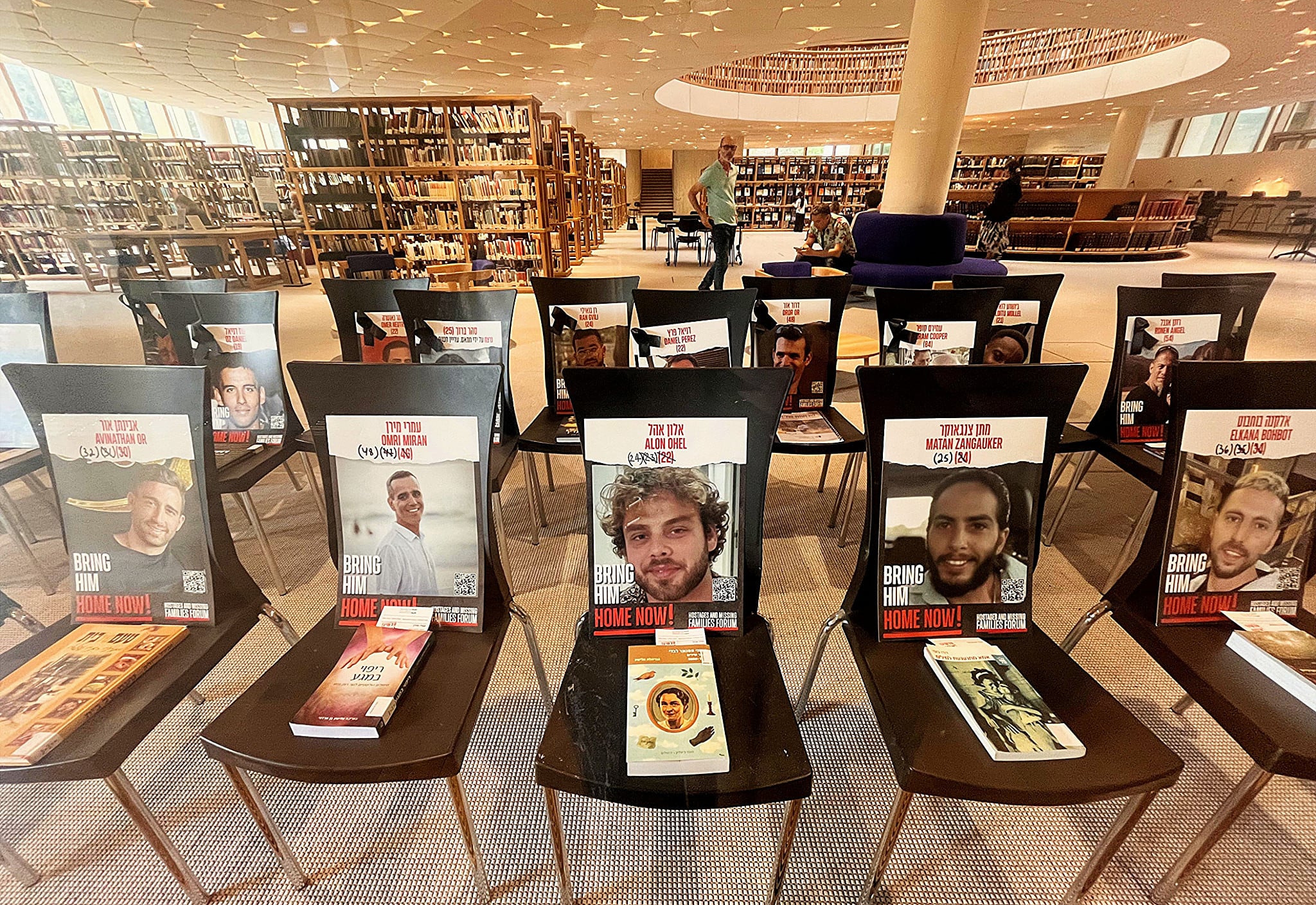
Hostage chairs at the National Library of Israel in Jerusalem, October 9, 2025. (Courtesy)
Hours after the hostage deal between Israel and Hamas was signed, I understood the meaning of the Psalmist’s words: “We were like dreamers.”
After a series of partial hostage releases over the course of two years, the “Trump Deal” had just been negotiated. Suddenly, the predictions jumped from weeks to days, to hours, to minutes — until it was announced in the middle of the night that the deal had been signed and the hostages were all coming home.
As it happened, I had booked a tour of the National Library in Jerusalem for the next morning. After a sleepless night watching the news, I stood in front of an installation dedicated to the hostages. Three rows of black metal chairs were neatly arranged, each with a poster of a hostage and a book he might like to read. As I walked past the front row, I saw that Alon’s book was about piano playing, Omri’s was about healing, and Matan’s was about a mother’s love.
Could these hostages, whom I have come to know so well, really all be coming home? Together? Within days?
“When God returned the captives of Zion, we were like dreamers.”
It did not feel real.
But standing there, I began to imagine it. My mind wandered from chair to chair, poster to poster, and pictured what had seemed impossible for so long.
Alon, the last survivor from the roadside shelter where he was abducted, will be coming home to his parents, Idit and Kobi. He will be reunited with his mentor, Eli Sharabi, receive treatment for his failing eyes, and begin to play piano again.
Avinatan will once again be in the arms of his beloved Noa, after they were separated and taken to Gaza while fleeing from the Nova music festival and were held apart during their captivity.
Ariel will be reunited with his courageous partner, Arbel—hearing about her 480 days of fear and isolation, sharing his 737 days of separation and longing.
Omri will return to his indomitable wife, Lishay, and their daughters, Roni and Alma—now two and four, twice the age they were when he was taken.
Matan will embrace his lioness mother, Einav, and his fiancée, Ilana, who spent 55 days in captivity and has been fighting for his return ever since.
Twins Gali and Zivi will be reunited with each other and with their family. They will be welcomed by their spunky friend Emily Damari Damari, and will be introduced to their new soul siblings from the hostage family Romi, Omer, and Eliya.
Thirteen additional hostages will be reunited with their parents, their children, their brothers and sisters, and all who love them. They will once again fill their empty chairs at their family dinner tables on Shabbat and holidays.
I was like a dreamer. Could it really be true?
But then, in the midst of my joy, I noticed the black ribbons on the back two rows of chairs, and it struck me:
What about the chairs that will remain empty?
The chairs of the hostages in the back two rows. Those hostages will be returned to the land of their people for a proper burial. For them, there will be no run and embrace. Twenty-eight families will finally bring the bodies of their loved ones home. But their heartbreak will continue—or perhaps only now begin in full.
The chairs of the fallen: the victims of October 7; the police officers, emergency workers, security personnel, and volunteers who rushed out to aid and never returned; the valiant soldiers who fell on that black Simchat Torah and in the two years since—who protected us all and made this hostage deal a reality; and the chairs of the sons of my friends and neighbors—Aner, Chaim, Zechariah, Elisha, Ari, Ben, and Yuval—which will forever remain empty.
The chairs of the hostages who were taken alive but murdered or killed while in captivity. I thought of our beloved Hirsh and the other young hostages known as the “beautiful six.” They will never gather around their family tables.
The chairs of those whose bodies have come home, but whose souls are still in distress: Those who are in rehab; those who remain in their rooms because they cannot bring themselves to get out of bed; those who are abroad, trying to gain distance from the events they witnessed and the trauma they endured.
The chairs of the victims of terror whose murderers are about to be released as part of the deal. Their families now must confront the price that Israel is forced to pay to redeem its captives.
And what of the thousands in Gaza—women and children, young and old—who met their deaths because brutal terrorists embedded themselves amidst and beneath a civilian population? They too have left empty chairs.
Standing before the exhibit, my profound joy was mixed with sorrow, my intense hope was mingled with anxiety, and my sense of relief was intertwined with concern—in that uniquely Israeli blend of conflicting emotions that characterizes these complicated times, when paradoxical feelings share the same chair.
May this Sukkot be remembered as a holiday of peace.
May the upcoming Simchat Torah be a holiday of joy.
May we celebrate the return of our captives with compassion and grace, tenderness and sensitivity.
And may we remember our sisters and brothers who will continue to have empty chairs in their homes and in their hearts.
Related Topics
Related Posts