


Mathematics Teaching Professor, Author
Garnethill Synagogue, Scotland’s Oldest Synagogue
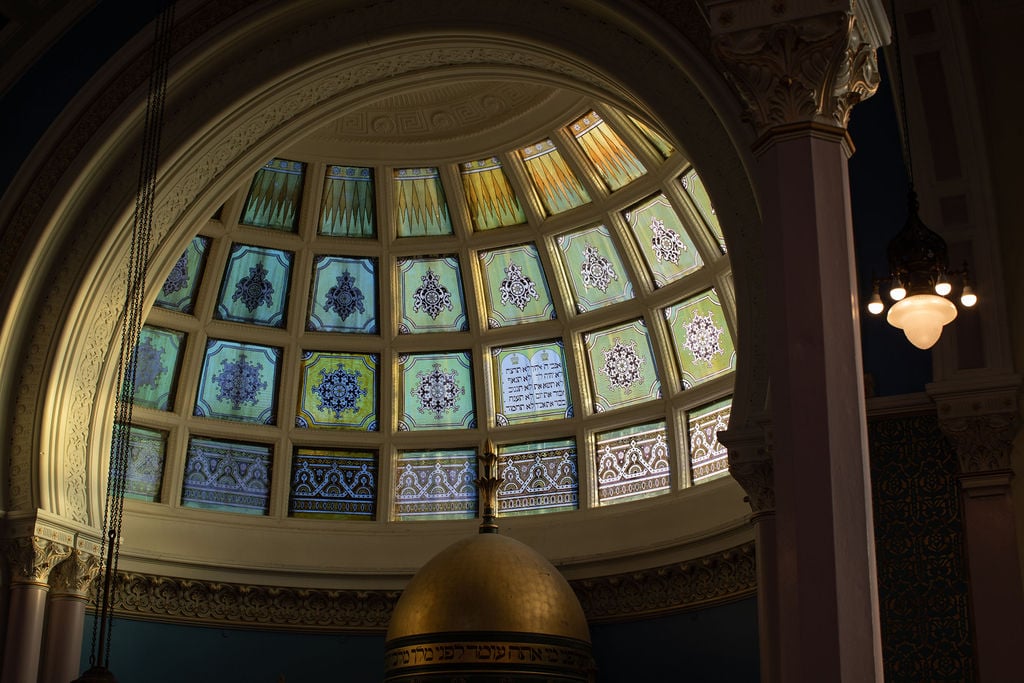
Interior Dome of Synagogue (Source: Scottish Jewish Heritage Centre/Sequoia Hearne)
Nestled in the heart of Glasgow, Scotland, is the historic Garnethill Synagogue, home to the Scottish Jewish Heritage Centre and the Scottish Jewish Archives Centre. Opened in 1879, Garnethill Synagogue is the oldest synagogue in Scotland and one of the oldest surviving synagogues in the United Kingdom outside London. I would like to thank Kerry Patterson, Manager, Scottish Jewish Heritage Centre, for her support of this article.
Synagogue
Architecturally, the Category A–listed Garnethill Synagogue is one of the finest examples of High Victorian synagogue architecture in Britain, distinguished by its Romanesque exterior and richly ornamented Byzantine-inspired interior.
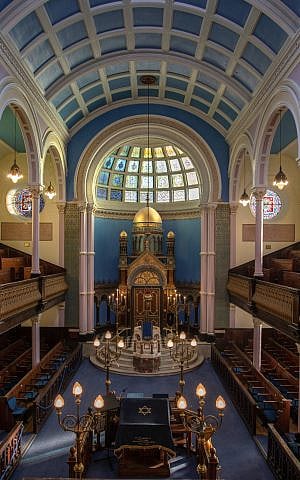
The synagogue is constructed in a Romanesque Revival style, distinguished by its richly decorated round-arched entrance portal and intricate stone carving. Among its most striking architectural features is the magnificent half dome above the Ark. The dome creates a sense of both grandeur and intimacy, drawing the eye upward while filling the sanctuary with light and color. The dome is regarded as one of the finest examples of Victorian craftsmanship in Britain.
The sanctuary itself is a tall and richly decorated barrel-vaulted hall. The foyer leading up to the prayer is characterized by geometric-patterned flooring, including Star of David motifs, finely crafted woodwork, and richly colored stained-glass windows.
The prayer hall of Garnethill Synagogue is a majestic room that combines Victorian synagogue design with rich Byzantine and Oriental influences. The hall is arranged along an east–west axis so that the congregation faces east toward Jerusalem.
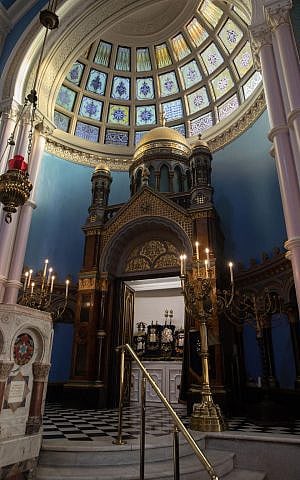
At the eastern end of the Hall, one can see marble steps that give rise to the glorious Torah Ark. When the Holy Ark (Aron Kodesh) at Garnethill Synagogue is open, it reveals one of the most impressive features of the synagogue’s interior. Designed by John McLeod, working with Nathan Solomon Joseph, the Ark resembles a miniature domed sanctuary.
Scottish Jewish Heritage Centre
The Garnethill Synagogue is home to the Scottish Jewish Heritage Centre, and the attached Holocaust-era Study Centre which opened in 2021. The Centre supports school visits, researchers, and visitors who want to explore Jewish history and the Holocaust in Scotland. Exhibits in the adjacent sukkah highlight how individuals and organizations across Scotland helped refugees fleeing Nazi-occupied Europe, deepening understanding of Jewish heritage and its place in wider Scottish history.
The Centre provides research resources including digitized editions of the Jewish Echo, an illustrated catalogue of over 2,500 Holocaust-era items, and a specialist reference library. School groups also use hands-on learning kits to explore refugee stories.
Scottish Jewish Archives Centre (SJAC)
On the lower floor of the Garnethill Synagogue is the Scottish Jewish Archives Centre (SJAC). Founded in 1987, the SJAC collects a wide range of material relating to Jewish life in Scotland since the 1700s, including synagogue minute books and registers, photographs, oral histories, personal papers, war medals, works of art and records of Jewish businesses and organizations. The SJAC hold copies of records from the 17 Jewish cemeteries in Scotland and can give access to the Family Tree of Scottish Jewry database, with information on over 100,000 Scottish Jews.
Culture and Religious Events or Social and Religious Life
Garnethill Synagogue is home to an active Ashkenazi Orthodox congregation that maintains a vibrant religious life. Regular Shabbat services are held each Saturday morning, alongside observances for major Jewish festivals including Passover, Rosh Hashanah, and Yom Kippur.
School Visits
Garnethill Synagogue regularly welcomes primary and secondary school groups for educational visits exploring Judaism, Jewish heritage, and the history of Jewish life in Scotland. Students learn about Jewish immigration to Scotland, including where Scotland’s Jewish communities came from, the reasons for migration, and their contributions to Scottish society.
Pupils explore the synagogue as Scotland’s oldest purpose-built Jewish place of worship, discovering sacred symbols, trying on religious dress, and learning about Jewish practices such as Shabbat, festivals, and kosher food laws.
The program also covers the Holocaust and the Second World War, focusing on the experiences of refugees from Nazi Europe who found safety in Scotland. Using replica documents, photographs, and personal testimonies from the Scottish Jewish Archives Centre, students examine life under Nazi rule, escape to Scotland, and the challenges of rebuilding life.
Overall, the experience helps students understand Scotland’s Jewish heritage and its place within the wider story of Scottish history and culture.
Historical Background
In 1691, Edinburgh was the capital of Scotland, with a population of roughly 35,000, making it one of the largest towns in Britain outside London. Most residents lived within the crowded medieval Old Town, a dense urban landscape enclosed by defensive walls where space was scarce. The city’s streets were generally unpaved and muddy, and most buildings were constructed from local stone.
It was in this year, 1691, that the first Jewish person arrived in Scotland. A Jewish trader named David Brown applied for permission to live and trade in Edinburgh. His arrival marked the beginning of a small but growing Jewish presence in Scotland. Throughout the eighteenth century, Jewish merchants, peddlers, and university students gradually settled in Scottish towns and cities.
By the 1790s, Jewish immigrants had begun settling in Glasgow in small numbers. These early pioneers were primarily Dutch and German merchants, craftsmen, and furriers seeking new economic opportunities. As the Jewish community grew, it established its first congregation, holding services in a rented tenement flat on Glasgow’s High Street in 1821. In 1832, the community purchased a dedicated Jewish burial ground within the newly opened Glasgow Necropolis.
Then in 1879, the Garnethill Synagogue opened, and it was Scotland’s first purpose-built synagogue. Officially inaugurated on September 9, 1879, the synagogue was widely praised in newspapers across the country, which commented on both its architectural beauty and the dignity of the consecration ceremony.
From the 1880s onward, Glasgow’s Jewish community expanded rapidly as thousands of Jewish immigrants arrived from Eastern Europe, fleeing pogroms, persecution, and economic hardship. Their arrival transformed the scale and character of Jewish life in Scotland, establishing Glasgow as the principal center of Jewish communal life in the country, as it is today.
Today, the Garnethill Synagogue in Glasgow, Scotland, is the oldest surviving synagogue in the country. This historic building stands as an architectural treasure and continues to serve an active Orthodox congregation. It is also home to the Scottish Jewish Heritage Centre and the Scottish Jewish Archives Centre, preserving and sharing the story of Jewish life in Scotland. Together, its ongoing religious use and cultural institutions make it a powerful testament to the long and rich history of Jews in Scotland.
Contact Information:
Scottish Jewish Heritage Centre, 129 Hill Street, Glasgow G3 6UB
Email: Heritage Centre info@sjhc.org.uk
Website: https://sjhc.org.uk/