Gaza: Lives Hanging by a Thread
The hostages
I watched Evyatar David, starved and digging into the earth, in a video recently released by his captors. My body reacted before I could think. For a week, I struggled to focus on work, found myself crying without warning, and had trouble sleeping. I cannot imagine what he is enduring: the isolation, the physical and emotional pain, the constant fear for his life, hanging by a thread. This situation must be unimaginably distressing for him and his family, each day a nightmare for over 600 days. No journalist on site witnesses the hostages’ daily reality.
Rom Braslavski appeared next, crying and visibly injured, in a video also just released by his captors. His cry went under my skin. Earlier in the war, I had seen a separate video of Noa Argamani and her mother, which also struck me. Her mother was battling brain cancer. She longed to see her daughter before she passed, worrying about her every day during treatment. On October 7, 2023, Noa was separated from her boyfriend, Avinatan Or, and held by violent captors. She was freed after months in captivity but is still waiting for Avinatan to return. Even though she was able to see her mother before her death, they had only three weeks together instead of what could have been months.
Hersh Goldberg-Polin stayed with me as well. A grenade had taken part of his arm, and captivity confined him. He loved to travel, explore, and learn from the world. He could communicate with his parents only through an impersonal video, while they never knew whether he could hear their responses. He had to speak in Hebrew instead of American English, their preferred language at home, and his parents could not be with him during surgery or recovery when his arm was amputated. A few months later, he was found dead, far too young and alone. These stories, alongside Rom and Evyatar’s suffering, remain etched in my mind.
About 800 lost their lives immediately during the attack. Their names are listed here:
https://www.gov.il/en/pages/swords-of-iron-civilian-casualties
The People in Gaza
One story that has particularly stayed with me is that of Hind Rajab, a six-year-old Palestinian girl killed during an Israeli military operation in Gaza in January 2024. Hind initially survived and spent three hours pleading for help over the phone with the Palestinian Red Crescent Society, saying, “I’m so scared, please come.” Despite efforts to reach her, the rescue attempt failed. Twelve days later, her body was found alongside those of her family and two paramedics.
Her story is one of many. Countless other innocent civilians, especially children, appear daily in the news: distressed, reaching for food, suffering severe malnutrition, or receiving treatment in overcrowded hospitals, some of which have been struck by Israeli airstrikes.
According to UNICEF, the number of dead and injured children is alarmingly high, and many have been displaced multiple times, living with deep trauma.
Although food supplies are said to be sufficient for several months, deliveries are hindered by logistical and political obstacles, with supplies stuck in warehouses and at risk of spoiling. Deaths from malnutrition have already been reported, and dehydration is a growing concern during the ongoing heatwave.
Most available figures come from local authorities in Gaza, and many of the journalists reporting from the area are locals themselves. Nearly 200 journalists have been killed, according to the BBC, while Al Jazeera puts the number closer to 270. Among them was 28-year-old correspondent Anas al-Sharif, who had reported prominently on the war since its outset and was killed in an Israeli airstrike in Gaza City. Allegations suggest he may have worked with Hamas before the war, yet he was also critical of the group.
Another journalist killed while reporting was 25-year-old photojournalist Fatma Hassouna, also known as Fatima Hassouna. She died on April 16, 2025, in an Israeli airstrike on her family’s home, just one day after her documentary Put Your Soul on Your Hand and Walk was selected for the 2025 Cannes Film Festival.
The risks journalists take in war zones are unimaginably high. Each new report of their deaths reminds me of the fate of American journalist James Foley, kidnapped in Syria in 2012 and later executed by ISIS. This reminds us that terrorists share one clear goal: to intimidate and instill fear. For safety reasons, many international journalists cover the conflict from Tel Aviv, Jerusalem, or other Israeli-controlled areas, but in doing so, parts of the story inevitably remain unseen. Yet we know that our histories and national perspectives shape how we interpret events, and sometimes we notice things that others miss.
This leads me to wonder: if I were given the opportunity, would I have the courage to go to Gaza right now, knowing that I could be bombed or kidnapped? And why am I compelled to keep examining everything so closely? I am not a political journalist driven by a political agenda. I know my why. I am a seeker of truth. I would hate to be misled by politically motivated people and find myself on the wrong side of events. I also never want to lose my humanity, and I wish to help protect the lives of innocent people.
Antisemitism
Antisemitism is rising again. In May 2025, a young couple, Yaron Lischinsky and Sarah Milgrim, Israeli embassy aides, were fatally shot as they left a museum. According to the BBC, their murderer said, “I did it for Palestine. I did it for Gaza.”
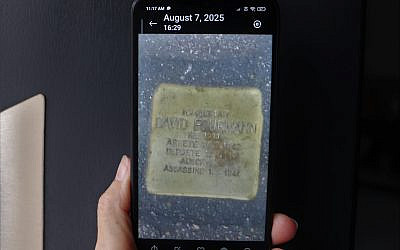
During my recent walks in Le Havre, I noticed, as I had so many times before, the Stolperstein (memorial stone) of David Fourmann. Once shiny and bright, it now had a smudge of paint and appeared much more worn. Fourmann was deported to Auschwitz, where he died. Perhaps the stain was accidental, caused by nearby construction, yet it unsettled me. I took a photo with my phone and showed it to a man who had just stepped out of the building. “Have you seen this?” I asked. “Look at how it looks now. Only a few weeks ago, it still looked almost new.” He glanced at it and said, “Was it always Fourmann? I thought it was a different name.” I replied, “Yes, it has always been Fourmann.” Then I showed him a picture I had taken of it in April.
The attack on the music festival was clearly wrong. Nobody should have to fear attending a concert or risk being kidnapped or murdered. Not only under international law, but also for ethical reasons, you cannot go to a festival and kill children or people simply enjoying themselves. Nothing justifies this. Yet as images from Gaza showing destroyed neighborhoods and the bodies of children circulate, public reactions have grown more complex. Some defend Israel’s right to security, while others criticize the humanitarian consequences of its actions. Increasingly, empathy is expressed only for one side. Opinion is divided, shaped by differing perspectives, experiences, and access to information.
Some now accuse Israel of committing genocide, Jewish people openly criticize Israel, and others go even further, drawing parallels between Israel and the Nazi regime. The situation has thus become extremely complex and confusing. However, anyone who has studied World War II should recognize that these circumstances differ significantly from the Holocaust. The Jews, along with the mentally ill, the disabled, and other victims of the Nazis, had not carried out an attack on 800 Germans at a music festival, and Germany at that time was not a democracy. Israel is a democracy; Gaza under Hamas is not.
The word “genocide” must be used with extreme care. It refers to acts committed with the intent to destroy, in whole or in part, a national, ethnic, racial, or religious group. It is not simply about mass killings or widespread suffering. The crucial element is the specific intent to annihilate a protected group. Using the word too quickly, without careful investigation, can have serious consequences and inflame tensions.
Many also keep overlooking the fact that Nazis targeted not only Jews but also their own non-Jewish citizens, using their own nurses and doctors to kill them.
Last week, Prime Minister Benjamin Netanyahu announced that he plans to expand military action in Gaza to completely destroy Hamas, secure the release of hostages, and strengthen Israel’s security and deterrence. He held a press conference to explain exactly what he intends to do and why. Yet such an operation could put more Gazan civilians and the remaining hostages at risk. Twenty of them are reportedly still alive.
What would be the safest thing to do to get them home? Indeed, a very, very challenging situation.
The presence of so many children, nearly half of Gaza’s population, makes this also a particularly sensitive undertaking. Have there been attempts by the Hamas-run government to send them to relatives outside Gaza, as 10,000 Jewish children were once sent to safety through the Kindertransport, or as British children were evacuated during Operation Piper? Are orphaned Palestinian children allowed to be adopted abroad? During war, it should be the responsibility of any government to do everything possible to protect civilians.
There is some small comfort in knowing there are still days to prepare. But can they truly be kept safe? What is the situation of patients in hospitals? Who is treating them? How will they survive further chaos? Can patients be sure their treatment is free from political influence, or might some medical staff hold sympathies that complicate their work?
A closer look at Hamas again
Although only about 1.3–1.7% of Gazans are estimated to be active Hamas fighters, a March 2025 poll showed that roughly 37% of Gazans support Hamas. This figure reflects general approval rather than direct involvement, according to the Palestinian Center for Policy and Survey Research. Considering that nearly 50% of Gaza’s population consists of children, the 37% represents a significantly larger proportion of the adult population, highlighting that support among adults is much higher than the overall percentage suggests. Why are so many of the victims of this war women and children? That fact in itself is deeply saddening. It raises painful questions about the nature of warfare itself.
Designated as a terrorist organization by multiple countries and international bodies, including the United States, Canada, the European Union, the United Kingdom, Israel, Japan, Australia, and France, Hamas has networks and sympathizers beyond Gaza.
For instance, I recall Samidoun supporters in Berlin celebrating the October 2023 attack on Israel by handing out sweets. This information came from reliable sources such as Deutsche Welle.
https://www.dw.com/en/germany-takes-steps-to-restrict-hamas-support-ban-samidoun/a-67111398
In the search for truth
References
Statistics and Reports:
UNICEF. (2025, August 16). Unimaginable horrors: More than 50,000 children reportedly killed or injured in the Gaza Strip. UNICEF. https://www.unicef.org/press-releases/unimaginable-horrors-more-50000-children-reportedly-killed-or-injured-gaza-strip
United Nations News. (2025, August 16). Gaza: UN reports on children and civilian casualties. https://news.un.org/en/story/2025/08/1165643
Journalists Killed:
BBC News. (2025, August 11). [Title of the article]. BBC. https://www.bbc.com/news/articles/cq688qz3rlro
Al Jazeera. (2025, August 11). Here are the names of the journalists Israel killed in Gaza. https://www.aljazeera.com/news/2025/8/11/here-are-the-names-of-the-journalists-israel-killed-in-gaza
Research Center:
Palestinian Center for Policy and Survey Research. (2025). Survey report. https://www.pcpsr.org/en/node/997
Countries Recognizing Hamas as a Terrorist Organization:
U.S. Department of State. (2025). Foreign terrorist organizations. https://www.state.gov/foreign-terrorist-organizations/
Global Affairs Canada. (2025). Sanctions: Terrorist organizations. https://www.international.gc.ca/world-monde/international_relations-relations_internationales/sanctions/terrorists-terroristes.aspx?lang=eng
Council of the European Union. (2025). Sanctions against terrorism. https://www.consilium.europa.eu/en/policies/sanctions-against-terrorism/#list
UK Government. (2025). UK and US target Hamas with new sanctions to isolate terror group. https://www.gov.uk/government/news/uk-and-us-target-hamas-with-new-sanctions-to-isolate-terror-group
Israel National Counterterrorism Center. (2025). Hamas overview. https://www.dni.gov/nctc/groups/hamas.html
Australian National Security. (2025). Listed terrorist organisations. https://www.nationalsecurity.gov.au/what-australia-is-doing/terrorist-organisations/listed-terrorist-organisations
Ministry of Foreign Affairs of Japan. (2025). Statements on Hamas attacks. https://www.mofa.go.jp/press/kaiken/kaikenwe_000001_00009.html
French Ministry of Europe and Foreign Affairs. (2025). Israel-Palestinian Territories: Hamas leader in the Gaza Strip. https://www.diplomatie.gouv.fr/en/country-files/israel-palestinian-territories/news/2024/article/israel-palestinian-territories-hamas-leader-in-the-gaza-strip-yahya-sinwar