
Clear analysis of Israel's politics, security and history
Gaza: The Forgotten Jewish History
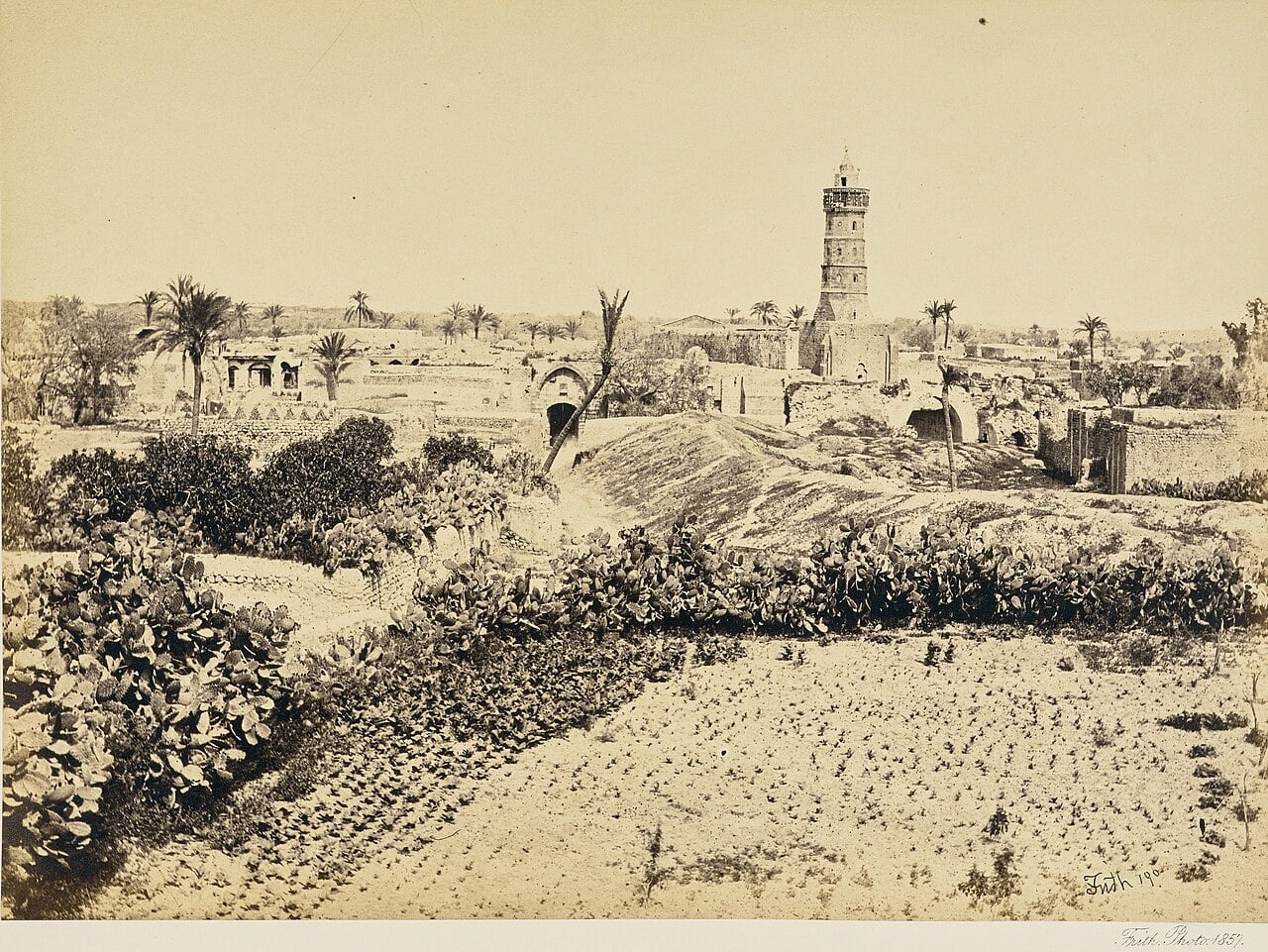
Gaza during the Ottoman period. Photograph by Francis Frith (c. 1857) Public domain.
Since Oct 7th, Gaza has become one of the most discussed places on Earth. Most observers view Gaza as inherently and unquestionably Palestinian, and any Jewish claim or sentiment toward it is dismissed as extremism, expansionism, or part of a “Greater Israel” conspiracy. Yet for the majority of the last two thousand years, Gaza was home to Jewish communities – long before modern nationalism existed.
Gaza’s rich and enduring Jewish history is something even many Israelis are unaware of, but knowing it adds essential context to many of the debates taking place about the region today.
1. Biblical Gaza (around 1800–1000 BCE): Promised But Not Yet Conquered
Gaza appears explicitly in the Bible as part of the land promised by God to Abraham, Isaac, and Jacob. Later, when Joshua divided the land among the twelve tribes, Gaza was included in the territory assigned to the Tribe of Judah. As Joshua 15:47 records: “Ashdod, its towns and villages, Gaza, its towns and villages, unto the Brook of Egypt.”
Yet despite this designation, Joshua did not conquer Gaza. The Philistines – migrants from the Aegean region, likely from Cyprus or Crete – still controlled the entire coastal plain, including Gaza. They were a formidable military power with fortified cities, so Israel’s early conquests focused instead on the inland highlands, the region known today as Judea and Samaria.
Before Gaza ever came under Jewish rule, the famous story of Samson unfolded there, where he was captured by the Philistines and died when he collapsed the pillars of the city’s temple. This episode reflects Israelite presence and conflict in the Gaza region, but Gaza City itself remained under Philistine control for centuries.
2. Hasmonean Gaza (around 96–63BCE): Jewish Rule
Jewish rule first reached Gaza during the Second Temple period, when the Hasmonean dynasty – the ruling family that emerged from the Maccabean revolt – expanded Jewish sovereignty across much of the Land of Israel.
Around 96 BCE, the Hasmonean king Alexander Jannaeus (Yannai Hamelech) captured Gaza after a prolonged campaign against the coastal cities. The historian Josephus describes how Gaza fell after a fierce struggle and was brought under Jewish administration. This marks the first fully documented period of Jewish rule in Gaza and the beginning of permanent Jewish settlement there.
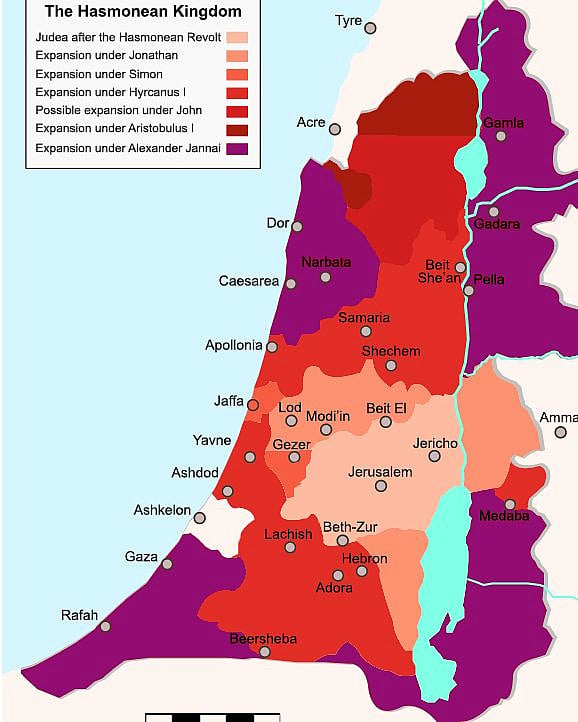
Hasmonean rule in Gaza lasted until 63 BCE, when the Roman general Pompey conquered the region and brought Gaza under Roman control. After the destruction of the Second Temple in 70 CE, and especially following the Bar Kokhba revolt in 135 CE, Jews were barred from Jerusalem, prompting many to relocate to other cities, including Gaza.
3. Roman and Byzantine Gaza (63BCE–638 CE): A Flourishing Jewish Centre
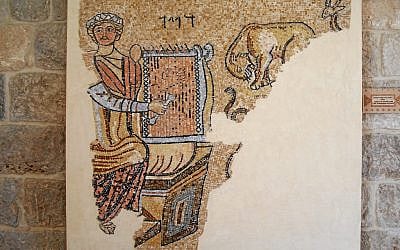
By the Roman and Byzantine periods, Gaza had become an important Jewish centre with a well-established community. Archaeological evidence includes the Great Gaza Synagogue, dating to the 5th–6th centuries CE, whose mosaic floor famously depicted King David playing the lyre with a Hebrew inscription.
During this period, Gaza was renowned for its wine exports across the Mediterranean, with Jewish producers playing a significant and well-documented role in the industry.
Further references to Jewish life in Gaza appear in the Cairo Geniza, a vast collection of medieval Jewish manuscripts preserved in Egypt, which contains documents mentioning Jewish residents of Gaza and their involvement in regional commerce.
At the same time, Gaza also contained a significant Christian population, particularly after Christianity became the dominant religion of the Byzantine Empire in the 4th century.
4. Early Islamic Gaza to the Crusaders (638–1291): Continuity To Expulsion
With the Islamic conquests of the 7th century, Gaza came under Arab rule, yet Jewish life in the region continued. Medieval sources reference a Jewish quarter, ‘Harat al-Yahud’, indicating an identifiable and organised community.
However, Jewish presence in Gaza appears to have ceased during the Crusader period (11th–13th centuries), when Jews, like in Jerusalem and other cities, were likely expelled or killed. There is no evidence of a continuous Jewish community in Gaza during this time.
5. Mamluk & Ottoman Gaza (1291–1917): Jewish Return
The first clear evidence of Jewish return to Gaza after the Crusader period appears in 1384, during Mamluk rule, when a European traveller records Jewish residents living in the region.
Late 15th-century Jewish travellers, including Rabbi Meshullam of Volterra (1481) and Rabbi Ovadiah of Bartenura (1488), describe an organised Jewish community in Gaza of approximately sixty households, concentrated once again in the Jewish quarter.
Gaza was also home to Rabbi Israel Najara, one of the most influential Hebrew poets of the early modern period, whose song ‘Yah Ribon Olam’ is still sung by Jews worldwide today.
Following the Ottoman conquest in the 16th century, the Jewish community consolidated on a small but stable scale and included leading Jewish scholars, among them Rabbi Avraham Azulai. Born in Fez, Morocco, he settled in Gaza and authored the influential kabbalistic work Chesed LeAvraham there in the early 17th century.

During the 18th and early 19th centuries, multiple sources describe between 50 and 70 Jewish families living in Gaza, making up roughly one-third of the population. The remaining residents were drawn from a mix of local Arab Muslims that settled after the Islamic conquest, Bedouin clans, and Egyptian-origin settlers that arrived in the 19th century.
Over time, economic pressures led many Jewish families to relocate to larger centres such as Hebron, Jerusalem, and Jaffa.
6. British Mandate Gaza (1917–1936): Riots and the End of Jewish Life
By the early 20th century, Gaza’s Jewish community had declined to a small number of merchant families maintaining trade links with other Jewish Cities.
During the Arab riots of 1929, Jewish residents, homes and businesses in Gaza were attacked. Most Jews left Gaza at this point, following British evacuation orders – justified by the claim that the authorities could not guarantee their safety.
A handful of Jews remained for several more years, but during the Arab Revolt of 1936–1939, the last Jewish resident left Gaza, marking the final end of continuous Jewish life in the region prior to 1967.
7. Gaza under Egyptian Rule (1948–1967): No Jewish presence
Following the 1948 Arab-Israeli war, Gaza came under Egyptian military administration. Tens of thousands of Arabs from surrounding areas were displaced into the narrow coastal strip, some fleeing combat, others heeding calls from Arab leaders to leave temporarily, and others displaced from areas deemed strategically critical.
Under Egyptian rule, there was no return for Jews, and Jewish religious sites, homes, and cemeteries were inaccessible. At the same time, there were no meaningful calls for the establishment of an independent Palestinian state during this period.
8. Israeli Control (1967–2005): Return of Jewish life and Disengagement
The 1967 Six-Day War ended Egyptian rule in Gaza and marked the return of Jewish presence to the territory for the first time since 1936. Under Israeli control, small Jewish communities were re-established, and places such as Kfar Darom and later Gush Katif became home to around 8,000 residents.
In 2005, Israel unilaterally disengaged from Gaza. All Israeli settlements were dismantled, every Jewish resident was forcibly relocated, and Jewish cemeteries were exhumed and removed. The withdrawal was carried out with the stated aim of creating conditions for a peaceful resolution of the Israeli–Palestinian conflict. It marked the first time in Gaza’s history that Jewish communities were removed by decision of a Jewish government, rather than as a result of conquest, massacre, or external expulsion.
Conclusion
It is an irrefutable historical fact that Gaza has a Jewish history stretching back thousands of years, far deeper and more substantial than that of undisputed Israeli cities such as Tel Aviv or Eilat.
Israel’s unilateral disengagement from Gaza in 2005 was a conscious political decision. The territory was rendered entirely devoid of Jewish residents, justified as a necessary sacrifice for security and a step toward “peace.” Israelis who opposed the move – citing biblical ties, documented history, and warnings that extremist jihadist groups would fill the vacuum – were dismissed as a marginal, extremist minority detached from reality.
The outcome of that decision is now undeniable: Gaza was transformed into a terror enclave, culminating in a massacre of historic proportions.
The most commonly argued position in Israel was that maintaining a Jewish presence in Gaza was simply not viable due to security concerns. Yet if similar levels of violence were to emerge in Jaffa or Jerusalem, few would argue for abandonment. Most would insist on doing whatever was necessary to defend Jewish life there, and would not be labelled extremists for doing so. That contradiction can only be explained by the widespread ignorance of Gaza’s Jewish past.
A further claim, often advanced from liberal or progressive circles, is that Gaza is “100 percent Palestinian.” If that assertion is grounded in history, the question must be asked: when does history begin? Those who argue most forcefully for universal rights and for Palestinian residency throughout Israel simultaneously deny, even in principle, the right of Jews to live in Gaza – despite its deep historical connection to the Jewish people.
The case for Jewish presence in Gaza does not rest on a single pillar. It is supported by biblical connection, centuries of documented history, and legal reality. Gaza lies within the 1949 armistice lines and was relinquished voluntarily in the pursuit of peace. When terror and war are returned instead, the idea of re-establishing Jewish life there cannot be dismissed as extremism.
One may debate the political feasibility of Jews returning to Gaza, but not the history – and if history teaches us anything at all, it is that this story is far from over.
Related Topics
Related Posts