
Looking forward
Gaza’s famine is a suicide attack
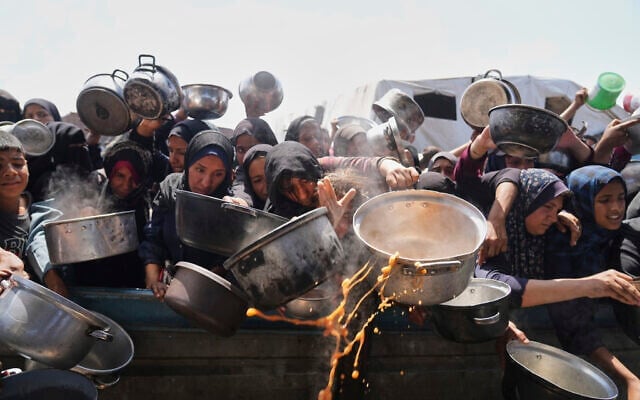
Palestinians struggle to get donated food at a community kitchen in Khan Younis, Gaza Strip, May 5, 2025. (Abdel Kareem Hana/AP)
How understanding the manufactured famine in Gaza in terms of Islamist strategy can help us identify the appropriate response
There is hunger in Gaza, and innocents are unnecessarily suffering. As Yaakov Katz points out, the current government’s reversal of policy is an admission of such. By observing their actions (as opposed to their violent, politically charged rhetoric), one can see that this government truly did think it could address the basic nutrition needs of Gaza while avoiding passing aid through Hamas. The Gaza Humanitarian Foundation (GHF) was its immature attempt at doing so. They failed.
Understanding why they failed is critical if we would like to avoid such failures in the future. If we would like to minimize damage to innocent lives as we seek to break Hamas and pressure it to release our loved ones from captivity, we need to understand why Hamas would rather shoot Gazans gathering to collect food at distribution sites than to help them bring much needed aid back home to support their families. We need to understand why Hamas would rather aid distribution fail (if it bypasses them) even when the price is the starvation of their people.
I’ve come to understand that the best means of categorizing the famine in Gaza is as a suicide attack. Not by the people in Gaza, who for the most part would like more than anything to live peaceful lives and definitely not starve. A suicide attack by the Islamist movement controlling the government of Gaza who could, at any given moment, surrender its arms and end the war and its attendant miseries. It is the existence of Hamas’s agency, its capacity, its ability to exercise control to ensure attempts to distribute aid without it fail that makes the famine in Gaza not solely a tragedy (which it is) but a targeted strike on behalf of an ideology to achieve its aims. Policy by other means.
We shouldn’t have been surprised to see Hamas turn to using the mass suffering of its people as its tool. Their leadership states this as their intention, repeatedly. The late Yahya Sinwar said so at the beginning of the war, calling Gazan deaths a way to get “Israel right where we want them.” Hamas’ negotiator, Khalil al-Hayya, went further in his Eid al-Adha speech to say that “Gaza has offered itself as a sacrifice for the Muslim ummah [nation] and deserves its full support in return.” This is, after all, the movement that perfected the suicide bombing.
Once we understand famine as a suicide attack strategy, we can learn from how we’ve dealt with suicide attacks in the past to prevent famine in the future: through resource prevention, vector disruption, and quick actions.
In the case of suicide attacks using explosives, Israel learned the best way to prevent a bomb from being strapped to a chest is to ensure the materials required (and the people with the knowledge of how to mix and construct them) are dealt with before they come together. This means heightened intelligence investment in the material requirements for the attacks. To prevent famine, this means Israel needs to have a fine-grained understanding of the nutritional needs of Gazans to ensure pockets cannot be isolated by Hamas for sacrifice. An open channel to enable Gazans to reach out to share their needs.
Similarly with vector disruption: Hamas was able to sabotage the already immature and poorly planned GHF food distribution by causing panic by shooting at Gazans either on their way to get food or after leaving with boxes. This was relatively easy due to the concentration of the depots. By setting up a larger number of distribution centers, Israel would be able to ensure greater spread of distribution and split up Hamas’ remaining forces simultaneously.
Finally, while quick action to neutralize a suicide bombing has to happen in minutes if not seconds, quick action for malnutrition can happen over the course of hours and days. I spent time in Haiti not long after the big earthquake, where hunger still gripped corners of the island. I learned from that experience that responding to hunger does not always mean sending the foodstuffs the population is used to cooking. Fortified peanut butter, energy bars, enhanced water, etc., are easier means to distribute to quickly increase caloric intake in affected areas to avoid a suicide attack by famine while new infrastructure is laid for regular distribution of aid.
There will be those who say that the best way to avoid attacks altogether is to deal with what they call the “desperation” that motivated the attackers. They are factually incorrect, seeking to explain the urge to fulfill a religious commandment or ideological directive by applying a secular lens. The fact is that the majority of the groomers and planners of suicide attacks are well-fed, rich even, and the people they prey on seek meaning and often eternal life. Hamas is a case in point: its leaders live in luxury in Doha, its fighters eat bananas in the tunnels, all while their suicide attack rolls across the people of Gaza.
This won’t be the first time a people’s leadership used starvation as a strategy in our region. Two thousand years ago, approximately this time of year between the 17 of Tammuz and the 9th day of Av, legend tells us that the Jewish zealots locked inside the walls of Jerusalem burned our foodstocks in order to starve the Israelites taking shelter within the walled city. Their purpose? To spark a resistance. To defeat their enemy. To achieve victory through sacrifice. Perhaps reflecting on our narratives of resilience and failure might teach us that we are not so different from the Palestinians, after all. Perhaps we may learn how to stop the zealots this time around, and avoid the destruction that has marked both of our peoples so thoroughly in the past.
Related Topics
Related Posts