An Engineer’s Perspective on Israel and Jewish Life
Genocide: When Accusation Replaces Evidence
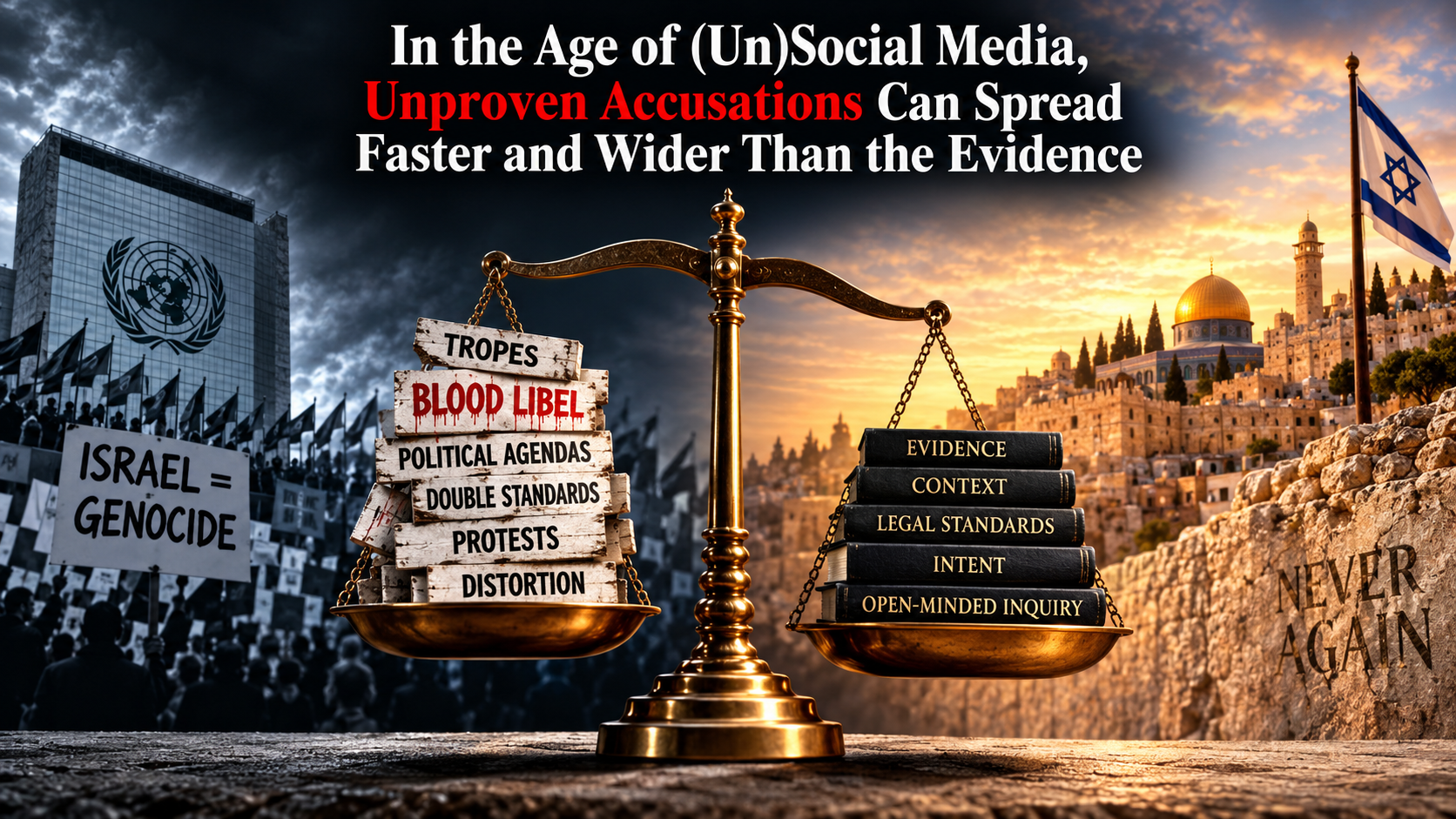
History teaches us that if you repeat something often enough, people may begin to believe it, even when the evidence is missing.
I hear this accusation everywhere now: ‘Israel is committing genocide.’ Politicians say it. Organizations repeat it. Commentators pass it along as fact.
We have seen the power of the ‘big lie’ before. What feels different today is the speed. Social media can carry an accusation around the world in minutes, and repeat it thousands of times before anyone stops to ask for proof.
For Jews, genocide is not an abstract word. We think of the Holocaust and the systematic murder of six million of our people. In its aftermath, Israel was established as a refuge for Jews returning to their ancestral homeland, a land to which the Jewish people have maintained a connection for thousands of years. Now Israel itself stands accused of genocide.
On college campuses and online, I often see that accusation treated not as a claim to examine but as a fact no decent person should question. That troubles me. Deeply.
I’ve spent much of my life as an engineer, researcher, and professor. At Bell Labs and later in academia, I learned a simple rule: treat an assertion as a hypothesis, not a verdict. Test it. Look for evidence. Challenge your own assumptions. Above all, pay attention to facts that might prove you wrong.
A theory doesn’t become true just because enough people believe it. Why would we abandon that rule when accusing a nation of one of the worst crimes imaginable?
A Word With a Precise Meaning
Raphael Lemkin, the Polish-Jewish lawyer who coined the word genocide in 1944, knew that words matter. He wanted to name a particular crime against humanity.[1] The 1948 Genocide Convention defines genocide through specific acts committed with the intent to destroy, in whole or in part, a national, ethnical, racial, or religious group, as such.[2]
That last point matters. The law requires a specific intent to destroy a protected group, in whole or in part. Civilian deaths and widespread destruction, even on a horrific scale, do not by themselves establish genocide. But they can be important evidence when examined alongside statements, policies, and patterns of conduct. The critical legal question is whether the evidence establishes the specific intent required by the Genocide Convention.
This isn’t a technicality. It’s what makes genocide a distinct crime.
The destruction in Gaza is real. So is Palestinian suffering. If Israeli forces broke the law, those allegations deserve investigation and, where justified, accountability. But the charge of genocide asks us to establish something more than the horrors of war that are so readily depicted in snapshots and snippets online and in the media.
Let me be clear. I do not believe Israel is committing genocide in Gaza or anywhere else. That doesn’t mean I believe every Israeli soldier has acted lawfully. Some may have committed serious crimes, and those responsible must be investigated and held accountable. But individual crimes, however reprehensible, do not by themselves establish the specific intent to destroy the Palestinian people that the crime of genocide requires.
The Evidence That Too Often Goes Unheard
On October 7, 2026, 78 retired American military leaders and legal experts signed an open letter rejecting the claim that Israel committed genocide in Gaza.[3] They pointed to evacuation warnings, humanitarian measures, legal reviews of military operations, and efforts to limit civilian casualties. In their view, those actions cut against the claim that Israel intended to destroy Palestinians as a people.
The next day, Jeffrey Miller and Stuart Eizenstat, the current and former chairs of the United States Holocaust Memorial Museum, published an article rejecting the genocide accusation and warning that its misuse fuels antisemitism.[4] They didn’t look away from Gaza’s suffering. They acknowledged that tens of thousands of Palestinians had died, including many children.
I pay attention when two people associated with an institution devoted to remembering the Holocaust speak this plainly. Still, I wouldn’t ask you to believe them just because of their titles. That would defeat my whole point.
Look at their reasoning. And look just as carefully at everyone else’s.
Does the above end the debate? No. We still need to ask whether those measures worked and examine evidence that points the other way. Surely their arguments deserve to be heard and examined.
October 7 Was Not a Footnote
On October 7, 2023, Hamas-led terrorists invaded Israel. They brutally murdered about 1,200 people and took 251 hostages. They targeted civilians in homes, communities, and at a music festival.[5]
Israel went to war with two declared goals: dismantle Hamas’s military and governing power, and bring the hostages home. That doesn’t make every Israeli military action lawful. And Hamas’s atrocities don’t excuse violations of international law.
But how can we judge Israel’s intent without looking at why the war began, what Israel said it was trying to do, and how Hamas fought? Hamas operated in Gaza in crowded civilian areas, used tunnel networks, and carried out military activity near civilians. That made Israel’s operations harder. It did not erase Israel’s duty to protect civilians.
Palestinian civilians have suffered enormously. They deserve our compassion. We also need to examine Hamas’s role in creating and prolonging conditions in Gaza, without treating that question as an excuse to ignore Israel’s responsibilities.
Context is not an excuse. But we cannot leave it out.
When Prestige Becomes a Substitute for Proof
The International Court of Justice ordered provisional measures in South Africa’s genocide case against Israel. Those orders are binding, but they were not a final ruling that Israel committed genocide.[6]
Amnesty International and a UN commission of inquiry chaired by Navi Pillay have reached that conclusion. They offered evidence and legal arguments. We should examine them, including how they handled evidence that challenges their findings.[7]
Consider what happened at the International Association of Genocide Scholars. In September 2025, the association adopted a resolution declaring that Israel was committing genocide in Gaza. Sara E. Brown, a comparative-genocide scholar and longtime member, challenged both the conclusion and the process. She reported that only 129 of roughly 500 members voted, questioned the association’s membership standards, and criticized the lack of meaningful scholarly debate. Her account raises an uncomfortable question: when an organization speaks in the name of experts, how can we tell whether its conclusions reflect rigorous scholarship, transparent procedures, and meaningful debate?[11]
In October 2026, Pillay received the Nobel Peace Prize. Elisha Wiesel, son of Nobel laureate Elie Wiesel, sharply criticized the award. He accused Pillay of attacking the Jewish state and distorting the legal meaning of genocide.[8] I share his concern about misuse of that word. We must recognize that a prize cannot establish whether her commission got the facts or the law right.
International institutions wield enormous influence. Their conclusions deserve scrutiny, as do the arguments of those who challenge them.
A Nobel Prize doesn’t prove a genocide allegation.
Prestige is not proof.
The Power of Repetition
Here’s what worries me most.
Someone makes an accusation. A politician repeats it. Activists amplify it. Social media spreads it. Before long, people stop asking what evidence supports it.
The accusation starts to stand in for evidence.
Natan Sharansky, the former Soviet political prisoner and Israeli leader, recently recalled an 1892 essay by Ahad Ha’am about the blood libel against Jews. For centuries, Jews were falsely accused of murdering Christian children for religious purposes.[9] It was a lie. Yet countless people believed it, including educated and powerful people.
Sharansky asks a hard question: can much of the world believe something and still be wrong? Of course.
That history doesn’t tell us whether today’s allegations are true or false. It tells us something else: a claim doesn’t become proven because a crowd accepts it.
Consensus is not evidence. And questioning a consensus is not a moral failing.
Take New York City Mayor Zohran Mamdani’s statement on the third anniversary of October 7.[10] He acknowledged Hamas’s atrocities and the suffering of Israeli families. Then he described Israel’s conduct in Gaza as an ongoing genocide and invoked apartheid.
He spoke as though those conclusions were settled facts, not contested claims that demand careful proof. He has every right to his opinions. Holding public office, though, doesn’t turn an assertion into a fact.
For American Jews, the consequences can reach far beyond an argument about Israeli policy. Criticizing Israel is not automatically antisemitic. And I don’t assume that everyone who alleges genocide is prejudiced. But when criticism turns into blaming Jews as a group, or draws on antisemitic stereotypes, we need to say so clearly.
I am also deeply concerned about anti-Zionism, particularly when it denies the Jewish people’s right to national self-determination in their ancestral homeland. Criticizing Israeli policies is one thing. Denying Jews a right that we recognize for other peoples is quite another.
Repetition makes a claim familiar. But evidence is what can make it true.
One Standard for Everyone
Something else troubles me. Why does Israel so often face a level of scrutiny that other countries and armed groups seem to escape?
Consider the United Nations. According to figures cited by the Combat Antisemitism Movement, the UN Human Rights Council has adopted more resolutions condemning Israel since its creation in 2006 than all other countries combined. In 2024 alone, the UN General Assembly adopted 17 resolutions targeting Israel. Does anyone seriously believe that this imbalance reflects an objective assessment of human rights abuses around the world? These numbers don’t excuse Israeli wrongdoing. But they certainly raise questions about whether the UN applies its standards fairly.[12]
Where is the comparable outrage over atrocities in Sudan, the persecution of minorities, or the abuse of migrant workers and Black Africans in parts of the Arab world? These abuses deserve serious attention, investigation, and accountability. Yet they rarely seem to command the same sustained international attention as Israel.
I am not arguing that criticism of Israel should stop because others behave badly. Two wrongs don’t make a right. Israel must answer for its actions, just as every nation must.
But the standards should be the same. If civilian suffering demands our attention in Gaza, it should demand our attention in Sudan, Yemen, Syria, and elsewhere. If international law matters, it must matter everywhere. And if we condemn racial hatred and discrimination, we cannot ignore it when the victims are Black Africans, migrant workers, or religious minorities in Arab societies.
Selective outrage raises legitimate questions about the motives and priorities of those expressing it. It does not, by itself, prove antisemitism. But when Israel alone is subjected to standards not applied to others, we should ask why.
Human rights should be universal. So should accountability.
Ignorance or Deliberate Misuse?
Some people who use the word genocide may not know its legal meaning. Others may know it but use the word more loosely because it carries such emotional and political force. And some have studied the evidence and sincerely believe genocide occurred.
I can’t read their minds. I also can’t dismiss their arguments without examining them. I can ask one thing of everyone: use the same standard.
Define the charge. Show the evidence. Face the strongest arguments against your position. Then tell us why your conclusion holds up.
After several years in academia, I worry about what students are learning from all this. A university should be a place where students can ask hard questions without being treated as bad people for asking.
If we teach them that repeating a conclusion is the same as proving it, we’ve failed them. And the damage won’t stop at the Middle East.
And why wait until college? These habits should begin in elementary and secondary schools. Students need to learn about the Holocaust and other genocides, understand what the word genocide actually means, and recognize the difference between an accusation and a proven fact. They should learn to question sources, examine competing evidence, and think for themselves. We should teach young people how to reach sound conclusions, not simply which conclusions to accept.
Said another way, teach students how to think, not what to think.
From Outrage to Action
Elisha Wiesel ended his essay by promising to challenge the genocide accusation against Israel with facts, wherever necessary, for as long as it takes.[8] I agree. But a promise isn’t enough.
Why not create an independent group of respected legal scholars, military professionals, historians, statisticians, and humanitarian experts? Give them a clear task: examine the genocide allegations, test the competing arguments, and reach conclusions wherever the evidence leads.
Who would choose these experts? And why should anyone trust them? We can’t find people with no opinions. We can demand real expertise, full disclosure of conflicts, open selection rules, serious engagement with opposing evidence, and room for dissent. We should choose people who can admit when the facts challenge what they believe. The group’s credibility must come from how it works, not from the names on its letterhead. In a future essay, I plan to explore how such an institution could be structured, governed, and funded so that it earns people’s trust.
Publish the evidence. Explain the reasoning in plain English. Take opposing arguments seriously. When you get something wrong, correct it in public. Then bring that work to universities, newsrooms, and the online spaces where so many people form their views.
Major American Jewish organizations need to ask themselves some uncomfortable questions, too. Are their usual public-relations efforts working? Are they reaching young Americans? Are they changing anyone’s mind beyond people who already agree? If not, what will they do differently?
I’ve worked in research organizations long enough to know that hard problems don’t yield to press releases. You define the problem. Bring in the right people. Test competing explanations. Measure what works. We should do that here.
And the inquiry has to be free to find Israeli wrongdoing when the evidence supports it. Otherwise it will become one more advocacy effort talking mostly to people who already agree.
We won’t answer an accusation just by repeating a denial. We have to show why our conclusions deserve to be believed.
The Question That Matters
Jews know what can happen when false accusations, distortions, and collective blame take hold. That history gives us good reason to demand precision when anyone uses the word genocide, against Israel or against anyone else.
We can’t control what politicians say, what activists post, or what international institutions decide. But we can insist on testing allegations. We can challenge claims the evidence shows are false. We can reach people who are willing to listen. And we can do it together, with a serious plan.
Sharansky reminds us that the world can be wrong. Science and engineering taught me another lesson: even when I’m sure I’m right, I still have to look hard at evidence that might prove me wrong.
Truth doesn’t depend on how many people believe something. It depends on evidence. Defending it takes courage to challenge others, and enough humility to question ourselves.
Author’s Note
I used ChatGPT to help develop and edit this essay, identify and check sources, and create the accompanying graphic. The ideas, judgments, and conclusions are mine. I take full responsibility for what appears here.
Sources
[1] United States Holocaust Memorial Museum. Introduction to the Definition of Genocide. https://encyclopedia.ushmm.org/content/en/article/introduction-to-the-definition-of-genocide
[2] United Nations. Convention on the Prevention and Punishment of the Crime of Genocide. https://www.un.org/en/genocide-prevention/1948-convention
[3] Jewish Institute for National Security of America, October 7, 2026. Open Letter From Military Professionals Refuting Genocide Allegations Against Israel. https://jinsa.org/open-letter-from-military-professionals-refuting-genocide-allegations-against-israel/
[4] Jeffrey Miller and Stuart Eizenstat, October 8, 2026. Genocide Charge Fuels Antisemitism. https://main.ushmm.org/information/press/press-releases/genocide-charge-fuels-antisemitism
[5] United Nations Independent International Commission of Inquiry. Investigations of October 7 and the Gaza conflict. https://www.ohchr.org/en/hr-bodies/hrc/co-israel/index
[6] International Court of Justice. South Africa v. Israel: Official Case Record. https://www.icj-cij.org/case/192
[7] Amnesty International, December 2024. Report alleging genocide in Gaza (see also American Jewish Committee critique: https://www.ajc.org/news/american-jewish-committee-decries-amnesty-internationals-report-on-false-genocide-charge). https://www.amnesty.org/en/documents/mde15/8668/2024/en/
[8] Elisha Wiesel, “The Death of the Nobel Peace Prize,” The Free Press, October 9, 2026. https://www.thefp.com/p/elie-wiesel-death-nobel-peace-prize-israel. See also The Wall Street Journal, editorial on Navi Pillay and the Nobel Peace Prize, October 2026: https://www.wsj.com/opinion/navi-pillay-nobel-peace-prize-israel-hamas-south-africa-523efb07.
[9] Natan Sharansky, Tablet, October 9, 2026. Is the Whole World Wrong?. https://www.tabletmag.com/sections/news/articles/whole-world-is-wrong-natan-sharansky
[10] Office of the Mayor of New York City, October 7, 2026. Statement From Mayor Zohran Kwame Mamdani on the Third Anniversary of October 7. https://www.nyc.gov/mayors-office/news/2026/10/statement-from-mayor-zohran-kwame-mamdani-on-the-third-anniversa
[11] Sara E. Brown, “I Joined the Genocide Scholars to Prevent Atrocities. Here’s How They Failed,” Jerusalem Journal, September 26, 2025. https://www.ajc.org/news/i-joined-the-genocide-scholars-to-prevent-atrocities-heres-how-they-failed
[12] Combat Antisemitism Movement, “The Double Standard: One Set of Rules for Israel, Another for Everyone Else,” July 10, 2026. https://combatantisemitism.org/special-features/double-standard-against-israel/
Related Topics
Related Posts