


“Giants” Among Us
On Wednesday evening, the New York Knicks made a record-breaking comeback against the San Antonio Spurs in Game 4 of the NBA Finals! People celebrated at Madison Square Garden, on the streets of New York, and throughout the tri-state area—in sports bars and in people’s homes.
How fascinating it was to watch how gracefully the players on both teams moved around the court. You almost forget that the average height of an NBA player is 6 feet 7 inches.
That is roughly eight inches taller than the average American male and probably about ten inches taller than the average Jewish American male.
Yet I don’t think that when encountering such a “giant” we feel intimidated. On the contrary, if we came across a Knicks player, we would probably be very excited. Most likely, we would ask for a selfie and an autograph.
On the other hand, if you were walking through a rough neighborhood and someone of that height were walking toward you, you might be frightened. That reaction would be natural because, typically, when we encounter someone of great size, we feel apprehensive.
That is exactly how ten of the twelve spies whom Moses sent to scout the Land of Canaan (modern-day Israel) felt upon seeing the Anakites (which literally translates to “giants”) and the Nephilim. Once they saw those enormous inhabitants of the Promised Land, the land did not look so promising to them!
Hence, when they returned with their report, they tried to dissuade the Israelites from moving forward by saying: “We cannot go up against this people, for they are stronger than we are!… The land we traveled through to inspect is a land that consumes its inhabitants, and all the people we saw in it are men of great size… We seemed to ourselves as tiny as grasshoppers next to them, and so did we seem to them!” (Numbers 13:31–33)
Caleb and Joshua—the other two spies—had a very different impression. Caleb said to the Israelites, “We can go up and take possession of it [the land], for we can indeed overcome it [the giants].” (Numbers 13:30)
Predictably, the scare tactics of the ten spies worked, and the Israelites complained to Moses and Aaron, saying they would rather return to Egypt than face those giants—God’s promise or not.
Then Joshua, the son of Nun, offered another perspective. He said, “The land we traveled through to inspect is an exceedingly good land. If God desires us, He will bring us to this land and give it to us, this land flowing with milk and honey.” (Numbers 14:7–8)
In other words, he brought God back into the picture, reminding everyone why they were there in the first place. By doing so, he helped reignite the people’s courage and zeal in the face of the unknown. He exclaimed: “God is with us; do not fear them!” (Numbers 14:9)
Knowingly or unknowingly, Joshua gave the people courage by bringing God into the equation—not only for the Israelites of that time, but for every generation of Jews for centuries to come. Throughout the years since the spies entered Canaan and encountered those hostile giants, Israel has faced threats from stronger, larger, and more powerful nations.
Similarly, the people of Israel and Jews throughout the Diaspora have continually faced threats, regardless of how comfortable they may have felt in one country or another. We see now that even in America, where many of us felt safe, we find ourselves surrounded by hostile giants. They may not stand as tall as basketball players, yet they are no less—and perhaps even more—dangerous.
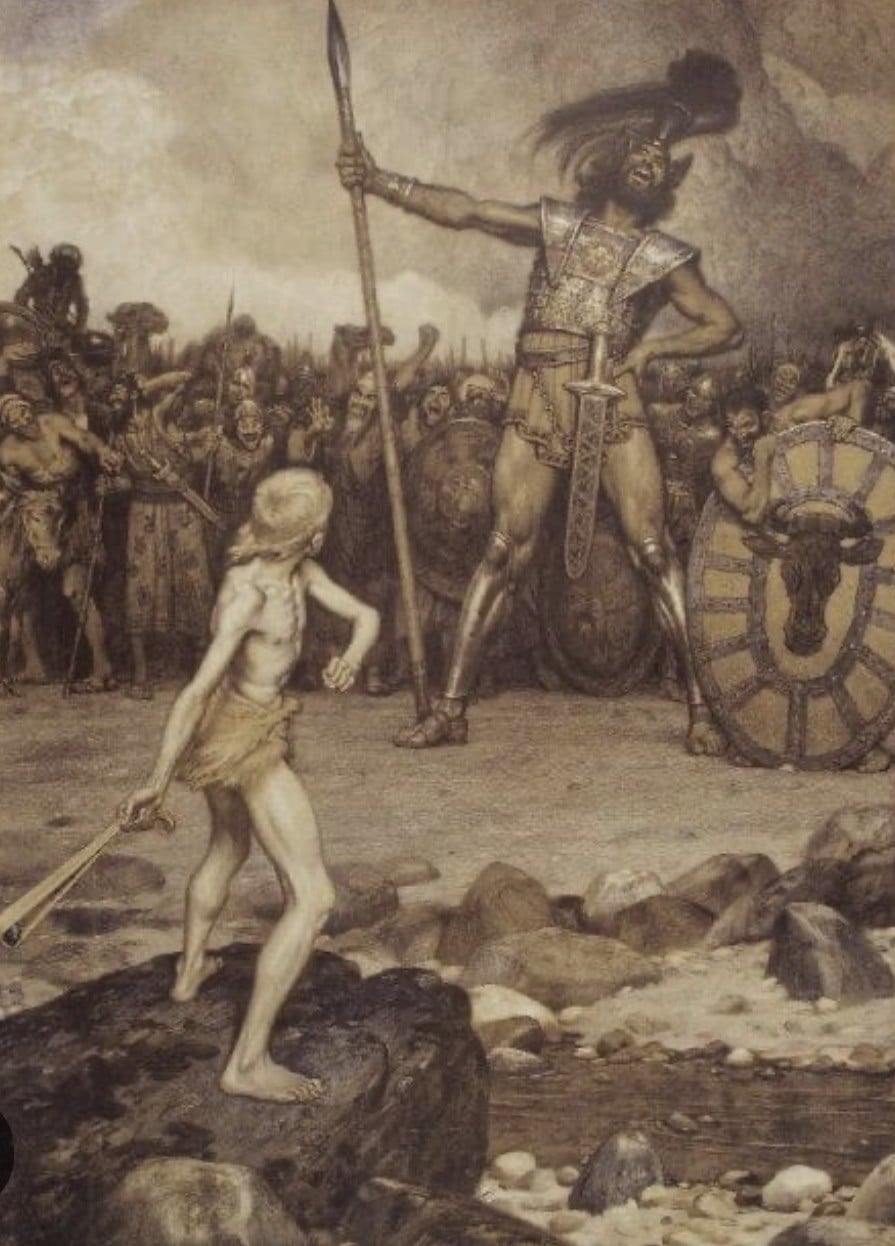
To fight someone physically stronger requires force and military strategy. After all, David defeated Goliath because he outsmarted him.
But when the enemy is conniving and appeals to values that are near and dear to us, we may fall for that duplicity and play right into their hands.
There are several examples of this dynamic taking place today.
For instance, we witnessed the rise of New York Mayor Zohran Mamdani, due in part to the support of many Jews who believed in the values he promoted.
Next came the victory of Democratic candidate Adam Hamawy in New Jersey’s 12th District primary. He also garnered many Jewish votes despite allegations regarding ties to the late Omar Abdel Rahman, the “Blind Sheikh,” who was convicted in 1995 of conspiring to carry out a bombing campaign targeting the United Nations and other New York City landmarks.
In addition, he traveled to Gaza in 2024 to work at a hospital operating under Hamas rule.
Yet these facts fade in the face of his defense of a platform that aligns with the views of many who seek to improve our society.
Then came Graham Platner, a Marine veteran reported to have a swastika tattoo, who won his primary with 72% of the vote. He was endorsed by Bernie Sanders, who is Jewish and the child of Holocaust survivors.
Friends, these “giants” continue to appear among us, and we are naïve to think they will not eventually act on what they truly represent—their hostility toward Jews and their opposition to the State of Israel.
Where are the Democratic candidates who promote the values so many of us share, while also supporting and respecting the Jewish community, caring for its safety, and maintaining a constructive relationship with the State of Israel? I know there are many of them, and many still serve in Congress, but the trajectory toward the opposite position is becoming increasingly apparent.
Friends, our fight against these “giants” in the United States is conducted not with bullets, but with the power and clarity of our ballots.
As Israel continues to fight its own “giants”—such as the Iranian regime and its proxies, as well as internal “giants” in the form of Arab terrorists and Jewish extremists—we, too, must take responsibility as part of the Diaspora.
Perhaps it is not possible to win this battle once and for all, but with God’s help, we will continue to defeat these giants one at a time.
As for the Knicks, I hope those giants continue to win!