


Gil Mihaely Interview | Alexandre Gilbert #300
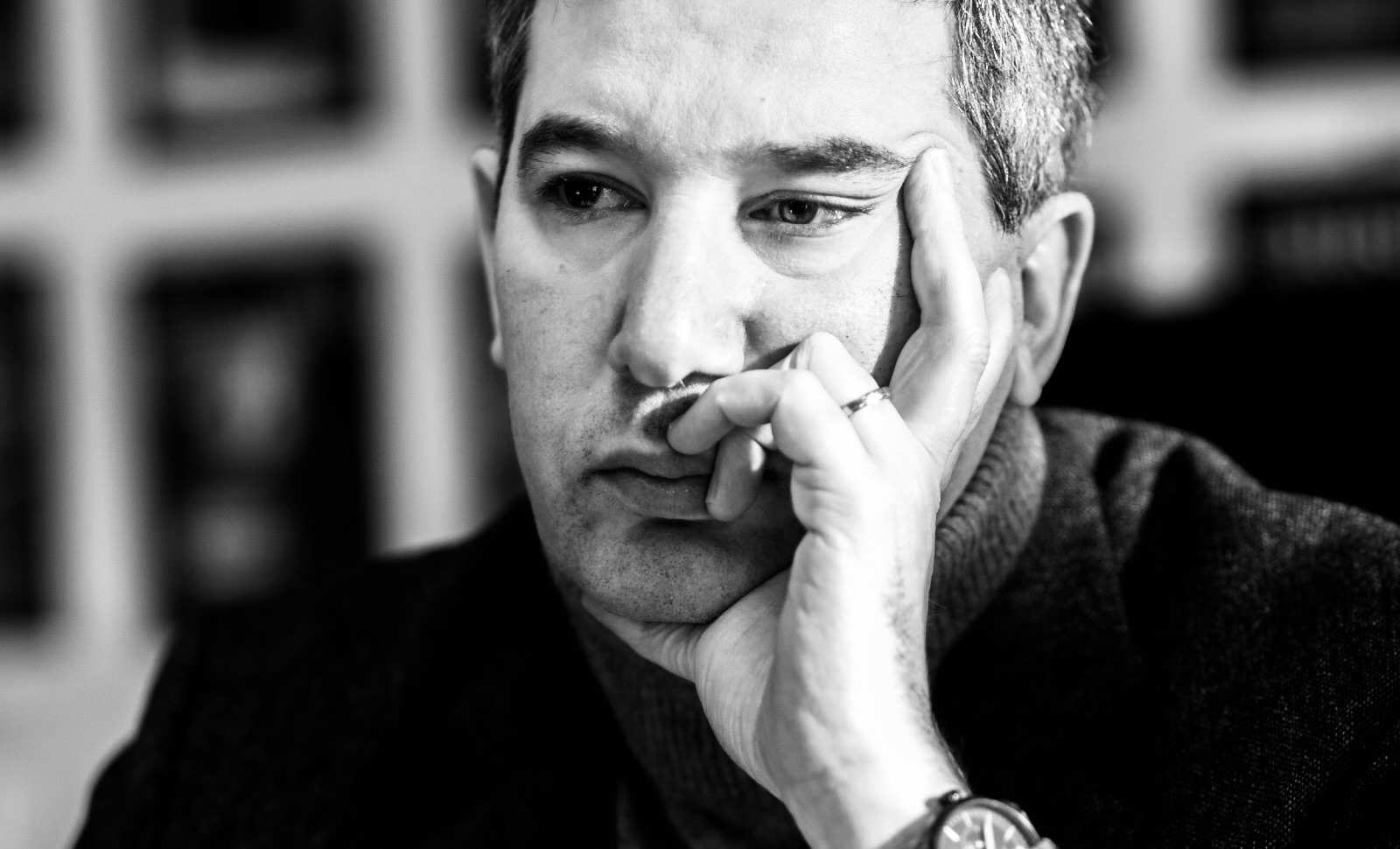
Gil Mihaely is a franco-israelian historian.
You co-founded Causeur with Paul Thibault, Alain Finkielkraut, and Peter Sloterdijk. Was the project philosophical in spirit?
Gil Mihaely: First, it was Elisabeth Lévy’s dowry, so to speak. Those philosophers accompanied us, not as shareholders but as companions. Sloterdijk, somewhat less. At the beginning, we often spoke with him, around the time he published The Crystal Palace, about the world in a bubble. That was 20 years ago.
Our initial idea was to create a kind of salon, a “causerie” in the Enlightenment spirit — a space for style, argument, and time. A long conversation, not a talk show.
Thibault came from Esprit; Finkielkraut drew on Kundera and Arendt; Sloterdijk inherited Heidegger — all rooted in the phenomenological tradition. Emmanuel Macron, too, has ties to that milieu, through Esprit, Anselm Kiefer, and Sloterdijk. Do you still feel connected to that world, 20 years on?
Gil Mihaely: What I can say is that we shared — and still share — the way these thinkers view the world: the articulation between individual and collective, particular and universal. That’s where the link with politics lies. The central questions crystallized around nation versus European Union, and Republic versus other identities. For many of us, after long detours through the left, the conclusion was that the nation remains the only structure capable of forming a political body with real legitimacy — however flawed.
At the time, Sloterdijk — and even Finkielkraut — were not seen as national defenders, but as mainstream, less partisan voices.
Gil Mihaely: What drew us in were affinities and personal ties, not ideology. Yet those same philosophical questions guided us. Elisabeth Lévy was already seasoned, as were they. Public reputation always lags ten to fifteen years behind reality — people still think Jean-François Kahn runs Marianne. In fact, the “néoréac” label given around 2000–2002 showed that critics had already sensed a divergence.
Habermas once criticized Sloterdijk’s supposed drift. Later, when AfD ideologue Marc Jongen — his former student — tried to claim him, Sloterdijk rejected it. In Germany today, he is viewed as a moderate.
Gil Mihaely: They were never reactionaries; it was more about grappling with deviations from slogans than defending reaction. From the mid-2000s to about 2010, there was a moment of awakening. Questions of immigration and national identity pushed us back to the nation as the space of articulation — already under Sarkozy, but even earlier.
I recall Elisabeth Lévy and Aude Lancelin alternating philosophy columns in Le Point, often interviewing Sloterdijk — two young women philosophers, now so different, writing in a magazine then seen as left-leaning. Was that an early sign of an ideological shift?
Gil Mihaely: Yes. Things evolve, and looking back one can trace ruptures. But there wasn’t a single trigger event.
It mirrors shifts elsewhere: for instance, Zionism was once seen as a Bolshevik ideology of kibbutzim, later recast as nationalist and right-wing.
Gil Mihaely: To put it in perspective: between 1920–22, Ben-Gurion’s socialist Zionism became hegemonic, balancing Jewish particularism with universalism — nourished by socialism and by Freud, especially among kibbutzniks. Over decades, those universalist strands eroded. Today, Israeli Judaism has lost that universalism. In Israel, Judaism is often narrowed to “Jew equals man, others don’t count.” This fuels a profound moral crisis: leaders who barely master Hebrew, don’t speak foreign languages, and show ignorance of history and social sciences. It’s an intellectual catastrophe.
On the very day France recognizes Palestine — after the UK, Australia, and Canada — what is the reaction in Israel?
Gil Mihaely: I don’t live there, but my sense is shock. On the surface, diplomatically, it feels like a blow. The deeper reality: Western leaders closest to Israel broke with Netanyahu last July. The British, French, Canadians, Australians — not the usual critics like Spain or Ireland — concluded Netanyahu is untrustworthy. They no longer believe he controls Ben Gvir and Smotrich.
Behind recognition lies an implicit deal: Hamas must be disarmed, excluded from governance, with a reformed Palestinian Authority in its place. That’s long been Israel’s dream scenario. Yet recognition is still seen as a humiliation, because it signals something deeper: Macron and others believe Netanyahu has destroyed Israel’s rule of law and governs with corrupt, incompetent extremists. They now consider him a liar.
Recognition, therefore, is less about Palestine than about telling Netanyahu, in diplomatic language: Be quiet. We don’t believe you anymore.
Israel’s main problem with France is the lack of a clear interlocutor. Figures like Meir Habib failed to build broad influence, and while Pierre Lellouche remains, it’s unclear if he can fill that role.
Gil Mihaely: After October 7, President Macron reacted swiftly: speeches, calls for a coalition, a rapid visit to Israel. These moves were not only strategic but also rooted in France’s symbolic and psychological capital, its enduring soft power, when Israel was still part of the western family. Even if France is no longer a top global power, it is still seen as the “land of human rights,” an image inherited from another era but still shaping diplomatic reflexes. In international affairs, stereotypes and simplified perceptions of nations often guide decisions more than genuine knowledge.
Israel long benefited from this inertia of perception. After October 7, solidarity was almost instinctive. French presidents like Chirac or Sarkozy also knew how to play with these levers, punishing or rewarding Israel depending on their political aims. But with Netanyahu, patience has run out. Europeans who once looked the other way now see the tangible effects: quiet boycotts of Israeli products, declining tourism, reduced trade without formal sanctions, simply because younger generations scroll past “Made in Israel.” Where once officials tacitly helped Israel, now many discreetly obstruct it.
In truth, the international community lets Israel wage its war—not to back Netanyahu, but due to fatigue with Hamas, Hezbollah, Qatar, and Assad. Even symbolic Palestinian recognition is often framed as isolating Hamas.
Gil Mihaely: Another Israeli government might have capitalized on this convergence of interests. But trust in Netanyahu has collapsed. He has long been seen as manipulative—Sarkozy and Obama openly branded him a liar—and his strategy is now reduced to clinging to power day by day, with no vision beyond survival.
Netanyahu broke Israeli political conventions by speaking directly to fears and frustrations. But his circle of ministers—viewed as corrupt and incompetent—is the price he pays for staying in office. As a result, Israel now looks irrational. The strike on Doha epitomized this shift: as long as fighting stayed in Gaza, outsiders could frame it as a centuries-old “tribal” conflict. By widening the battlefield, Israel instead appeared consumed by its own fury.
The only viable domestic alternative is a “republican bloc” uniting figures as diverse as Lieberman and Yair Golan around defending the rule of law and fighting corruption. Netanyahu knows this and works to break it, delegitimizing any coalition reliant on Arab Israelis. Like Trump, he may even try to manipulate the electoral calendar to postpone his reckoning at the polls.
The deeper problem is existential. Israel cannot afford to sever ties with the United States, despite the messianic illusions of the settler right, who fantasize about pivoting to Russia or China. This is an ideological bubble, a parallel state in the settlements, detached from economic and diplomatic realities. Breaking with Washington would be suicidal, yet the rhetoric persists.
In truth, Netanyahu is burning through Israel’s accumulated capital—its rationalism, secularism, scientific excellence. The country still lives on the dividends of its founding decades, but the erosion is clear.
Let me end with an anecdote. I was in Israel between October 7 and the start of the ground incursion—around October 24, 2023. On October 15 or 16, I met a reserve officer living in a West Bank settlement. He wasn’t born in Israel but immigrated after university, completed his service, pursued a military-technical career, and settled there.
Whenever we discussed the United States—this was still under Biden—he sounded like a Charlie Kirk disciple. His argument was that Israel doesn’t need the U.S.: that $3 billion in aid is insignificant, that Americans profit from Israeli-tested weapons anyway, and that the political and economic costs of dependence are too high. In short, he was living in a bubble, like the zealots of 69–70 BC.
Settlements in Judea and Samaria function as a republic within the republic, gated communities without diversity—unlike cities like Haifa or Rehovot. They have built an alternative Israel, not a real society. Economically, they couldn’t survive without salaries earned inside the Green Line and state-funded jobs.
So when they began to believe their future required breaking with the United States and abandoning the rule of law, they crossed into irrationality. This isn’t an opinion—it’s madness. Some even floated the idea of pivoting to Russia or China. It is delusional.
This reveals a deep crisis in Israeli society. Unless it is addressed, everything else will unravel. I often use this example: you can burn down every school and university in France, and life will seem to go on. Children will swim, students will party. But twenty or thirty years later, the sky will collapse. That is what’s happening now. Netanyahu is burning through Israel’s accumulated capital—its investments, scientific culture, rationalism, secularism. The country is living off the dividends of the 1950s to the 1990s, but the reserves are finite.
France’s hard right stil backs Benjamin Netanyahu— even more than Israel’s own right, doesn’t she ?
Gil Mihaely: I have bad news here as well. The dynamic resembles the U.S. While figures like Alexandre Devecchio or Eugénie Bastié once defended him, the tide is turning, sometimes called islamo-gaullism. Two reasons: first, the images from Gaza are increasingly hard to justify; second, Israel’s political culture—so impoverished, irrational, messianic—has, metaphorically and literally, begun spitting on its Christian allies.